
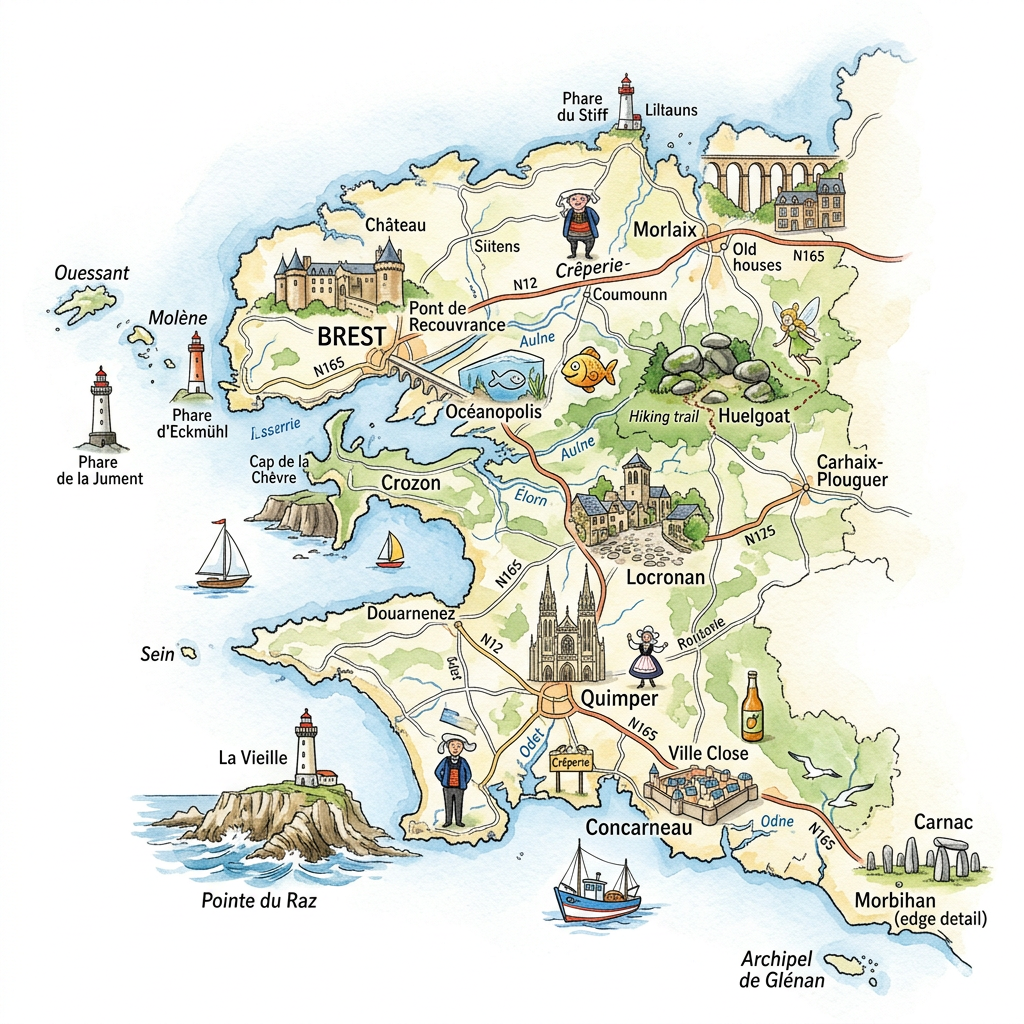
What you need to know about the Finistère department ?
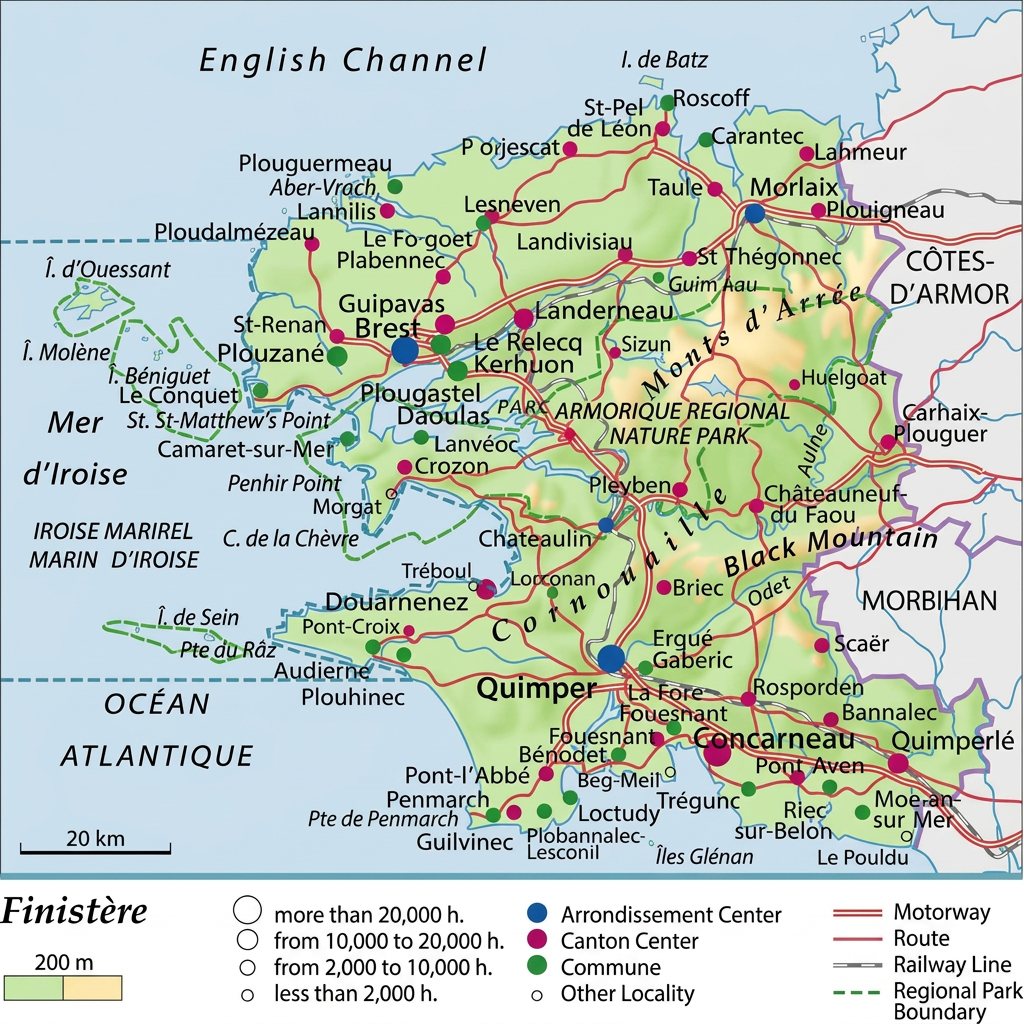
Here we present to you the 29th French department, called Finistère, which in France is located near Brittany, to the east of it. The main prefecture and the capital of Finistère is Brest. But there are also many sub-prefectures: Morlaix, Douarnenez, Quimperlé, and Carhaix.

The Finistère department can be considered one of the French departments most influenced by an oceanic climate, as its weather conditions are strongly shaped by the Atlantic Ocean. This department is also made up of 277 municipalities, a large number of which are located along the coastline. The total population of the department is approximately 927,000 inhabitants, and the area of the 29th department covers 6,733 km², with around 1,250 km of coastline forming a natural boundary with the maritime areas of Brittany.
The landscape of Finistère is actually well marked by rugged coves and abers; the former will remind you of the fjords of the northern coast. This is very characteristic of this northern area of Finistère.
What are the neighboring departments of Finistère?
The Finistère department has as neighbors the Côtes-d’Armor department and the Morbihan department. It also has coastlines on the English Channel and the Atlantic Ocean to the south and north. The Finistère department is mainly bordered by coasts and shoreline. This is why tourists like to visit it. Moreover, the beaches of this department are less crowded and the landscapes are truly magnificent, especially when visiting the Crozon peninsula.
What is the climate like in the Finistère department?
Overall, the climate of department 29 is categorized as oceanic. That is to say, it is a climate strongly influenced by westerly winds coming from the Atlantic. This causes a lot of humidity in the northeast section and is more significant than the influence of the Gulf Stream. Furthermore, the westerly flow can cause many climatic disturbances such as constant rain throughout all seasons.
Summers are rather mild, with many temperature fluctuations, but mainly dominated by intense cold waves. On the other hand, heat is less present in the Finistère territory.
There is also the fact that rain is evenly distributed throughout the year with more precipitation in the autumn period rather than in winter. These rains are even more significant inland than outside. Frost is almost nonexistent and the wind is very characteristic along the coastal areas in the west and north zones.
What are the best cities in the Finistère department?
For this ranking, we based ourselves on the number of inhabitants and the popularity of the cities in Finistère, so here are the 10 most important cities in the department:
- Brest
- Quimper
- Concarneau
- Landerneau
- Morlaix
- Guipavas
- Douarnenez
- Plougastel-Daoulas
- Plouzané
- Quimperlé
What are the best communes in the Finistère department?
Here are the most important communes of the Finistère department ranked by largest area:
- Scaër
- Plonévez-du-Faou
- Bannalec
- Poullaouen
- Elliant
- Quimper
- Crozon
- Pleyben
- Scrignac
- Plougonven
We have ranked these municipalities of Finistère from the most populated to the least populated, that is to say according to the density of inhabitants per km2:
- Brest
- Concarneau
- Douarnenez
- Guipavas
- Plouzané
- Quimper
- Morlaix
- Landerneau
- Plougastel-Daoulas
- Quimperlé
FAQ – Finistère map
A map of Finistère helps you locate the main towns, coastlines, roads, and natural areas of the department. It also provides a better understanding of the geographical diversity of this Breton region.
A map helps identify tourist sites, municipalities, and suitable travel routes. It also makes it easier to organize your stay and discover the different landscapes of the department.
Yes, it makes it easier to locate beaches, hiking trails, and natural areas. It is also a practical resource for exploring the coastline and inland areas of Finistère.
