
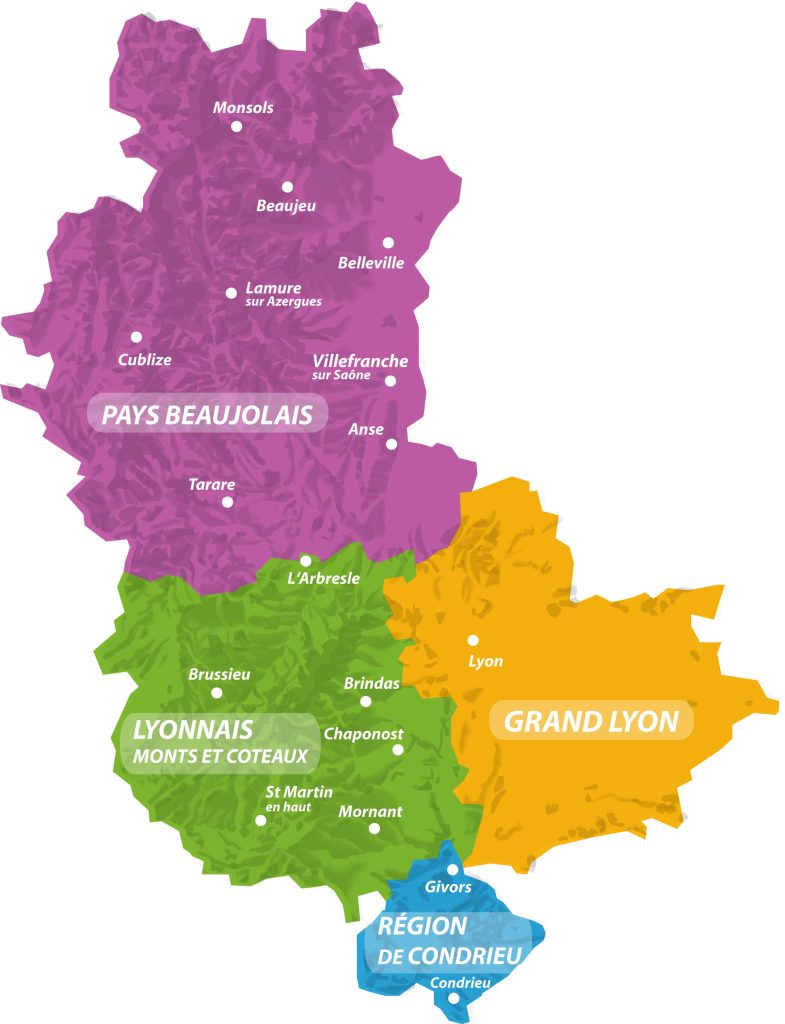
What you need to know about the Rhône department ?
Today we are going to talk to you about department 69, which is a department named Rhône, which is part of the Auvergne-Rhône-Alpes region. It is actually a very old department dating back to 1793, because previously, it occupied the territory of Rhône-et-Loire. It was only after this territory was split that department 69 was created.
Furthermore, its prefecture, which is also its chief town, is called Lyon and its sub-prefecture is called Villefranche-sur-Saône. The inhabitants of the Rhône department are called Rhodaniens and number 1,932,284 inhabitants with a density of 712 inhabitants per km². The reason is that the surface area of department 69 is 2,715.11 km². Administratively, the Rhône has 2 arrondissements, 14 legislative constituencies, 13 cantons, 11 intercommunal entities, and 208 communes.

What are the neighboring departments of the Rhône department?
Since department 69 is part of the Auvergne-Rhône-Alpes region, it has 4 neighboring departments as well as the Lyon metropolis. These departments are the Saône-et-Loire department, the Ain department, the Isère department, and the Loire department.
What is the climate like in the Rhône department?
The climate of department 69 is considered to be continental and/or semi-continental. This is evidenced by the alternation of three climates, namely oceanic climate, continental climate, and Mediterranean climate.
This rather particular type of climate is marked by a harsh winter (with a lot of frost, fog, and unexpected snowfalls). On the other hand, the summer periods are hot and sunny.
Regarding the wind, it is very windy in the 69; in fact, there is a light breeze coming from the Rhône valley from the North direction. From the South, there is a strong windy gust that sometimes brings violent disturbances due to the influence of the Mediterranean.
This North-South wind orientation is a consequence of the fact that the Saône-Rhône valleys lie on the same line as the western reliefs (namely the Massif Central) or the eastern relief (namely the Alps). Added to this are the summer storms which can be quite harsh and violent.
What are the most important cities in the Rhône department?
Regarding the best cities for tourist destinations, that is to say the most visited cities in the 69 by tourists, we count:
- Lyon
- Villeurbanne
- Caluire-and-Cook
- Oullins
- Saint Prêtre
- Bron
- Villefranche-sur-Saône
- Génas
- Vénissieux
- Vaulx en Velin
What are the most important communes in the Rhône department?
To make this list, we referred to the population density per km2 of each commune in Rhône:
- Lyon
- Amplepuis
- Poule-les-Écharmeaux
- Saint-Pierre-de-Chandieu
- Colombier-Saugnieu
- Saint-Martin-en-Haut
- Larajasse
- Saint-Priest
- Claveisolles
- Saint-Georges-de-Reneins
Regarding this second ranking of the municipalities in the Rhône department branch, we grouped them according to the density of occupants per km2:
- Lyon
- Vénissieux
- Caluire-et-Cuire
- Bron
- Rillieux-la-Pape
- Villeurbanne
- Saint-Priest
- Vaulx-en-Velin
- Villefranche-sur-Saône
- Meyzieu

FAQ: Rhône map
Old Lyon is famous for its “traboules” and unique Renaissance architecture. The Beaujolais region also offers magnificent landscapes through its rolling vineyards.
Spring is perfect for exploring urban parks and countryside trails. Autumn allows you to enjoy the harvests and the changing colors in the vineyards.
The public transport network is very dense within the Lyon metropolitan area. A car is preferable for visiting the more isolated villages of the department.
