
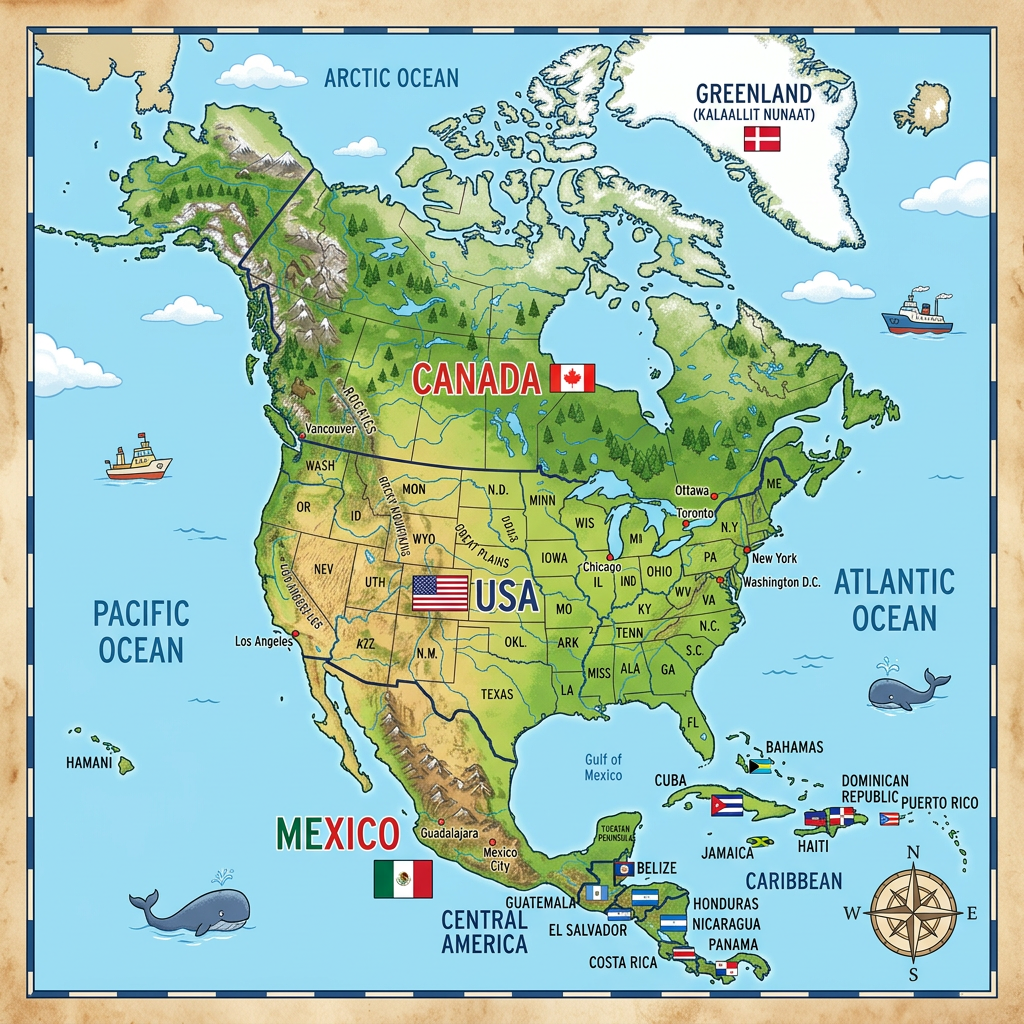
Map of America: What you need to know ?
With an area of 42,437,680 km², America is the second largest continent in the world after Asia.
Its geographical extremes extend:
- to the north up to Cape Columbia (Canada, Ellesmere Island),
- to the south up to the Diego Ramírez Islands (off Cape Horn, Chile).
The American continent is bordered by:
- the Arctic Ocean to the north,
- the Antarctic Ocean to the south,
- and separated from the Eurasian continent by the Atlantic and the Pacific.
America is divided into three subcontinents:
- North America
- Central America (including the island arc of the Antilles)
- South America
The narrowest part of this vast landmass is the Isthmus of Panama, formed about 3 million years ago, connecting North America and South America.
The map of America illustrates a continent stretching from the Arctic Ocean to Cape Horn. It includes North America, Central America, and South America. Bordered by the Atlantic and the Pacific, the continent features diverse landscapes, from North American deserts to Amazonian tropical forests.
Table – America: Geographic and demographic information
| Element | Key Information |
|---|---|
| Total Area | ~42.5 million km² |
| Estimated Population | ~1.05 billion inhabitants (2025) |
| Number of Countries | 35 independent states |
| Most Populous Capital | Mexico City (Mexico) |
| Relief | Rockies and Andes, great plains, river basins (Mississippi, Amazon) |
| Climate | Arctic in the north, equatorial at the equator, temperate and tropical elsewhere |
| Particularity | Two large continents (North and South) connected by Central America and the Isthmus of Panama |
| Bordering Oceans | Pacific, Atlantic, Arctic |
Additional points on the map of America

- America extends from the Arctic Ocean in the north to Cape Horn in the south.
- The continent is traditionally divided into three major zones: North America, Central America, and South America.
- The physical map highlights the Andes mountain range and the Rockies, two major mountain chains.
- The largest rivers are the Amazon (Brazil) and the Mississippi-Missouri (United States).
- The main languages spoken are English, Spanish, Portuguese, and French.
List of countries: Number of countries in America: 35.
List of countries in alphabetical order:
Antigua and Barbuda
Argentina
Bahamas
Barbados
Belize
Bolivia
Brazil
Canada
Chile
Colombia
Costa Rica
Cuba
Dominican Republic
Dominica
Ecuador
United States
Grenada
America map: geopolitical boundaries
Canada
Canada is represented by 10 provinces: Alberta, British Columbia, Prince Edward Island, Manitoba, New Brunswick, Nova Scotia, Ontario, Quebec, Saskatchewan, and Newfoundland and Labrador, as well as by 3 federal territories: Northwest Territories, Nunavut, and Yukon.
These divisions have legislative powers but remain under the authority of the Canadian federal Parliament.
United States

The geopolitical map of the United States shows a country divided into 50 states and a federal district: Washington D.C.
- The 48 continental states are located in North America, with Alaska in the northwest and Hawaii in the Pacific.
- The United States also has peripheral territories in the Caribbean (e.g., Puerto Rico) and the Pacific (e.g., Guam).
The 50 states include: Alabama, Alaska, Arizona, Arkansas, California, Colorado, Connecticut, Delaware, Florida, Georgia, Hawaii, Idaho, Illinois, Indiana, Iowa, Kansas, Kentucky, Louisiana, Maine, Maryland, Massachusetts, Michigan, Minnesota, Mississippi, Missouri, Montana, Nebraska, Nevada, New Hampshire, New Jersey, New Mexico, New York, North Carolina, North Dakota, Ohio, Oklahoma, Oregon, Pennsylvania, Rhode Island, South Carolina, South Dakota, Tennessee, Texas, Utah, Vermont, Virginia, Washington, West Virginia, Wisconsin, and Wyoming.
South America
The geopolitical map of South America represents a subcontinent bounded by:
- to the west by the Pacific Ocean (Humboldt Current in Peru),
- to the east by the Atlantic Ocean.
It includes 12 independent nations: Argentina, Bolivia, Brazil, Chile, Colombia, Ecuador, Guyana, Paraguay, Peru, Suriname, Uruguay, and Venezuela.
Also included are the associated territories: French Guiana (France), Falkland Islands (United Kingdom), Galápagos Islands (Ecuador), and Tierra del Fuego (shared between Argentina and Chile).
Map of America: the main peninsulas

Canada
- Avalon Peninsula (southeast of Newfoundland).
- Boothia Peninsula (Canadian Arctic, south of Somerset Island).
- Bruce Peninsula (between Lake Huron and Georgian Bay).
- Gaspé Peninsula (Quebec).
- Long Point Peninsula (north of Lake Erie, Ontario).
- Melville Peninsula (Canadian Arctic).
- Ungava Peninsula (Quebec, between Hudson Bay and Ungava Bay).
Costa Rica
- Nicoya Peninsula (Pacific coast, Guanacaste and Puntarenas provinces).
- Osa Peninsula (southwest of the country).
Mexico
- Yucatán Peninsula (shared with Belize and Guatemala).
- Baja California Peninsula (between Cabo San Lucas and the Gulf of California).
- Azuero Peninsula (southwest Panama, often included in the Mesoamerican area).
United States
- Alaska Peninsula (extended by the Aleutian Islands).
- Cape Cod (Massachusetts).
- Delmarva Peninsula (between Delaware, Maryland, and Virginia).
- Door Peninsula (Wisconsin).
- Kalaupapa Peninsula (Hawaii, Molokai Island).
- Point Reyes (California).
- Seward Peninsula (Alaska, between Norton Sound and Bering Strait).
- Upper Michigan Peninsula (between Lakes Superior, Michigan, and Huron).
South America
- Guajira Peninsula (northern Colombia and northwestern Venezuela).
- Santa Elena Peninsula (Ecuador, Gulf of Guayaquil).
- Paraguaná Peninsula (northern Venezuela, Falcón state).
The different types of maps of America

Road map
The United States road map highlights highways and main roads.
- The Interstate Highways, in light red, adhere to strict construction standards.
- The older US routes, often in dark red, do not always follow these standards.
Some notable examples:
- US 51 in Illinois (former route 251),
- US 278 (ending at the Cross Island Parkway, South Carolina),
- US 301 (toll alternative crossing Delaware),
- US 412 (connected to the Cimarron Turnpike in Oklahoma and the former US 64).
In Canada, the main road is the Trans-Canada Highway (Route 1), crossing British Columbia, Alberta, Saskatchewan, and Manitoba.
- The north axis is represented by the Yellowhead Highway (Route 16), joining Route 17 towards Thunder Bay.
- The south axis is connected to Highway 20 (Ontario–Quebec) and merges with the north axis east of Montreal.
- To the east, Route 104 crosses Nova Scotia up to New Glasgow.
In South America, the main roads are:
- Brazil: BR-101 and BR-116,
- Argentina: Routes 9, 7, and 142,
- Colombia: expressway 36 and secondary roads,
- Chile: Routes 5 and 37.
Relief map
The relief map of Canada shows the Appalachians in the northeast, and further west the recent ranges: Rockies, Sierra Nevada, and Cascades.
In the United States, the represented reliefs include:
- the Blue Ridge, the Appalachian Plateau, the Adirondacks,
- the Ouachita Mountains (~790 m) and the Boston Mountains (~600 m),
- the Rocky Mountain Massif (1,500 to 4,270 m),
- the Pacific mountain range with the Sierra Nevada and the Cascades.
Administrative map
South America: 12 sovereign countries and associated territories:
Argentina, Bolivia, Brazil, Chile, Colombia, Ecuador, Guyana, French Guiana, Paraguay, Peru, Suriname, Uruguay, Venezuela, as well as the Falkland Islands (Malvinas).
Canada: 10 provinces (Alberta, British Columbia, Prince Edward Island, Manitoba, New Brunswick, Nova Scotia, Ontario, Quebec, Saskatchewan, Newfoundland and Labrador) + 3 territories (Northwest Territories, Nunavut, Yukon).
United States: 50 federated states (including Louisiana with its parishes and Alaska with its boroughs). Particularities:
census areas in Alaska,
independent cities such as Baltimore (Maryland), Carson City (Nevada), St. Louis (Missouri), and 39 cities in Virginia.

FAQ – America map
America is located west of Europe and Africa, and east of Asia and Oceania, separated by the Atlantic Ocean and the Pacific Ocean.
What are the main countries visible on the map of America?
It combines mountains (Andes, Rockies), vast plains, deserts, tropical forests, and a climatic diversity ranging from polar to tropical.
