
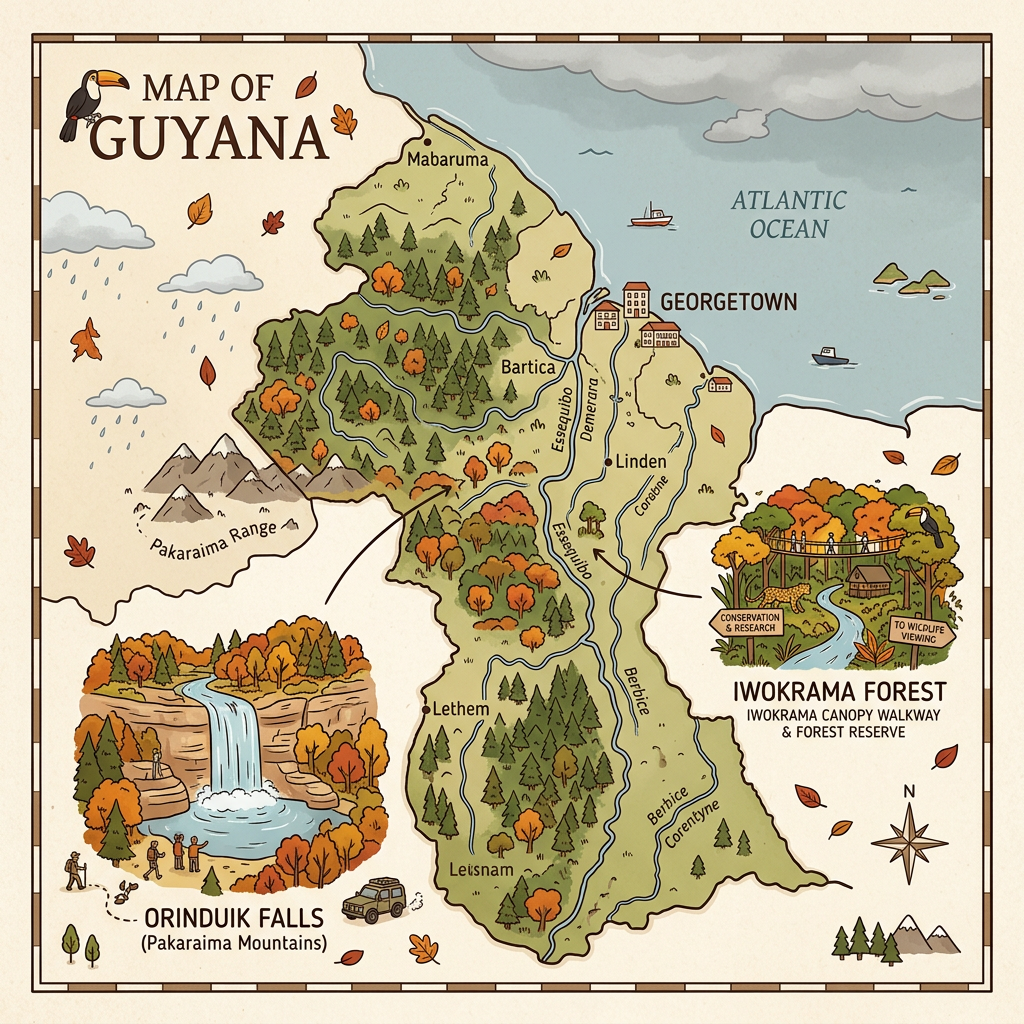
Nestled on the northern coast of the South American continent, Guyana intrigues with its unique identity. At the edge of the Caribbean Sea and in the heart of the Guianas region, this cooperative republic stands out for its cultural mosaic, lush landscapes, and a singular history marked by colonization and then independence. Between impenetrable tropical forests, majestic rivers, and colonial heritage, it is impossible to reduce this territory to a mere point on the map of South America.
Table – Guyana: Geographic and demographic information
| Element | Key Information |
|---|---|
| Total Area | 214,969 km² |
| Capital | Georgetown |
| Bordering Countries | Venezuela, Brazil, Suriname |
| Coastline | ~459 km on the Atlantic Ocean |
| Estimated Population | ~820,000 inhabitants (2025) |
| Population Density | ~4 inhabitants/km² (low) |
| Relief | Tropical forests, plateaus, mountains in the south, coastal plains |
| Climate | Hot and humid equatorial |
| Official Language | English |
| Economic Resources | Gold, bauxite, offshore oil, agriculture (rice, sugar) |
| Particularity | The only English-speaking country in South America |
Additional points on the map of Guyana
- Guyana is located in the northeast of South America, on the Atlantic.
- The physical map highlights a vast coverage of Amazon rainforest.
- The country shares its borders with Venezuela to the west, Brazil to the south, and Suriname to the east.
- Its capital, Georgetown, is located on the Atlantic coast.
- The country is known for its mining and oil resources as well as the Kaieteur Falls, among the highest in the world.
What is Guyana’s place in the Guianas region?
Guyana occupies the central portion of the Guianas region, a vast natural enclave between Venezuela, Suriname, Brazil, and the Atlantic Ocean. Its geographical location gives it significant strategic importance, as it serves as a link between different cultural and political areas of South America. This region encompasses three entities: French Guiana to the east, Suriname in the center, and Guyana to the west, each having followed different historical paths after the colonial period.

As a former British colony, Guyana has forged an identity distinct from its French-speaking and Dutch-speaking neighbors. Its attainment of independence in 1966 marks a major turning point for the country, symbolizing the end of a long foreign domination and the affirmation of a cooperative republic resolutely focused on enhancing its resources and social development.
The map of Guyana shows a South American country bordered by Venezuela to the west, Brazil to the south, and Suriname to the east. Its Atlantic coastline is home to Georgetown, the capital, and its vast tropical forests cover the majority of the territory.
A rich history between indigenous, european, and african influences
The history of Guyana begins long before the arrival of Europeans. Several indigenous groups have lived there for centuries, notably the Arawaks and the Waraos. These peoples already occupied the banks of the great rivers and exploited the fertility of the coastal plain long before European eyes turned to the northern coast of what would become South America.
The arrival of colonizers in the 17th century disrupts the local balance. Initially coveted by the Dutch, the territory came under British control at the beginning of the 19th century, giving birth to British Guiana. This period led to a profound demographic transformation with the massive introduction of African slaves, then indentured laborers from India and Asia, leaving an indelible impact on the social and cultural structure of the country.
How did independence shape Guyana’s politics?

The struggle for independence radically changed Guyana’s trajectory. The ethnic diversity resulting from these successive migrations strongly influences local political life. From the creation of the cooperative republic, parties with varied ethnic bases shape debates and alliances. The management of power must accommodate this plurality, thus ensuring balance and representation in national institutions.
Since independence, political stability remains a challenge for this young state. Issues related to the sharing of natural wealth and national identity dominate the political scene. Guyana today seeks to strengthen its democratic structures while relying on regional cooperation to increase its visibility on the international stage.
What are the social and cultural particularities of Guyana?
The Guyana population stands out for its incredible diversity. Descendants of Africans, Indians, Amerindians, Chinese, and even Europeans contribute to a cultural dynamism visible everywhere: in music, cuisine, or religious celebrations. This human mosaic is also reflected in the languages spoken: official English coexists with numerous creoles and local dialects.
National and religious holidays illustrate this blending. Divali as well as Carnival, Christmas, Chinese New Year, or Emancipation Day, all these celebrations punctuate daily life in Guyana and testify to a unique capacity for integration and respect for differences.
What natural treasures does Guyana hide?
Guyana spontaneously evokes a land dominated by still pristine tropical forests and the constant presence of water. More than 80% of the territory is covered by lush forests sheltering impressive biodiversity. Vast wetlands and mangroves line its Atlantic coast, offering precious refuges to diverse wildlife.

The rivers and abundant waters act as a common thread in this exceptional natural tableau. Powerful waterways, spectacular waterfalls, lakes with mysterious hues are part of everyday life. Among the most famous, the Essequibo River alone represents almost the entire hydrographic backbone of the country.
Why are Guyana’s tropical forests so exceptional?
Located in the heart of the Amazonian arc, the forests of Guyana have been relatively preserved from deforestation. They are home to rare species, including some emblematic ones such as the jaguar, the harpy eagle, or the giant iguana. These ecosystems also play a key role in regulating the global climate, storing significant amounts of carbon.
The natural reserves also serve as tourist attractions. Kaieteur National Park and its legendary waterfall, canopy hiking trails, botanical or ornithological excursions, each visitor leaves marked by the richness of this environment where raw nature and local legends intertwine.
What is the importance of rivers and abundant waters in daily life?
Rivers shape both the landscapes and the economy. They enable the transport of goods, connect isolated communities, and offer inexhaustible resources for fishing, agriculture, or hydroelectric power. Access to freshwater also supports crop irrigation and ensures the livelihood of rural populations.
During the rainy season, however, these rivers can cause major floods, testing the ingenuity of inhabitants in managing their homes and plantations. This close relationship with the environment explains a continuous adaptation to climatic variations.
- More than 80% of the territory covered by tropical forests
- An extensive hydrographic network composed of numerous rivers
- Varied fauna including threatened exotic species
- Agricultural basins benefiting from fertile alluvial soils
What are the current challenges for Guyana?
Faced with growing interest sparked by its offshore oil discoveries, Guyana is entering a new economic era. These energy resources present a huge opportunity but also raise intense debates regarding their sustainable exploitation and the possible impact on natural environments. Ensuring inclusive growth without sacrificing its exceptional biodiversity or the rights of local populations is a major challenge.
Diplomatically, the country must juggle several border disputes inherited from the colonial era. Its place in the regional geopolitical context requires Guyana to maintain stable partnerships with its neighbors while promoting its status as a cooperative republic involved in regional and global governance.
To what extent do history and politics influence current development?
The persistent influence of colonial history is felt in administrative organization, land rights, and linguistic management in Guyana. Divisions inherited from past rivalries sometimes complicate the adoption of economic or educational policies that could benefit all citizens fairly.
The affirmed commitment to respecting the rights of indigenous peoples is accompanied by reflection on the transmission of traditional knowledge and resource conservation, creating an ongoing dialogue between ancestral traditions and choices of modernity.
How does Guyana position itself in present-day South America?
Despite its relatively small size, Guyana is gaining importance on the continental stage thanks to its natural assets and sustained economic growth supported by foreign investments. Its membership in the Caribbean Community places it in a regional dynamic focused on cooperation and the sharing of innovative public policies.
Within South America, Guyana stands out due to the coexistence of an English-speaking heritage, multiple ethnic identities, and a collective management style inspired by the philosophy of the cooperative republic. This rare blend attracts the attention of observers eager to understand the drivers of a unique development, fueled by the energy of a young and optimistic population.
FAQ – Guyana map
Guyana is located in the northeast of the continent, between Venezuela, Brazil, and Suriname, with access to the Atlantic.
The capital is Georgetown, located on the Atlantic coast.
A country largely covered by the Amazon rainforest, crossed by rivers and home to high plateaus and spectacular waterfalls.
