You land abroad, turn off airplane mode, and then, nothing. No network, or worse, a roaming bill silently looming over you. I experienced this in Bangkok, passport in hand, looking for a shop to buy a local SIM card. The eSIM solves this problem in a few minutes.
And once you get the hang of it, it’s hard to go back.
What exactly is an eSIM
An eSIM is a virtual SIM card already integrated into your phone. No little piece of plastic to insert, no tray to open with a paperclip. The operator’s profile downloads directly onto the device. That’s essentially what an eSIM really is: an eSIM card housed in your phone’s chip, which you activate whenever you want.

Most eSIM-compatible phones even manage multiple profiles at the same time. Your usual number on one side, a local mobile data plan on the other. You switch between the two without physically changing anything.
How an eSIM works in practice

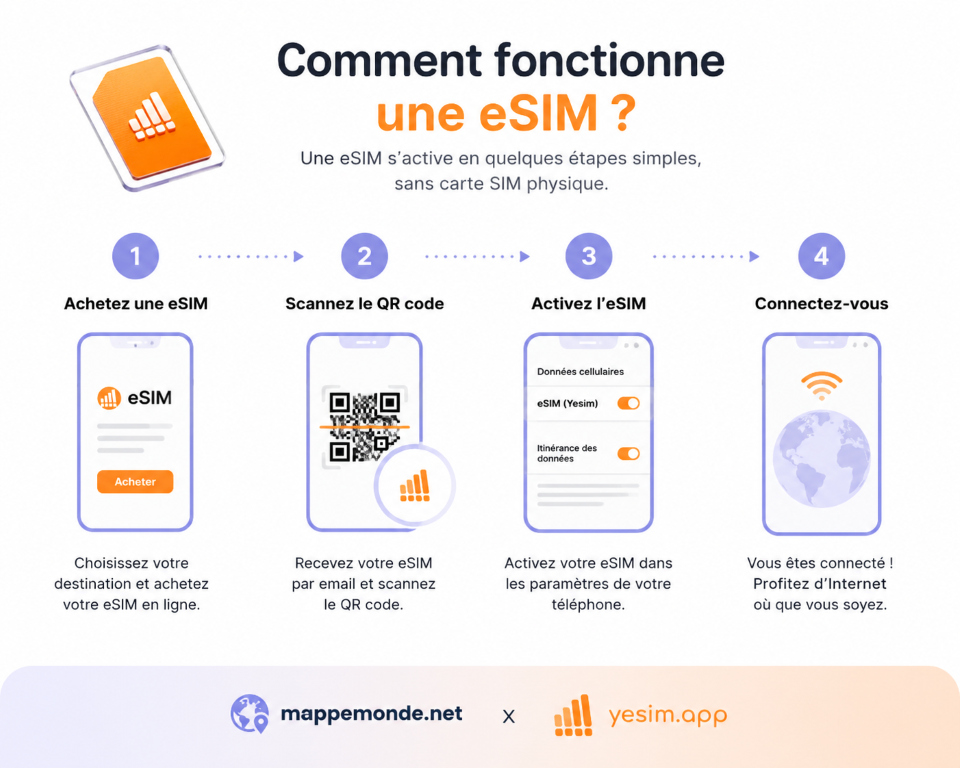
Here’s how an eSIM works, step by step. You choose a plan, you pay, you receive a QR code. You scan it from your phone’s settings, and the profile installs. Instant activation via QR code takes two minutes, tops.
Then, your device connects to the local network in 4G or 5G, just like with a traditional SIM card. The easy setup is really the game-changing argument.
- First check compatibility: dial *#06# on your keypad, you’ll see if your device displays an EID number. It works on both iOS and Android.
- Buy your plan before departure: you set everything up from your couch, at home.
- Scan the QR code: the profile loads in seconds.
- Land and connect: turn off airplane mode, and the internet works immediately.
If you’re still wondering how an eSIM works compared to your current SIM, just remember one thing. The network, speed, the GB you use, everything is identical. Only the medium changes.
Why frequent travelers should understand the eSIM card
When you travel often, roaming ends up costing a fortune. A travel eSIM lets you pay the local rate, not the “trapped tourist” rate. And you keep your French number reachable for important SMS messages.
| Step | What to do | Average time | Point to check |
|---|---|---|---|
| Purchase | Choose an eSIM suitable for the country or area visited | 2 to 5 min | Destination, duration, and data amount |
| Installation | Scan a QR code or install the profile via an app | 3 to 10 min | Phone compatibility |
| Activation | Activate the line in the mobile settings | 1 to 3 min | Correct mobile profile selected |
| Usage | Connect to the local network once on site | A few seconds | Mobile data and roaming enabled |
| Monitoring | Check remaining data during the stay | 1 min | Validity of the plan and consumption |
What convinced me was settling everything before even closing my suitcase. You download the eSIM app, choose your country, pay, and your plan is ready. To see how it works in detail, the page https://yesim.app/fr/what-is-esim/ explains the concept and lists options by destination, from small prepaid to unlimited plans. You compare the GB and duration, then you take it without commitment. No store to find, no queue, no passport to show.

Regarding offers, several providers offer this kind of service. Yesim, for example, covers more than 200 destinations with an app available on the App Store and Play Market, so on both Android and iOS. You can find practical regional plans for a road trip in Europe, unlimited plans for heavy users, and even a built-in VPN to secure your connection on public Wi-Fi.
Traveler reviews often highlight the speed of the first connection. Honestly, that’s the comfort. There is also a Yesim loyalty program, Ycoins, to top up your balance as you travel.
eSIM or physical SIM card: what really changes
On paper, both do the same thing. In real life, the difference is quickly felt.
- Time: you buy and activate online, instead of running after a store once on site.
- Price: a local prepaid plan costs much less than your operator’s roaming charges.
- Flexibility: you change country, you change plan, without handling any plastic.
- Ecology: zero card to manufacture, zero packaging to throw away.
The only real prerequisite is a recent phone. Models before 2018 do not always support eSIM, so check before buying.
In short, if you travel more than twice a year, understanding eSIM will save you time, money, and quite a bit of stress at the airport. You download, you scan, you go. The next time you land somewhere, you’ll be connected before even picking up your suitcase.
FAQ
You download an operator profile via a QR code, directly in your phone’s settings. Once installed, it connects to the local network in 4G or 5G, without a physical card. You can keep your usual number alongside it.
Most iPhones since the XS and recent Androids support eSIM. To check, dial *#06#: if an EID number appears, your device is compatible. You can also check the list of eSIM-compatible phones with your provider.
No, it adds on. Your plan remains active for calls and SMS, and the eSIM manages mobile data abroad. This dual profile is what makes it so convenient when traveling.
Many prepaid plans only start at first connection or can be activated later. So you can buy before departure without wasting a single GB.
Sources