
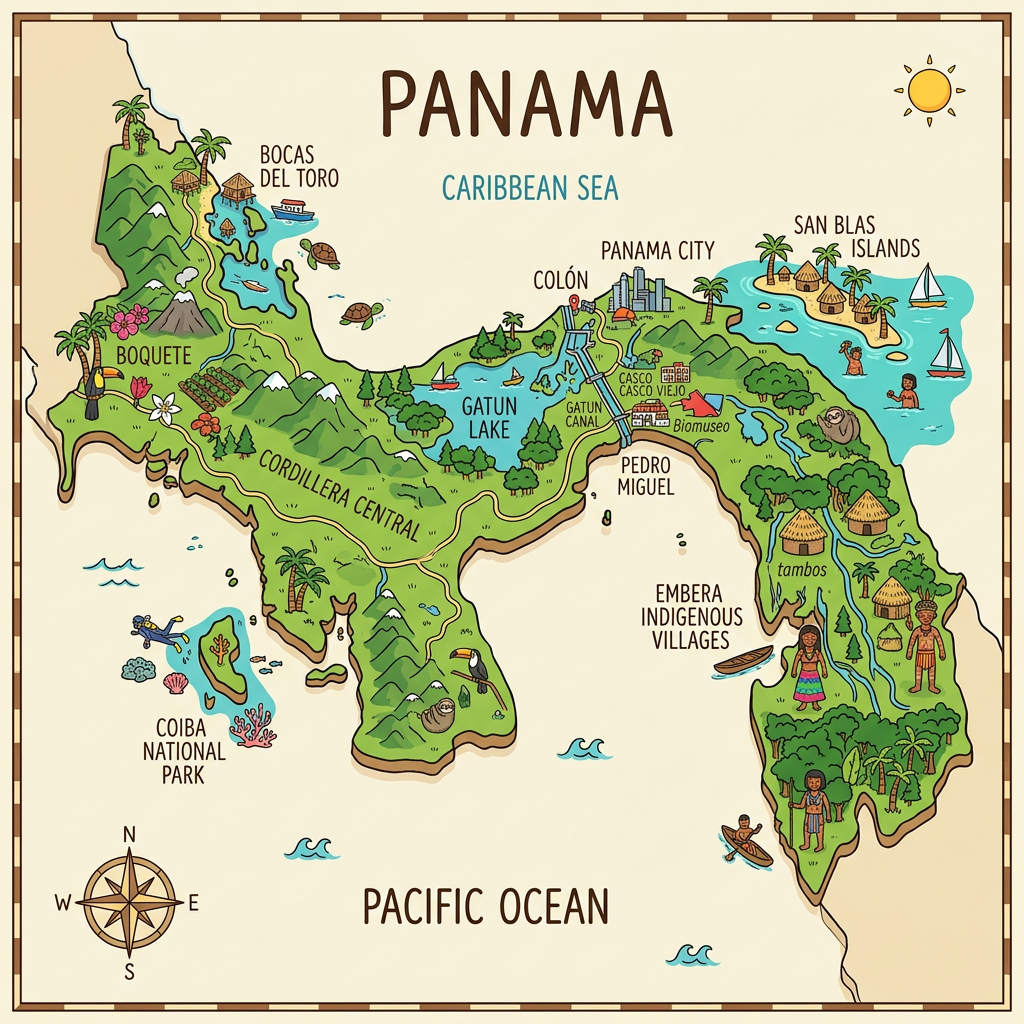
What you need to know about Panama ?
The Republic of Panama is a country in Central America, bordered by the Caribbean Sea and the Pacific Ocean. Its official language is Spanish, and its capital, Panama City, is also the country’s largest city. Panama has a total area of 75,417 km², and its population is estimated at 4,592,000 inhabitants in 2025.
Panama is one of Latin America’s leading financial and logistics hubs, largely thanks to the Panama Canal. Its population density is approximately 61 inhabitants per square kilometre. Finally, Panama’s international calling code is +507.
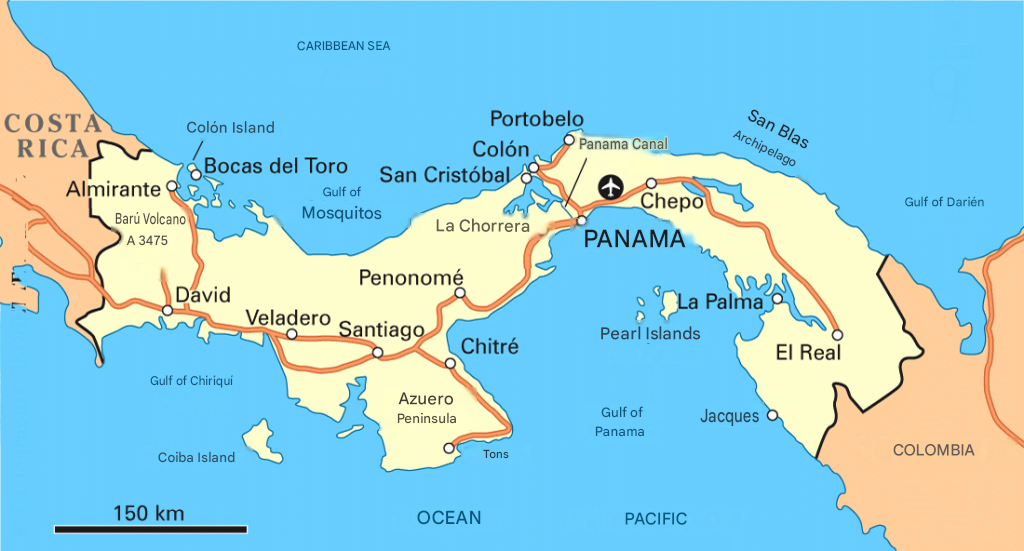
Countries bordering Panama
The nation is bordered to the north by the Caribbean Sea, to the east by Colombia, to the south by the Pacific Ocean, and to the west by Costa Rica; it is crossed by the Panama Canal.
The colors of Panama

The flag is divided into four quarters and has three colors (blue, red, and white). The first flag of Panama was made by María Ossa de Amador. The white represents peace to settle in the new nation. The blue color represents the conservative party; the red color, the liberal party. The blue star symbolizes the purity and honesty that govern the civic life of the country, and the red star, the authority and law that will impose the reign of these virtues.
Map of the best cities in Panama
Panama city
First, when you go to Panama, you absolutely must visit the capital. Besides its modernity, this city has a 106 km long coast overlooking the Pacific and offers very beautiful sites, such as buildings dating from the colonial period. Visit the San Felipe neighborhood and see the area with the President’s palace as well as the National History Museum of Panama.
Bocas del Toro
Bocas del Toro is an archipelago located in the northern section facing the Caribbean. Surfers will surely find their pleasure here. The architecture of Bocas del Toro is distinguished by its stilt houses, coconut trees, and the magnificent coastline. This city is considered one of Panama’s wonderful attractions. Moreover, hiking enthusiasts, tourists, and those who want a place to bask in the sun will find their pleasure here. You can also rent quads, go boating, and even island-hop.
San Blas Islands
It is a city made up of an archipelago of islands and one of the most beautiful in the country. Do not forget to visit when you travel to the country. These small islets are noted for their white sandy stretches and crystal-clear seawater revealing fish of various colors and beautiful coral reefs. San Blas is truly a paradise city, spend two full days on the island and try to discover the traditions and cultures of the Panamanians living there.
Financial map of Panama
Indeed, the service sector dominates 80% of Panama’s GDP. The rest of the economy is based on industry: textiles, aviation, and agro-food (mainly beverages). Panama’s exports are dominated by agricultural products. Here are some economic indicators of Panama:
- Official currency: Panamanian Balboa and US Dollar
- Nominal GDP: approximately USD 92.7 billion
- Gross Domestic Product (PPP): approximately USD 180 billion
- Annual GDP growth: approximately 4.0% (2025)
- GDP per capita (nominal): approximately USD 20,200
- GDP per capita (PPP): approximately USD 39,200
- Inflation rate: approximately 1.8%
- Population living below the poverty line: approximately 19%
- Human Development Index (HDI): 0.820
- Exports of goods: approximately USD 18.5 billion
- Imports of goods: approximately USD 33.5 billion
- Public debt: approximately 55% of GDP
Climate map of Panama
The climate of Panama is similar to that of many tropical countries in Central America, with warm weather almost all year round. Unlike North America, Panama does not have four seasons, but two. The dry season extends from mid-December to mid-April, a period during which most tourists choose to visit. The rainy season lasts from late April to late November.
Panama often experiences light to heavy rains lasting for hours at a time. The climate of Panama is characterized as tropical maritime. Much of the country experiences prolonged high temperatures from 29 to 35°C during the dry season and high humidity during the rainy season. From May to November, Panama can be cloudy, which can also mean higher humidity in the air.
While it is difficult to generalize, overall, the hottest regions of the country are the areas surrounding Panama City, especially in the dry season, as well as most coastal regions of the country. In contrast, the Panamanian highlands are often much cooler, with temperatures rarely exceeding 29°C.
Demographic and administrative map of Panama

Demographics
Panama’s population is estimated at 4,592,000 inhabitants in 2025. The annual population growth rate is approximately 1.2%. About 69% of the population lives in urban areas, and the population density is approximately 61 inhabitants per square kilometre.
The median age of the population is approximately 31 years. Life expectancy at birth is about 79.1 years, including 76.3 years for men and 82.0 years for women. The labour force is estimated at 2.2 million people, and the labour force participation rate is around 67%.
Administrative division
The Panamanian territory is subdivided into 9 territories or provinces plus 5 indigenous comarcas including:
- Emberá-Wounaan
- Kuna Yala
- Ngöbe-Buglé
- Madungandí
- Wargandí
Here are the 9 territories of Panama
- Veraguas
- Panama
- Los Santos
- Herrera
- Darién
- Colón
- Coclé
- Chiriquí
- Bocas del Toro
Panama demolinguistic Data
Population of Panama
Panama’s population is highly diverse in terms of ethnic composition. Mestizos make up the largest group, accounting for approximately 65% of the population. People of African descent represent around 15%, while those of European origin, mainly of Spanish ancestry, account for about 10%. Indigenous peoples make up approximately 12% of the population, and people of Asian descent represent around 3%.
The country’s most populous provinces are Panamá, Panamá Oeste, Chiriquí, Colón, and Veraguas. Panama officially recognizes seven Indigenous peoples: the Ngäbe, Buglé, Guna, Emberá, Wounaan, Naso (Teribe), and Bribri. The Ngäbe-Buglé are the largest Indigenous group, followed by the Guna, who are notably concentrated in the autonomous comarca of Guna Yala. In total, the country has seven indigenous peoples, many of whom live in regions with a certain degree of autonomy :
- Comarcas
- Waunan
- Ngöbe
- Kuna
- Emberá,
- Buglé
- Bri-Bri.
- Naso
Languages in Panama
In Panama, the vast majority communicate in Spanish, the official language of the country. Spanish in Panama shows some influences from English and the dialects of the different groups that have settled in the country.
Panama actually hosts about fourteen distinct dialects, including those spoken by indigenous groups and networks of workers. The seven indigenous assemblies of the country speak a variety of vernacular languages, with Kuna and Ngobe-Bugle being the most widely recognized.
About 14% of the Panamanian population speaks English, the second most common language in the country. Most experts and financial officials communicate in English and surprisingly, rural individuals have a good level of proficiency due to their collaborations with travelers.
Panama map FAQ
Panama is located in Central America, between Costa Rica and Colombia. It is bordered by the Caribbean Sea to the north and the Pacific Ocean to the south.
A map of Panama helps locate the country’s major cities, provinces, the Panama Canal, and its main landforms. It also highlights Panama’s strategic location between North America and South America.
A map is useful for understanding Panama’s geography, administrative divisions, and main transportation routes. It also helps when planning a trip or studying the country’s geographical and demographic characteristics.
