
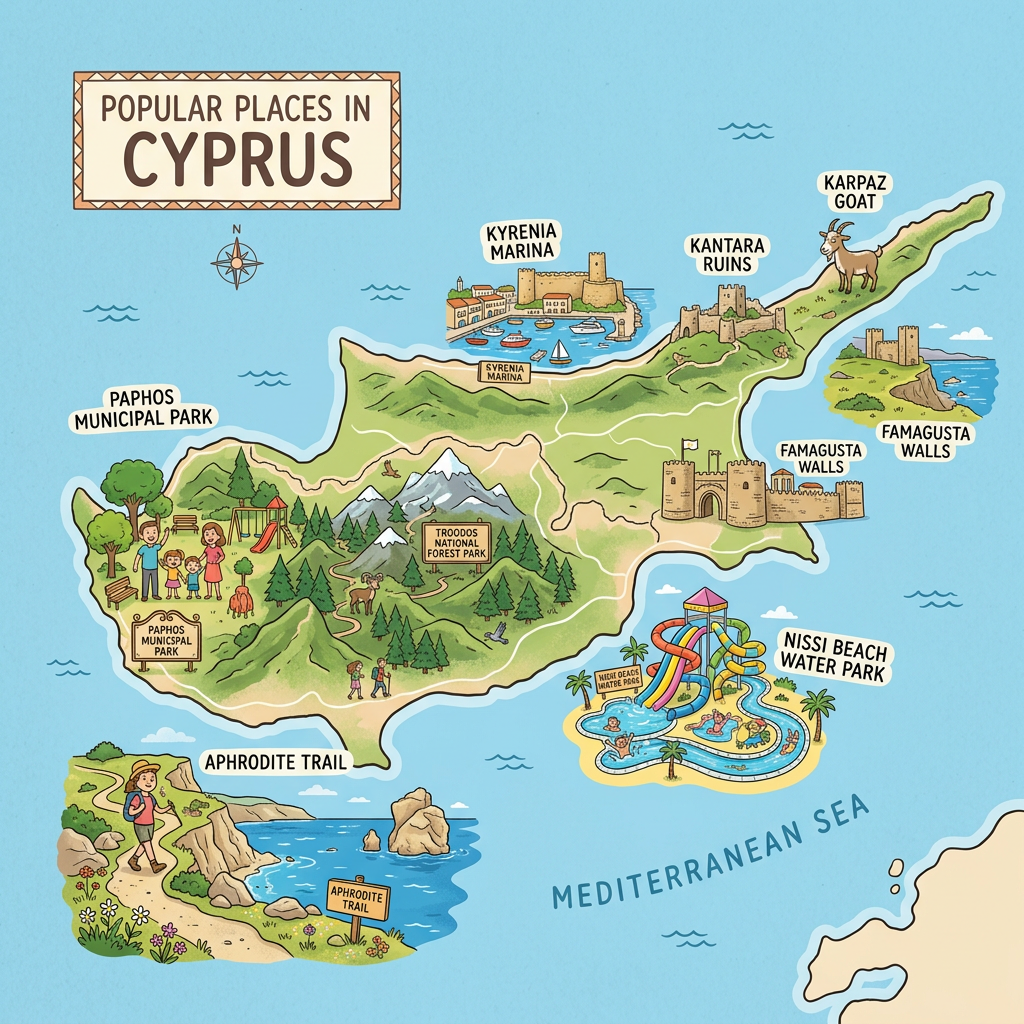
Cyprus is an island off the eastern section of the Mediterranean. Its administrative name as a country is the Republic of Cyprus. It shares the second half of the island with a Turkish territory called Northern Cyprus. The capital of the country is Nicosia and its population amounts to 1.1 million over an area of 9251 km2 or 3572 square miles.
This places it third in terms of the largest and most populous Mediterranean islands. Its maritime borders are shared with Egypt, Lebanon, Palestine, Israel, Syria, Greece, and Turkey. The languages spoken in Cyprus are Greek and Turkish. The main religions of the people are Christianity and Islam.
Map of Cyprus: key figures to read on the map
| Indicator | Key figure | Fun & useful insight |
|---|---|---|
| Total area | 9,251 km² | A bit larger than Southern Corsica |
| Europe ranking | 3rd largest Mediterranean island | After Sicily and Sardinia |
| Length East ↔ West | ≈ 240 km | Very elongated island |
| Width North ↔ South | ≈ 100 km | Mountains close to the coasts |
| Total population | ≈ 1.26 million | High urban concentration |
| Capital | Nicosia | Last divided capital in Europe |
| Total coastline | ≈ 650 km | Very varied beaches |
| Highest point | Mount Olympus – 1,952 m | Snow possible in winter |
| Mountain range | Troodos | Visible in the center of the map |
| Climate | Mediterranean | Hot summers, mild winters |
| Summer temperature | 30–35 °C | Almost guaranteed sunshine |
| Time zone | UTC+2 / UTC+3 | Eastern European Time |
Being part of the European Union, the country of Cyprus is connected by sea to Anatolia with only 69 km distance and only 104 km with Syria. However, the country shares its island with the British military bases of Akrotiri and Dhekelia as well as Northern Cyprus. Their common borders measure about 150 km. The telephone code in Cyprus is 357 or 00357 or +357.
The best cities in Cyprus

Map of Cyprus – reading by tourist regions
| Region | Key city | Atmosphere |
|---|---|---|
| South-West | Paphos | Culture & heritage |
| South | Limassol | Dynamic & seaside |
| South-East | Ayia Napa | Beaches & nightlife |
| Center | Troodos | Mountains & hiking |
| North | Kyrenia | History & landscapes |
Main attractions in Cyprus
Larnaca
Larnaca is often the first stop on a trip to Cyprus, as it houses one of the island’s main international airports. A port city and renowned seaside resort, it charms with some of the most accessible beaches in the country and its relaxed seaside atmosphere. Visitors appreciate its traditional taverns, ideal for observing local daily life, as well as its historical heritage, including the Al-Kébir mosque, Saint Lazarus Church, and the old Larnaca fort, now transformed into a medieval museum.
Nicosia
Nicosia, also called Lefkosia, is the capital of Cyprus and one of the oldest inhabited cities in the Mediterranean. It stands out for its complex history and its unique situation: it is the last divided capital in Europe, separated between the north and south by a buffer zone. Visitors come to discover this marked cultural contrast, but also its historical strategic role as a crossroads of trade exchanges between East and West.
Limassol
Limassol is the second largest city in Cyprus and is located on the southern coast of the island. Highly appreciated for its dynamism and cultural heritage, it combines modernity and traditions. Among the emblematic sites are the medieval Limassol castle and the folk museum, which showcases Cypriot art and traditions. The city also offers pleasant walks along the coast, notably around the public garden and the marina.
Paphos
Located on the west of the island, Paphos is one of the cultural highlights of Cyprus. Deeply rooted in Greek mythology, it is associated with the goddess Aphrodite, whose sanctuary is among the most famous ancient sites in the country. The city is also renowned for its Roman villas adorned with mosaics, its centuries-old Byzantine fortress, and the impressive Tombs of the Kings of Kato Paphos, listed as a UNESCO World Heritage site.
Famagusta
Famagusta was once a major seaside and cultural resort, now partly abandoned, especially in the Varosha district. Its tourist appeal is now mainly concentrated in the neighboring areas. Agia Napa is famous for its fine sandy beaches, including the very popular Nissi Beach, often compared to those of Ibiza for its lively summer atmosphere. Protaras, quieter, is known for its crystal-clear waters and family-friendly beaches, ideal for swimming and relaxation.
Where are the cities located on the map?

Larnaca
On the map of Cyprus, the city of Larnaca is located in the southeastern part of the island in a district of the same name. Geographic coordinates: 34° 55′ north, 33° 38′ east
Nicosia
Located in the central part of the island, Nicosia is a city situated on the banks of the Pedieos. Geographic coordinates: 35° 10′ 01″ north, 33° 21′ 00″ east
Limassol
It is located in the southwestern part of the island of Cyprus. The geographic coordinates are 34° 40′ 29″ north, 33° 02′ 39″ east
Paphos
Paphos is a port city located in the western part of the island; it is also the capital of the district of the same name. Geographic coordinates: 34° 46′ 01″ north, 32° 25′ 01″ east.
Famagusta
Located in the eastern section of the island, Famagusta is a port city. Geographic coordinates: 35° 06′ 54″ north, 33° 56′ 33″ east
Cyprus climate map
Since the country is located right in the center of the Mediterranean, the climate is naturally relative. It is therefore a Mediterranean climate marked by constant sunshine throughout the year.
Summer is characterized by high temperatures around 35°C. The season is dry but the sea breeze alleviates the heat. The hottest periods last through July and August.
The spring and autumn seasons are marked by fairly frequent sunshine. However, temperatures are lower than in summer. It would therefore be the ideal time for walks by the sea and hikes in the great outdoors.
As for winter, temperatures are low but not too low. This offers a mild and humid climatic environment with temperatures around 17°C. It could snow in winter and in some elevated areas, rainfall is more frequent.
In general, the country’s climate is quite pleasant throughout the year. But in our opinion, the best time to visit the country would be the months of April, May, September, and October.
Limassol
The climate in this city is characterized by a rainy winter, much more so than in summer. This is one of the features of a warm and temperate climate. Summer, on the other hand, is quite warm and average temperatures hover around 25°C. On average, there is 407 mm of rainfall per year in Limassol.
Paphos
This city is marked by a hot summer and a temperate winter. Rain falls regularly throughout the year but the rainiest periods are in summer. The average temperatures throughout the year range between 17°C and 21°C and the annual rainfall is 490 mm.
Peyia
Summer is marked by constant but light rains. The annual rainfall is 593mm. Winter is mild with less abundant rains than in summer. The climate of Peyia is classified as warm temperate.
Meaningful distances (compact island)
| Route | Distance | Estimated time |
|---|---|---|
| Nicosia → Limassol | ≈ 85 km | 1h |
| Larnaca → Paphos | ≈ 135 km | 2h |
| Limassol → Troodos | ≈ 45 km | 1h |
| Ayia Napa → Nicosia | ≈ 85 km | 1h15 |
Cypriot financial profile
Both a member of the European Union and the Eurozone, Cyprus is one of the high-income countries in Europe. Its economy is based on the service sectors, industry, and international trade. The category of the Cypriot economy is a liberal economy and commercial legislations are suitable for businesses.
Cyprus’s finance is also marked by a low unemployment rate and an increase in income from the tourism sector. The currency in Cyprus is the Euro. Moreover, unemployment is low and represents only 5.8% of the active population.
According to the IMF, Cyprus’s GDP amounts to 23.25 billion USD and the annual growth rate in % is -6.4 compared to 4.1% last year. This decline is the result of the Coronavirus pandemic which weakened the State’s financial resources.
Here are some important figures:
- Gross domestic product per capita: 28,159.3 Dollars
- Gross domestic product in nominal value: 23.25 billion dollars
- Activity sectors (as % of gross domestic product)
- Agriculture: 2%
- Industry: 16.1%
- Services: 81.6%
Demographic and administrative map of Cyprus

Demographics of Cyprus
According to recent United Nations data, the population of Cyprus stands at 1,237,088 inhabitants. The population growth this year is 1.27% and the fertility rate is 1.46 children per woman. These figures result from a birth rate higher than the death rate, at 1.12% and 0.68% respectively. The life expectancy of a Cypriot at birth is 80 years, with 76.3 years for men and 82.9 years for women.
The population of Cyprus is young since the average age is about 37.2 years, with women averaging 38.7 years and men 35.9 years. The male-to-female ratio is 104 men to 100 women. Cypriot men are therefore more numerous.
The population is composed of several ethnicities, notably: Greeks, Turks, and other uncounted races. The respective ethnic percentages are 77%, 18%, and 5%. Most inhabitants of Cyprus are Orthodox Catholics (79%), the rest is divided between Islam (17%) and Maronites, Armenian Apostolics (4%).
Administrative Subdivision of Cyprus
Officially, the country is divided into 6 administrative entities also called districts. The capitals of these 6 districts bear the same name as their administrative entity.
Here are the 6 entities:
- Famagusta
- Kyrenia
- Limassol
- Larnaca
- Nicosia
- Paphos
Demolinguistic data in Cyprus
The island of Cyprus is subdivided into two territories: that of the Republic of Cyprus and that of Turkey. These two zones differ by their language but also by their origin. The first speaks Cypriot Greek but the second speaks Cypriot Turkish.
What interests us here is the dialect of the Republic of Cyprus. This language originally comes from medieval Byzantine Greek. It has common characteristics that, to our surprise, do not resemble Common Greek in any way.
This leads us to think that Cypriot Turkish derives from Byzantine Latin, Old French, Venetian, Florentine, or English. According to the information we have gathered, Cypriot Greek has more than 18 variants, of which the most important are:
- Nicosia
- Paphos
- Morphou
- Limassol
FAQ-Cyprus map: What you need to know about Cyprus
Cyprus is located in the eastern part of the Mediterranean Sea, south of Turkey, west of Syria and Lebanon, northwest of Israel, and east of Greece.
Countries near Cyprus include Turkey to the north, Syria and Lebanon to the east, Israel to the southeast, and Greece to the west, across the Aegean Sea.
Cyprus is considered part of Asia geographically, but it is often associated with Europe culturally and politically.
