
What you need to know about the Paris department ?
Here we present to you the former Seine department, one of the oldest in the French territory, dating back to after 1790 following the French Revolution. It was formerly called the Seine department and it was only in 1968 that it ceased to exist, giving rise to the 75th department.
This is also the case for the departments of Oise and Haute-Seine. It was only after this year of territorial reorganization of the Seine department that the department was divided into 4 others, namely: Paris, Hauts-de-Seine, Val-de-Marne, and Seine-Saint-Denis.
Thus, department 75 has Paris as its capital and main city; it is also the Capital of the Country. Its current area is 475.41 km2. Paris is also divided into 20 administrative subdivisions, called arrondissements. It is also the capital of Île-de-France, a metropolitan region, but moreover, it is also the seat of the said metropolis, Greater Paris.
The people of Paris currently number 2,048,472 inhabitants, and the area of the 75th department is 105.40 km², resulting in a population density of 19,435 inhabitants per square kilometre. That said, Paris is not, strictly speaking, a standard department; it is simply an urban municipality with a special administrative status.

Which departments border Paris?
A departmental or urban commune of Paris is part of a specific and verifiable geological space, whose boundaries were created around 1860, during the annexation of several contiguous communes (Montmartre, La Villette, or Bercy). The former military corner of Thiers dates from 1840. The Petite Couronne is a territory made up of three departments bordering the city of Paris: Hauts-de-Seine, Seine-Saint-Denis, and the Marne Valley.
What is the climate like in Paris?
The climate of Paris is that of the Île-de-France region, which is oceanic and temperate. The fact is that this part of the country is influenced by oceanic winds two-thirds of the time. This generates air that travels across the territory and brings humidity and a change in weather. The climate of Paris is that of the Île-de-France region, oceanic and temperate. Regarding rainfall, however, the amount only reaches 600 mm per year.
Now let’s talk about the seasons: the winter period then gives way to a continental climate marked by a cool and dry season, strongly influenced by westerly winds. Summer, on the other hand, has very high temperatures, but during this period, it is dry and cool and also very sunny when there are no anticyclones crossing the country from the Atlantic. The autumn season, however, shows a lot of rain, notably because this season is really influenced by the small westerly winds. Finally, there is the spring period, which is marked by late frosts and also unexpected cold snaps.
What are the best suburbs to visit in Paris?
Let’s discover below four Parisian suburbs that are worth seeing
Saint Germain-en-Laye
This northwest suburb is a well-known choice for expatriate families. Especially since it is home to the world-renowned Lycée International de Saint Germain-en-Laye. It is famous for featuring a mix of essential subjects in French, as well as in some dialects from around the world, so that students can be bilingual. It is a beautiful green suburb and is also considered a protected living area.
Saint Cloud
This is another popular neighborhood for expatriate families. Thanks again to a range of excellent international schools nearby! There is a real “French” atmosphere here, with small bakeries, cafés, and shops, and a quiet lifestyle. It is friendly and safe, with many houses with gardens to choose from. It is located to the west of Paris and is served by the metro and buses to Paris.
Issy les Moulineaux
Located southwest of Paris, this small suburb is close to the main ring road and the metro line. It is actually one of the most well-known rural areas for local Parisians who decide to settle there to leave the city center. There are many media and innovation organizations in this suburb.

FAQ – Paris map
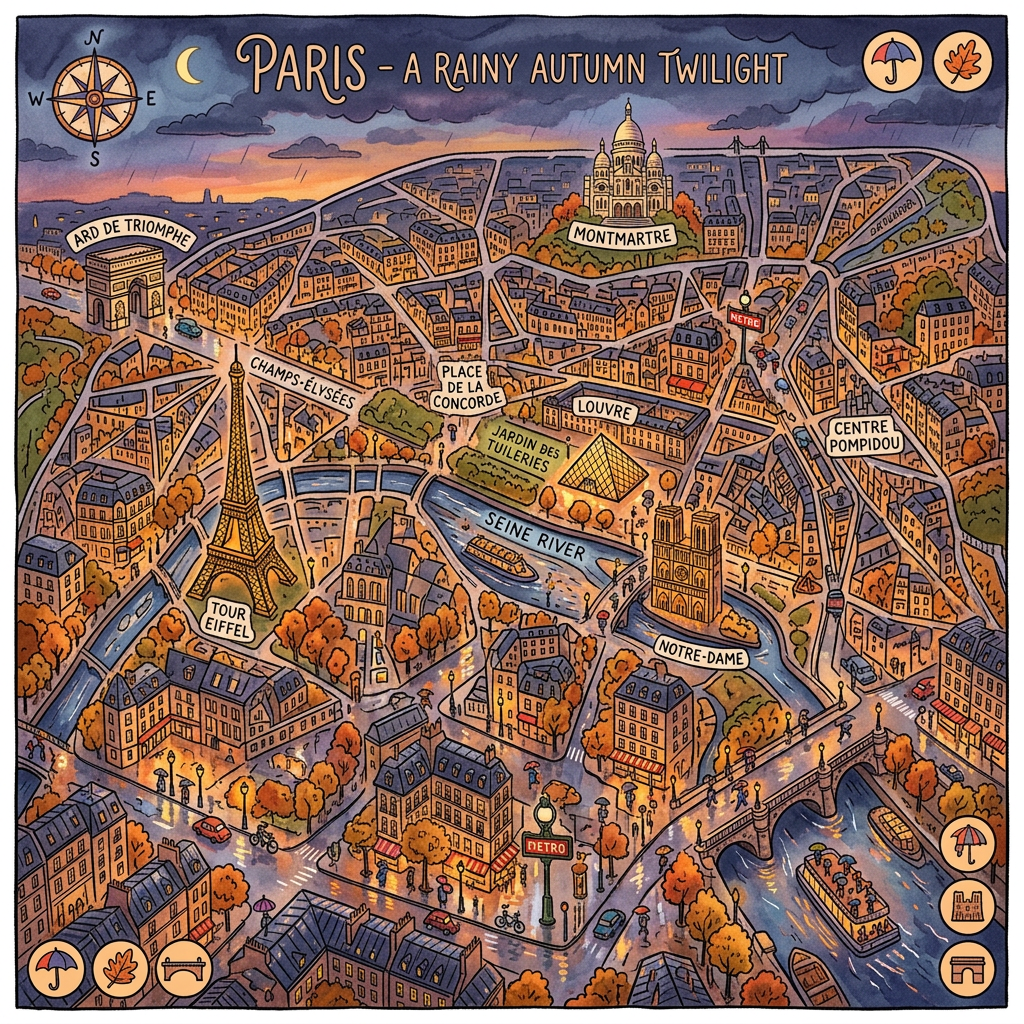
A map of Paris helps locate the city’s 20 arrondissements, major districts, and main roads. It also makes it easier to find famous landmarks, metro stations, and the capital’s green spaces.
Paris is divided into 20 municipal arrondissements arranged in a spiral pattern. Each arrondissement has its own town hall and distinctive historical and cultural characteristics.
A map of Paris helps you plan an itinerary by identifying the main tourist attractions and transportation options. It also makes getting around easier and helps you organize your stay more efficiently.
