
What you need to know about Gabon ?
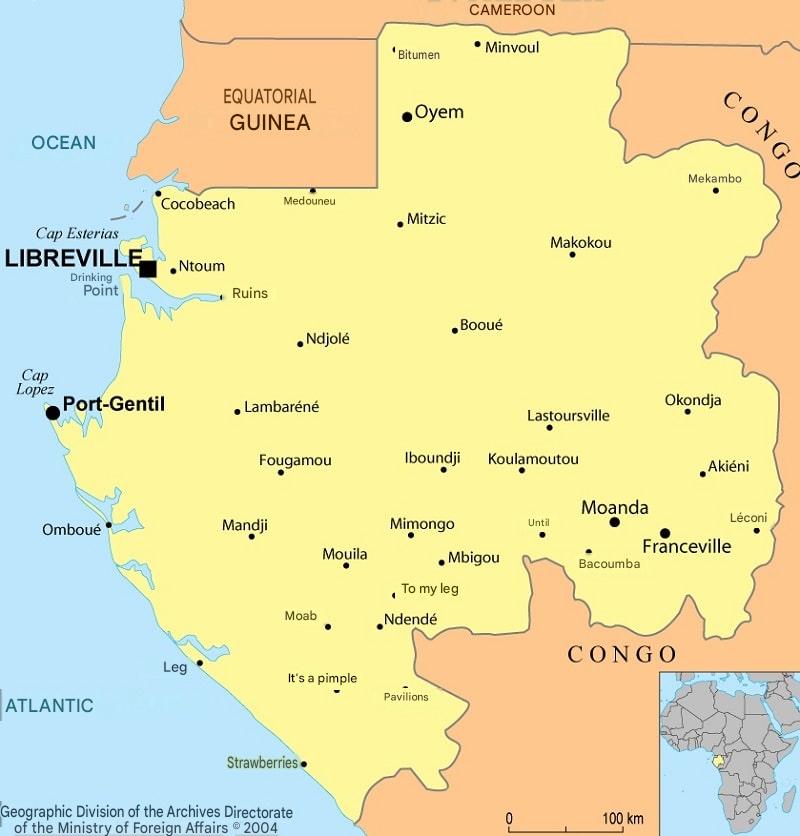
Gabon is a country located in central Africa and crossed by the equator. Also called the Gabonese Republic, the country is a semi-presidential republic. The capital and largest city of Gabon is Libreville, and the second largest urban area in the country is Port-Gentil.
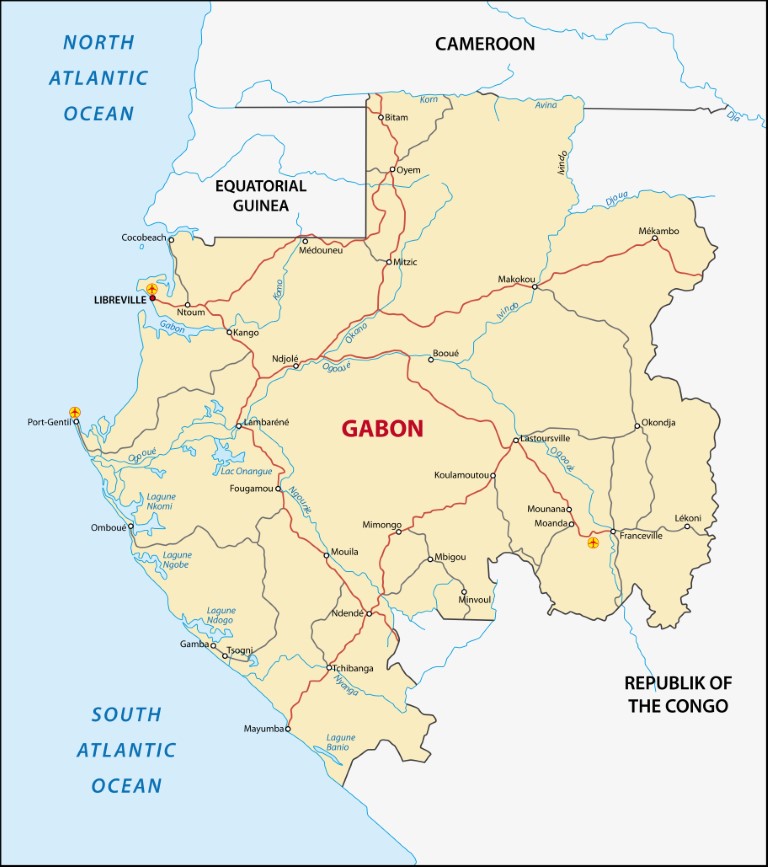
A forested Central African country opening onto the Atlantic, Gabon combines great rivers, iconic national parks, and a low population density. The Gabon Map helps structure an itinerary between Libreville, Port-Gentil, and the parks (Loango, Lopé, Ivindo), taking into account the seasons and sometimes demanding access.
Gabon covers an area of 267,667 km² and has approximately 2.23 million inhabitants (2024 estimate).
It ranks 76th worldwide by size and 145th by population, with an average density of about 8 inhabitants per km².
Located in Central Africa, Gabon shares borders with Cameroon, Equatorial Guinea, and the Republic of Congo, and has an opening onto the Atlantic Ocean to the west.
The country’s international telephone code is +241 (or 00241).
| Element | Details |
|---|---|
| Official Name | Gabonese Republic |
| Capital | Libreville |
| Population | ~2.3 million inhabitants (low density, high coastal urbanization) |
| Area | ~267,667 km² (mostly equatorial forests) |
| Relief & Hydrography | Plateaus, Chaillu Mountains, Ogooué and tributaries, Atlantic coast |
| Climate | Humid equatorial, alternating dry and rainy seasons |
| Language | French (official); Bantu languages (Fang, Myéné, Punu…) |
| Currency | CFA Franc (XAF) |
| Major Cities | Libreville, Port-Gentil, Franceville, Oyem |
| Economy | Oil, manganese, timber, services; developing ecotourism |
| Points of Interest | Loango, Lopé, Ivindo parks (Kongou Falls), Atlantic beaches |
| Access | Libreville Airport (LBV), internal air and road connections |
| Advice | Bring mosquito protection, be aware of rainy seasons, book parks in advance |
Countries bordering Gabon
Neighboring countries of Gabon are the Republic of Congo, Equatorial Guinea, and Cameroon. These countries border Gabon respectively to the East, Northwest, and North. Gabon is bordered by the Atlantic Ocean to the West.
The colors of Gabon

The flag of Gabon is a rectangular flag composed of 3 horizontal bands of equal size: From top to bottom, we have green, yellow, and blue. Green represents the equatorial forest, yellow represents the color of the sun, and blue represents the ocean.
The best places to visit in Gabon
Libreville
Capital and main urban area of the country, Libreville is located on the Atlantic coast, not far from the equator. It is the political, economic, and cultural center of Gabon, heavily dependent on the oil industry.
The city attracts with its modern residential neighborhoods, its elegant restaurants, its urban beaches such as Pointe-Denis or Cap Santa Clara, and its lively nightlife. More than a third of the Gabonese population lives in this cosmopolitan and dynamic metropolis.
Port-Gentil
Second city of the country, Port-Gentil is often considered the most beautiful city in Gabon. Located on Mandji Island, it is the economic heart of the country, hosting the main oil companies and an international commercial port.
The city offers a pleasant living environment, between Atlantic beaches, chic restaurants, and wide palm-lined avenues, ideal for a quieter stay than in the capital.
Lambaréné
Nestled on the edge of the Ogooué, Lambaréné is known for its lush nature and numerous sparkling lakes and rivers.
It is a peaceful city rich in history, famous for its hospital founded in 1924 by Dr. Albert Schweitzer, still in operation, and its research center on malaria and tropical diseases.
Franceville
Located in the east of the country, Franceville is one of the oldest cities in Gabon. It stands out for its rolling landscapes, its Poubara Falls, and its authentic atmosphere.
It is also an important university and mining center, contributing to the country’s internal development.
Mouila
Small town with a tranquil charm, Mouila is famous for its Blue Lake, a body of water with turquoise reflections surrounded by tropical vegetation.
It is an ideal stop for travelers wishing to discover the interior of Gabon, between traditional villages and wild nature.
Financial map of Gabon
The Gabonese economy mainly relies on oil exploitation and forestry exploitation, which alone represent nearly half of the GDP and the majority of the country’s exports. These natural resources have enabled Gabon to rank among the richest economies in sub-Saharan Africa in terms of income per capita.
Besides oil, the country benefits from its mineral deposits (manganese, gold, iron, uranium) and strives to diversify its economy through the sectors of agriculture, fishing, processed wood, and ecotourism, notably in its world-renowned national parks.
Key economic data (estimates 2024-2025)
- Official currency: CFA franc (XAF)
- Nominal GDP: 15 billion USD
- GDP at purchasing power parity (PPP): 37 billion USD
- Annual GDP growth: approximately 0.5%
- GDP per capita (PPP): 18,100 USD
- Inflation rate: 2.7%
- Population below the poverty line: 34.3%
- Human Development Index (HDI): 0.702
- Unemployment rate: approximately 28% of the active population
Despite its wealth in natural resources, Gabon faces significant structural challenges: a heavy dependence on oil, marked social inequality, and an urgent need for sustainable economic diversification. The government is currently pursuing a transformation strategy called “Emerging Gabon”, aiming to strengthen industrialization and investments in green sectors.
Climate map of Gabon
Three climatic zones make up Gabon: The northern section is characterized by a conventional equatorial climate. This climate is distinguished by 4 seasons including two rainy periods and two hot interspersed periods. The rainy season generally occurs between September and December for the main part and the second from March to June.
The central part of Gabon is marked by a transitional equatorial climate characterized by a long rainy season, a brief dry season, and a very long dry season. Finally, the southwest parts and coastal areas are marked by a transitional equatorial climate defined by a very long hot and dry period lasting about 5 months.
Demographic, demolinguistic and administrative map of Gabon

Demography
The population of Gabon is estimated at about 2.23 million inhabitants in 2024, with a population growth rate of 2.7% per year.
The fertility rate is 3.5 children per woman, while the birth rate reaches 26.5‰ for a mortality rate of 6.2%

The life expectancy at birth is about 68 years, with an average of 66.3 years for men and 69.6 years for women.
The median age of the population is 20.5 years, illustrating a very young society, characteristic of many sub-Saharan African countries.
The male/female ratio is 108 men for 100 women, and the net migration rate is estimated at +7‰, reflecting moderate regional immigration.
The Gabonese population is composed of several major ethnic groups, including the Fangs, Punu, Nzebi, and Obamba, who represent the majority of the country.
French is the official language and is spoken by nearly 80% of the population, while many local Bantu languages (such as Fang, Punu, or Nzebi) remain widely used in daily life.
Administrative divisions
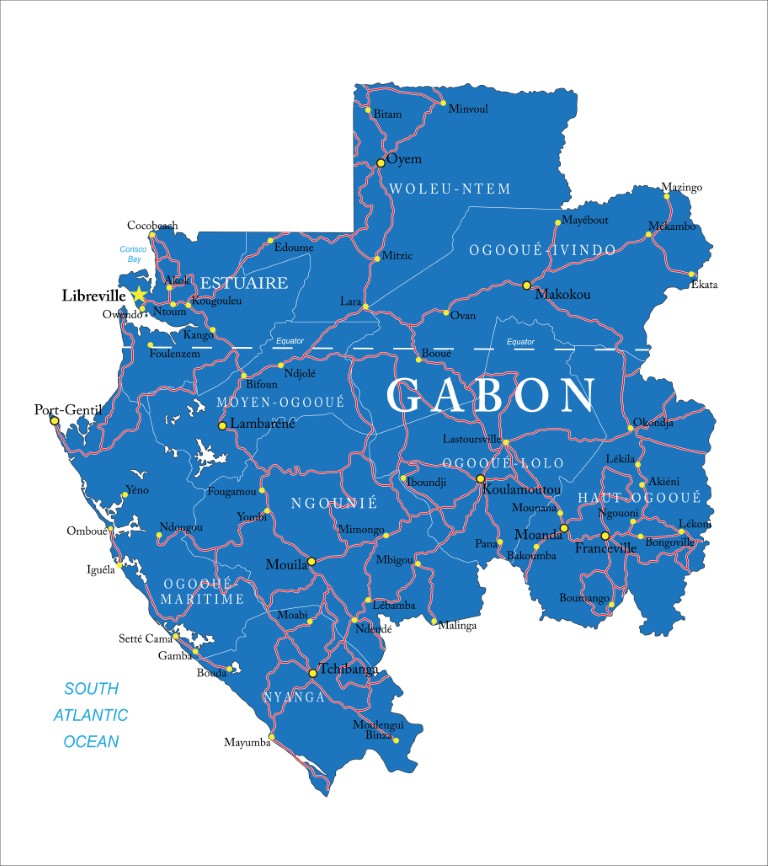
Administratively, Gabon is divided into 9 provinces which are in turn subdivided into 49 departments. The provinces of Gabon are:
- Estuaire
- Haut-Ogooué
- Moyen-Ogooué
- Ngounié
- Nyanga
- Ogooué-Ivindo
- Ogooué-Lolo
- Ogooué-Maritime
- Woleu-Ntem
The departments of Gabon by provinces are:
Province of Estuaire
- Komo (Kango)
- Komo-Mondah (Ntoum)
- Noya (Cocobeach)
- Komo-Océan (Ndzomoe)
- Libreville
Province of Haut-Ogooué
- Djoue (Onga)
- Djououri-Aguilli (Bongoville)
- Lekoni-Lekori (Akiéni)
- Lekoko (Bakoumba)
- Leboumbi-Leyou (Moanda)
- Mpassa (Franceville)
- Plateaux (Leconi)
- Sebe-Brikolo (Okondja)
- Ogooué-Létili (Boumango)
- Lékabi-Léwolo (Ngouoni)
- Bayi-Brikolo (Aboumi)
Province of Moyen-Ogooué
- Abanga-Bigne (Ndjole)
- Ogooué et des Lacs (Lambaréné)
Province of Ngounié
- Boumi-Louetsi (Mbigou)
- Dola (Ndendé)
- Douya-Onoy (Mouila)
- Louetsi-Wano (Lébamba)
- Ndolou (Mandji)
- Ogoulou (Mimongo)
- Tsamba-Magotsi (Fougamou)
- Louetsi-Bibaka (Malinga)
- Mougalaba (Guietsou)
Province of Nyanga
- Basse-Banio (Mayumba)
- Douigni (Moabi)
- Haute-Banio (Ndindi)
- Mougoutsi (Tchibanga)
- Doutsila (Mabanda)
- Mongo (Binza)
Province of Ogooué-Ivindo
- Ivindo (Makokou)
- Lope (Booué)
- Mvoung (Ovan)
- Zadie (Mekambo)
Province of Ogooué-Lolo
- Lolo-Bouenguidi (Koulamoutou)
- Lombo-Bouenguidi (Pana)
- Mouloundou (Lastoursville)
- Offoué-Onoye (Iboundji)
Ogooué-Maritime Province
- Bendje (Port-Gentil)
- Etimboue (Omboue)
- Ndougou (Gamba)
Woleu-Ntem Province
- Haut-Komo (Medouneu)
- Haut-Ntem (Minvoul)
- Ntem (Bitam)
- Okano (Mitzic)
- Woleu (Oyem)
Demolinguistic Data
The Gabonese population is relatively small, but very diverse ethnically and culturally. There are more than 50 ethnic groups originating from different regions of the country.
There is no dominant ethnicity, but several major communities structure Gabonese society:
- The Fang
- The Mpongwè (subgroup of the Myènè people)
- The Mbédé
- The Punu
- The Baréké (or Batéké)
- The Bakota
- The Obamba
- The Pygmies (indigenous communities present in the northern and eastern forests)
At the same time, the country hosts a significant immigrant population, estimated at about 150,000 people, including 10,000 French. There are also Togolese, Cameroonian, Lebanese, Nigerien, and Malian communities, mainly settled in large cities such as Libreville and Port-Gentil.
French is the official language and the main language of communication (spoken by about 80% of the population). However, Gabon has more than 50 local languages and dialects, mainly from the Bantu group.
The most spoken are:
- Fang (≈ 32% of speakers)
- Mbédé (≈ 15%)
- Punu (≈ 10%)
These regional languages remain very present in daily life and contribute to Gabon’s cultural and identity richness.
For an overview and reliable references, start with the page Gabon Map. Place the country in its regional context via the page Africa. If you are considering an extension, check the southern border and the forest interior on the Congo side to prepare your sequences.
FAQ: Gabon map
A clear Gabon Map locates the forest backbone, the major rivers (Ogooué), key cities, and access to national parks.
Yes, a good Gabon Map highlights protected areas, access tracks, and logistical bases.
The Gabon Map, combined with the seasons, helps avoid peak rainfall and plan trips to the coast and inland areas.
Yes, by visualizing relief, tracks, and river crossings, the Gabon Map allows anticipating longer durations than in urban areas.
