Every summer, vapes end up confiscated at security checks, and some checked luggage triggers alerts due to a battery forgotten in the wrong place. None of this is inevitable: the rules are known, consistent from one airline to another, and specialized shops like Ecigplanete.com remind their customers of them before each departure period. Here is the full set of precautions to take, from packing your luggage to landing, including layovers.
The golden rule: all in the cabin, never in the hold
Let’s start with the rule that admits no exceptions: your electronic cigarette travels in the cabin, in your carry-on bag or on you, never in checked luggage. This requirement comes from international air transport regulations on lithium batteries, whose risk of thermal runaway requires that they remain under crew supervision. It applies to all equipment that contains a battery: box mods, pods, rechargeable or disposable puffs.
The same treatment applies to spare cells and batteries: cabin only, with contacts protected in a hard case or their original box to prevent any short circuit. Commercial batteries remain below the 100 Wh threshold allowed without formalities, so you have no declaration to make, but plan to take out the equipment at the security checkpoint, like a laptop.
E-liquids: 100 ml in the cabin, the hold for stock
Bottles follow the general rule for liquids in the cabin: maximum 100 ml per container, all gathered in the transparent one-liter plastic bag presented at security. A detail that few vapers know actually reverses the logistics: the 100 ml limit only applies to the cabin.
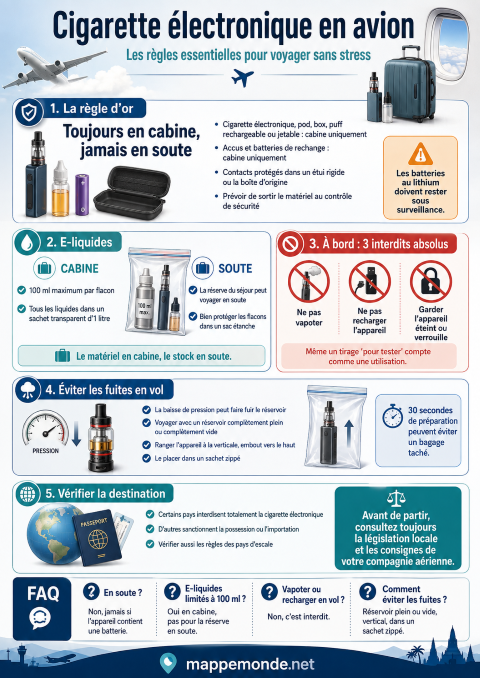
Your e-liquid bottles, however, do not contain batteries and can travel in the hold without volume restriction. The proper distribution imposes itself: the equipment and a backup bottle in the cabin, the supply for the trip in the checked suitcase, well protected in a waterproof bag.
On board: off, never used, never charged
Once seated, three absolute prohibitions. Vaping on board is forbidden on all airlines, including in the toilets: smoke detectors are sensitive to vapor, and triggering an alarm in flight results in penalties, sometimes severe.

Charging your equipment during the flight is equally prohibited, even on seat USB ports. And the device must remain off, or locked if your model allows it: on a box mod with cells, the safest is to remove the cells for the duration of the flight.
A dry puff “to check” counts as use. Refrain until you exit the airport.
The trap no one anticipates: pressure
At altitude, cabin pressure drops and the air trapped in your tank expands, pushing the liquid toward the outlet. A classic result: a clearomizer that leaked in the pocket during the flight.
The trick is simple: travel with a tank either completely full or empty, never half-full, store the equipment in an upright position, mouthpiece facing up, and slip the whole set into a ziplock bag. Thirty seconds of preparation versus spilled e-liquid on the passport, the math is easy.
Before booking: check the legislation of your destination
The most serious part of the issue is not on the plane, it is upon arrival. Some countries completely ban electronic cigarettes: India, for example, prohibits their transport even in luggage, as Air France reminds on its official page of regulated products.
Other destinations strictly punish possession or importation of vaping equipment, with confiscation, fines, or worse. The reflex to avoid ruining a trip: consult the website of the embassy or consulate of your destination before packing, and also consider transit countries, whose rules may apply even without leaving the airport.
Well prepared, your vape will cross borders without trouble. Poorly stored, it will be the one to write the travel anecdote.
FAQ: electronic cigarette and airplane
No, never. Any equipment containing a lithium battery, box, pod, disposable or rechargeable puff, must travel in the cabin, in carry-on luggage or on your person. This international rule targets the risk of battery fires, which must remain accessible to the crew during the flight.
Only in the cabin, where each bottle must be a maximum of 100 ml and fit in the one-liter transparent bag. Since e-liquid bottles do not contain batteries, the supply for the stay can travel in checked baggage without volume limit, well protected in a waterproof bag.
No to both. Vaping is prohibited on board all airlines, including in the toilets, under penalty of sanctions, and recharging during the flight is also prohibited, including on the seat USB ports. The device must remain off or locked throughout the flight.
The drop in pressure at altitude expands the air in the tank and pushes the liquid outward. Travel with a tank either completely full or completely empty, store the equipment vertically, nozzle facing up, and place the entire set in a zippered plastic bag.
Sources
For further information: Electrical and electronic devices, cells and batteries: prohibited and regulated products (Air France).