
What you need to know about Gambia ?
Gambia is a presidential republic located in West Africa. It is the smallest country on the African mainland continent, with an area of about 11,300 km². The country has a population of about 2.6 million inhabitants (2024 estimate), called Gambians.
The capital is Banjul, located on a peninsula at the mouth of the Gambia River, while the largest city and the main economic center of the country is Serrekunda.
Gambia is bordered by Senegal on almost all its perimeter, except for a narrow Atlantic coastline of about 80 km.

The country is part of several regional and international organizations, including:
- the ECOWAS (Economic Community of West African States),
- the AfDB (African Development Bank),
- the CEN-SAD,
- the South Atlantic Peace and Cooperation Zone (ZPCAS),
- and the Commonwealth of Nations (CIR).
The international telephone code for Gambia is +220 (or 00220).
A country stretching along the Gambia River, enclaved within Senegal with an Atlantic outlet, the Gambia is explored by combining roads and river crossings. A detailed map helps structure the stages between Banjul/Serekunda, the nature reserves, and the beaches, taking seasons and crossing points into account.
| Item | Details |
|---|---|
| Official Name | Republic of Gambia |
| Capital | Banjul |
| Population | ~2.7–2.9 million inhabitants (high concentration around the Gambia River and the coast) |
| Area | ~11,300 km² (narrow country along the river, enclave within Senegal except for the Atlantic coast) |
| Relief & Hydrography | Low plains, Gambia river valley, coastal mangroves |
| Climate | Tropical savanna: rainy season June–October, dry season November–May |
| Languages | English (official); Wolof, Mandinka, Fula, Jola… |
| Currency | Gambian Dalasi (GMD) |
| Major Cities | Banjul (capital), Serekunda (largest), Brikama |
| Economy | Agriculture (peanuts), beach tourism, fishing, diaspora remittances |
| Points of Interest | Kunta Kinteh Island (James Island), Abuko Nature Reserve, River Gambia National Park, Kololi/Kotu beaches |
| Access | Banjul International Airport (BJL), river crossings and road network to Senegal |
| Advice | Plan for the rainy season, check ferry/bridge schedules, prepare mosquito and heat protection |
Colors of Gambia
The Gambian flag is a rectangular flag composed of 3 horizontal stripes in the colors: red, blue, and green, separated by two white stripes. The red color represents the sun and the savanna lands, the blue represents the Gambia River, and the green represents agriculture and forest cover. The white color represents unity and peace.

To locate the region and prepare your road access, first consult Gambia (map). View the border context and connections with the immediate neighbor via Senegal (map), and place everything within its continental framework with the overview Africa. For a broader itinerary to the coastal Sahel, compare reliefs and access with Mauritania.
Best places to visit in Gambia

Banjul
Banjul, the capital of Gambia, is located on Saint Mary Island, at the mouth of the Gambia River.
It is a small capital with colonial charm, connected to the mainland by several bridges and ferry services.
Visitors can discover the lively Albert Market, the Gambian National Museum, the African Heritage Museum, as well as several religious buildings (mosques and cathedrals).
Banjul also houses an international port and Yundum Airport, the main entry point to the country.
Serrekunda
Located south of Banjul, Serrekunda is the largest urban area in Gambia.
Composed of nine former villages now unified, the city is a major commercial and cultural center.
There are colorful markets, craft centers, as well as a dynamic urban life blending tradition and modernity.
Close to the beaches of Kololi and Kotu, Serrekunda is also an ideal base for tourists seeking to explore the Gambian coastline.
Brikama
Located south of the capital, Brikama is one of the most important and developed cities in the country.
It houses several educational institutions, government buildings, and a local market renowned for its woodcraft.
Brikama is also known as the musical capital of Gambia, notably for its traditional rhythms and music schools.
Bakau
Bakau is a popular seaside resort located between Banjul and Serrekunda.
It is famous for its golden sandy beaches, its Kachikally natural pool (considered sacred), and its botanical garden, one of the oldest in the country.
Bakau is also an ideal place to observe local wildlife, notably green monkeys and many bird species.
Farafenni
Located in the north-central part of the country, on the north bank of the Gambia River, Farafenni is a strategic trading town linking Gambia to Senegal.
Its large cross-border market attracts visitors from across the sub-region, and the Senegambia Bridge, inaugurated in 2019, has strengthened its economic importance.
Farafenni embodies the commercial and cultural crossroads of the country.
Where is Gambia located on the world map?
Gambia is an African country located in the west of continental Africa. It is surrounded on three sides by Senegal and only its western coastline faces the Atlantic Ocean.

To locate the region and prepare your road access, first consult Gambia (map). View the border context and connections with the direct neighbor via Senegal (map), and place everything in its continental framework with the overview Africa. For an itinerary extended to the coastal Sahel, compare reliefs and access with Mauritania.
Climate of Gambia
The climate of Gambia is tropical. It is characterized by a dry season and a rainy season. The dry season occurs between November and May, and temperatures during this season hover around 18°C. The wet season takes place during the rest of the year, between June and October.
Temperatures reach around 43°C and are lower along the coast. Year-round temperatures range between 23°C and 27°C on the coasts and between 24°C and 32°C inland. Annual precipitation ranges from 920 to 1,450 mm.
Administrative division of Gambia
The Gambian territory is divided into regions (6 in number), which in turn are divided into districts (37 in number).
Here are the 6 regions:
- Greater Banjul
- West Coast
- North Bank
- Lower River
- Central River
- Upper River
Here are the 37 districts:
- Banjul
- Kanifing
- Foni Bintang-Karenai
- Foni Bondali
- Foni Brefet
- Foni Jarrol
- Foni Kansala
- Kombo Central
- Kombo East
- Kombo North
- Kombo South
- Central Baddibu
- Jokadu
- Lower Baddibu
- Lower Niumi
- Upper Baddibu
- Upper Niumi
- Jarra Central
- Jarra East
- Jarra West
- Kiang Central
- Kiang East
- Kiang West
- Fulladu West
- Janjanbureh
- Lower Saloum
- Niamina Dankunku
- Niamina East
- Niamina West
- Niani
- Nianija
- Sami
- Upper Saloum
- Fulladu East
- Kantora

The Gambian economy is one of the most modest in Africa, heavily dependent on agriculture, trade, and remittances sent by the diaspora.
About 75% of the population lives directly from agriculture, fishing, or livestock farming. The agricultural sector is dominated by peanut cultivation, the main export product, as well as by artisanal fishing and the trade of skins.
The economy remains vulnerable to climatic variations, global price fluctuations, and low industrial diversification. The country mainly exports food and agricultural products, but still largely depends on manufactured imports.
The government is focusing on macroeconomic stabilization, modernization of the agricultural sector, and tourism development to support medium-term growth.
Key economic data (2024-2025 estimates)
- Official currency: Dalasi (GMD)
- Nominal GDP: 2.1 billion USD
- Annual GDP growth: about 5.5%
- GDP per capita (PPP): 499 USD
- Inflation rate: 8.8%
- External debt: 628.8 million USD
- Main trading partners: China, Senegal, Brazil, United Kingdom, Netherlands, United States
Despite its still low level of development, Gambia has a significant tourism potential (Atlantic beaches, wildlife, culture) and growing political stability favorable to investment.
Population and linguistic data of Gambia
The Gambian population is estimated at about 2.6 million inhabitants in 2024, with a population growth rate of 2% per year.
The fertility rate is 3.4 children per woman, while the birth rate (28.6 ‰) remains significantly higher than the death rate (6.9 ‰).
The life expectancy at birth is 65.4 years, and the median age is 21.3 years, reflecting a very young population.
The sex ratio is 98 men per 100 women, and the net migration rate is -1.8 ‰, due to economic emigration to neighboring countries and Europe.
Languages spoken
- English: official language of the state and administration
- Mandinka
- Wolof
- Diola (Jola)
These local languages are widely used in daily life and coexist harmoniously.
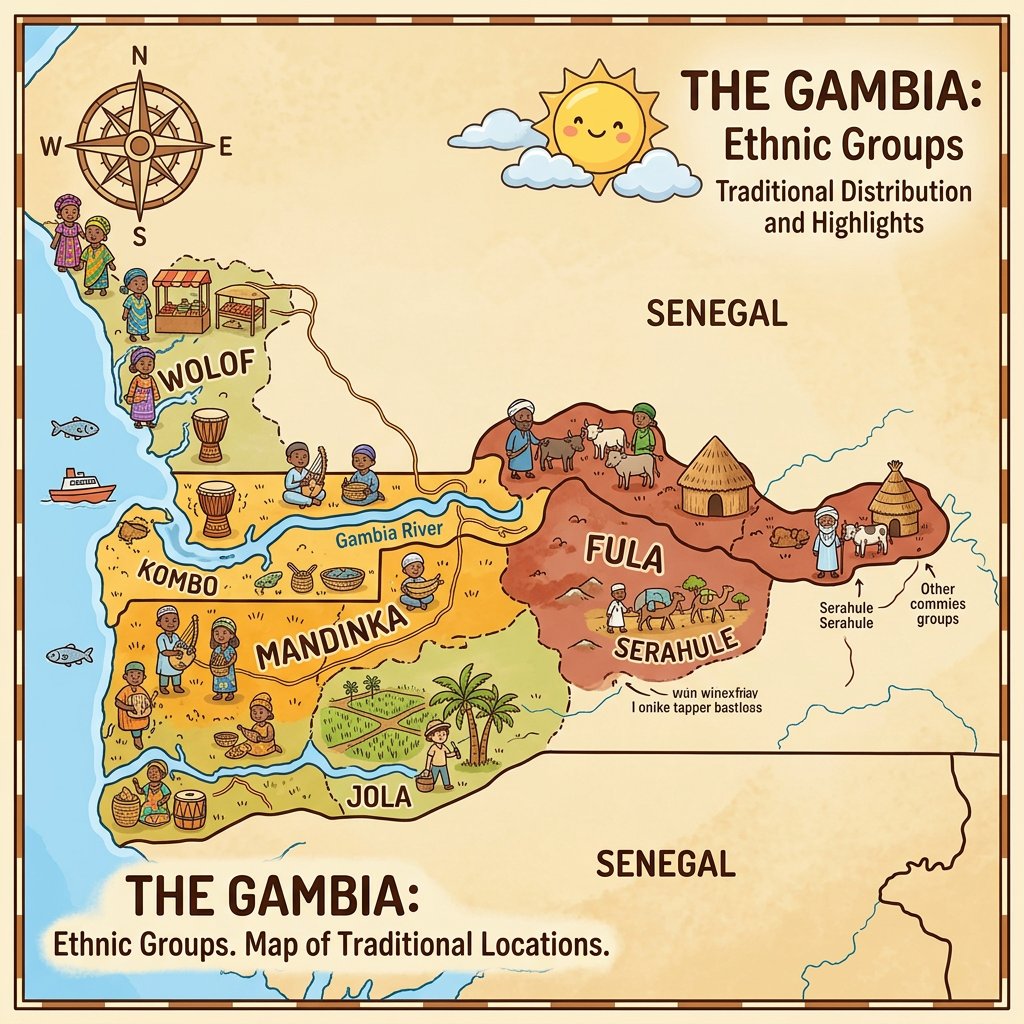
Ethnic Groups
- Diolas (Jolas): 32%
- Mandingues (Mandinka): 28%
- Peuls (Fulas): 18%
- Wolofs: 10%
- Soninkés: 7%
- Other African minorities: 4%
- Non-Africans: 1%
Religions
- Islam: about 90% of the population
- Christianity: 9%
- Traditional African beliefs: 1%
Gambia is a multiethnic and multilingual country, where different communities coexist harmoniously. Islam constitutes the cultural and spiritual foundation of the country, influencing social life, traditions, and institutions.
FAQ: Gambia map
A Gambia map highlights the narrow strip of territory along the river, the Atlantic to the west, and the main routes to the border posts.
A Gambia map showing bridges, ferries, and main roads allows anticipating actual speeds, waiting times at crossings, and possible detours.
The Gambia map, combined with climate zones, suggests aiming for the dry season (Nov.–May) for more passable roads and fewer showers.
On a Gambia map, spot Banjul/Serekunda, Abuko, River Gambia National Park, Kunta Kinteh Island, and the beaches of Kololi/Kotu.
