
What you need to know about Senegal ?
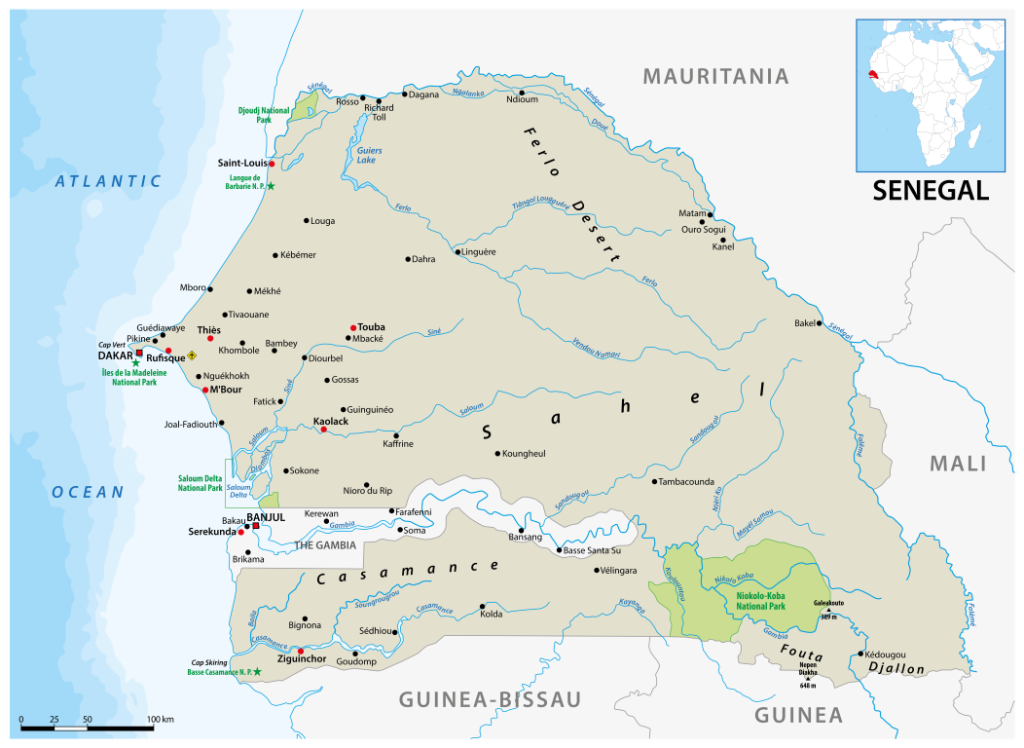
Senegal is a country located in West Africa, on the Atlantic coast of the continent. It shares its borders with Mauritania to the north, Mali to the east, Guinea and Guinea-Bissau to the south, and it encloses Gambia over more than 300 kilometers.
The Senegalese state is a constitutional republic with a presidential system, recognized for its political stability and democratic tradition in West Africa.
A coastal West African country, Senegal is organized around Dakar and the great rivers (Senegal, Gambia). The map helps plan a logical itinerary between the coast, Saint-Louis, the Sine-Saloum, and Casamance, taking seasons and distances into account. Aim for the dry season for more passable roads and more bearable heat.
Its capital, Dakar, is also the largest urban area in the country and its main economic, political, and cultural center.
The Senegalese territory covers an area of 196,722 km² and is home to approximately 17.9 million inhabitants (2024 estimate).
Senegal ranks 61st worldwide by population and 88th by area.
The country’s international telephone code is +221 (or 00221).
| Element | Details |
|---|---|
| Official Name | Republic of Senegal |
| Capital | Dakar |
| Population | ~17–18 million inhabitants, strong urbanization on the Cape Verde peninsula |
| Area | ~196,700 km² |
| Relief & Hydrography | Coastal plain, interior savannas, Senegal and Gambia rivers, Sine-Saloum delta |
| Climate | Tropical with dry season (Nov–May) and rainy season (Jun–Oct); coastal trade winds |
| Language | French (official); Wolof widely used, other national languages |
| Currency | CFA Franc (XOF) |
| Major Cities | Dakar, Thiès, Saint-Louis, Kaolack, Ziguinchor |
| Economy | Services, agriculture (peanut), fishing, phosphates, tourism |
| Points of Interest | Gorée Island, Pink Lake, Saint-Louis, Casamance, parks and reserves (Djoudj) |
| Access | AIBD Airport (DSS), improving road network, internal road and air connections |
| Advice | Plan for the rainy season, protect against heat/UV, arrange transfers to Casamance |
Senegal’s neighboring countries
Senegal’s neighboring countries are Mauritania, Mali, Guinea, Guinea-Bissau, and Gambia. These countries border it respectively to the North, East, South, Southwest, and West. Senegal also faces the Atlantic Ocean on its western coastline.

The colors of Senegal
The flag of Senegal is a three-color flag arranged in vertical stripes. From left to right: green, yellow, and red. In the center of the yellow stripe is a green five-pointed star.

- The star represents the country’s openness to the 5 continents; according to some sources, it could indicate the spiritual values of the people
- The red color symbolizes the blood and sacrifice of the people
- The yellow color symbolizes wealth and the fruit of labor
- The green color represents the Prophet’s flag but also hope and fertility.
The best places to visit in Senegal

Dakar
Capital and economic heart of the country, Dakar stretches from Cap-Vert to the plains of the East, combining modernity and African traditions.
A port city open to the Atlantic, it has a major commercial port and lively markets, notably that of Soumbédioune, famous for its seafood and crafts.
Dakar also charms with its cultural diversity, illustrated by the Museum of Black Civilizations, the Mosque of Divinity, and the African Renaissance Monument, a symbol of a modern Senegal proud of its heritage.
Saint-Louis
Located in the north of the country, Saint-Louis is a former colonial capital listed as a UNESCO World Heritage site.
It is crossed by the Senegal River, spanned by the famous Faidherbe Bridge, built at the end of the 19th century.
Its old town, with lime-washed facades, quiet streets, and preserved colonial architecture, offers a unique atmosphere.
Saint-Louis is also known for its international jazz festival, held every year in May, and for its proximity to the Djoudj National Bird Park, one of the largest ornithological sanctuaries in the world.
Ziguinchor
Capital of the Casamance region, Ziguinchor charms with its peaceful atmosphere and its colonial heritage still visible in its colorful buildings and old facades.
The city is an ideal starting point to discover the green Casamance, a tropical region crossed by many bolongs (sea arms) suitable for canoe rides.
Its Saint-Maur-des-Fossés market and its lively neighborhoods reflect a vibrant and mixed local culture.
Saly
Located on the Petite-Côte, an hour from Dakar, Saly is the main seaside resort of Senegal.
Famous for its golden beaches, its modern resorts, and its water activities, it attracts both travelers seeking relaxation and sports and golf enthusiasts.
It is a must-visit place to enjoy the African sun, lively evenings, and the warmth of Senegalese hospitality.
Touba
Holy city and spiritual center of the country, Touba is the heart of mouridism, one of the main religious brotherhoods in Senegal.
The Great Mosque of Touba, with its 87-meter minaret, is an architectural gem and a major pilgrimage site.
Every year, millions of faithful gather there during the Grand Magal of Touba, a major religious and cultural celebration of the country.
Financial Map of Senegal
The Senegalese economy is one of the most dynamic in West Africa, driven by the diversification of its sectors and significant public investments in infrastructure.
It mainly relies on the primary sector, dominated by fishing, agriculture (peanut, millet, rice, cotton, tropical fruits) and livestock farming, which constitute the main source of income for the rural population.
The industrial sector is based on mining extraction (phosphates, zircon, gold) and, recently, on the exploitation of natural gas and oil deposits off the coast. These resources are expected, in the medium term, to strengthen growth and reduce external dependence.
Tourism also represents an important economic pillar, notably thanks to the seaside resorts of the Petite-Côte (Saly, Somone), Casamance, and the cultural richness of Dakar and Saint-Louis.
Despite these assets, the country remains dependent on international aid and foreign investments to support its development projects and reduce inequalities.
Key economic data (2024-2025 estimates)
- Official currency: CFA franc (XOF)
- Nominal GDP: 31.5 billion USD
- GDP at purchasing power parity (PPP): 72 billion USD
- Annual GDP growth: approximately 7.2%
- GDP per capita (PPP): 2,600 USD
- Inflation rate: 3.6%
- Human Development Index (HDI): 0.494
- Unemployment rate: approximately 15.7%
Thanks to the implementation of the Emerging Senegal Plan (PSE), the country aims to transform its economy towards inclusive and sustainable growth, based on energy, modern agriculture, industry, and digital services.
Climate map of Senegal
Senegal has a divergent climate, meaning that in the North there is a desert climate and in the South a tropical climate. These climates differentiate only two seasons. The first is the dry season which occurs between June and October. This season experiences continental breezes from the trade winds with mild temperatures.
The second season is the wet season occurring annually between June and October, considered the country’s winter with fairly high temperatures and abundant rainfall due to the monsoon. The western part of the country shows cold temperatures year-round. On the other hand, the eastern part of the country shows fairly warm temperatures. The Senegalese territory can be subdivided into 5 climatic zones:
- The Sahelian zone starts at Rosso and ends at Matam.
- The Sahelo-Sudanese zone begins at Matam and ends at Fatick
- The Sudanese zone starts from Fatick and ends at Upper Casamance
- The Sudanese-Guinean zone: starts from Upper Casamance and ends at Kolda
- The Guinean zone ends at Casamance.
Demographic, demolinguistic and administrative map of Senegal

Demography of Senegal
The population of Senegal is estimated at about 17.9 million inhabitants in 2024, with a demographic growth rate of 2.4% per year.
The birth rate reaches about 32.9 ‰, while the mortality rate is 7.9 ‰.
The fertility rate is 4.2 children per woman, reflecting a high demographic dynamic.
The life expectancy at birth is about 67 years, and the median age of the population is around 19 years, highlighting the youthfulness of the country.
The sex ratio is 94 men per 100 women, and the net migration rate is slightly negative (-1.4%), due to departures to neighboring countries and Europe.
Administrative divisions of Senegal
The Senegalese territory is divided into 14 regions, which are themselves subdivided into 45 departments, then into arrondissements and communes.
The 14 regions of Senegal
- Dakar
- Diourbel
- Fatick
- Kaffrine
- Kaolack
- Kédougou
- Kolda
- Louga
- Matam
- Saint-Louis
- Sédhiou
- Tambacounda
- Thiès
- Ziguinchor
Each region has a governor appointed by the State and a regional capital that concentrates local administrative and economic activity.
Demolinguistic data
The official language of Senegal is French, used in administration, education, and media.
However, the country is linguistically very diverse, with more than twenty recognized national languages, mostly belonging to the Niger-Congo family.
The main spoken languages are:
- Wolof (dominant lingua franca, understood by more than 80% of the population)
- Peul (or Pulaar)
- Sérère
- Diola
- Malinké
- Soninké
Ethnically, the Senegalese population is mainly composed of:
- Wolofs, Lébous, and Sérères (in the western and central regions of the country)
- Peuls, Toucouleurs, and Sarakolés (in the north and east)
- Forest groups: Diolas, Balantes, Mandjaques, Mancagnes, Baïnouks, Karoninkas, and Pepels, mainly present in Casamance.
Wolof serves as the common language in most daily exchanges, while local languages maintain a strong cultural identity within the regions.
FAQ: Senegal map
Choose a Senegal Map detailing road networks, river crossings, and natural areas (Sine-Saloum, Djoudj) to calibrate travel times.
Yes, a Senegal Map associated with climatic zones helps plan trips by avoiding fragile tracks during the rains.
A Senegal Map with a southern focus (Ziguinchor, Cap Skirring) is useful to locate bridges, ferries, and route alternatives.
It is better to have an offline Senegal Map and/or GPX: signage is uneven off main roads and network coverage varies.
