
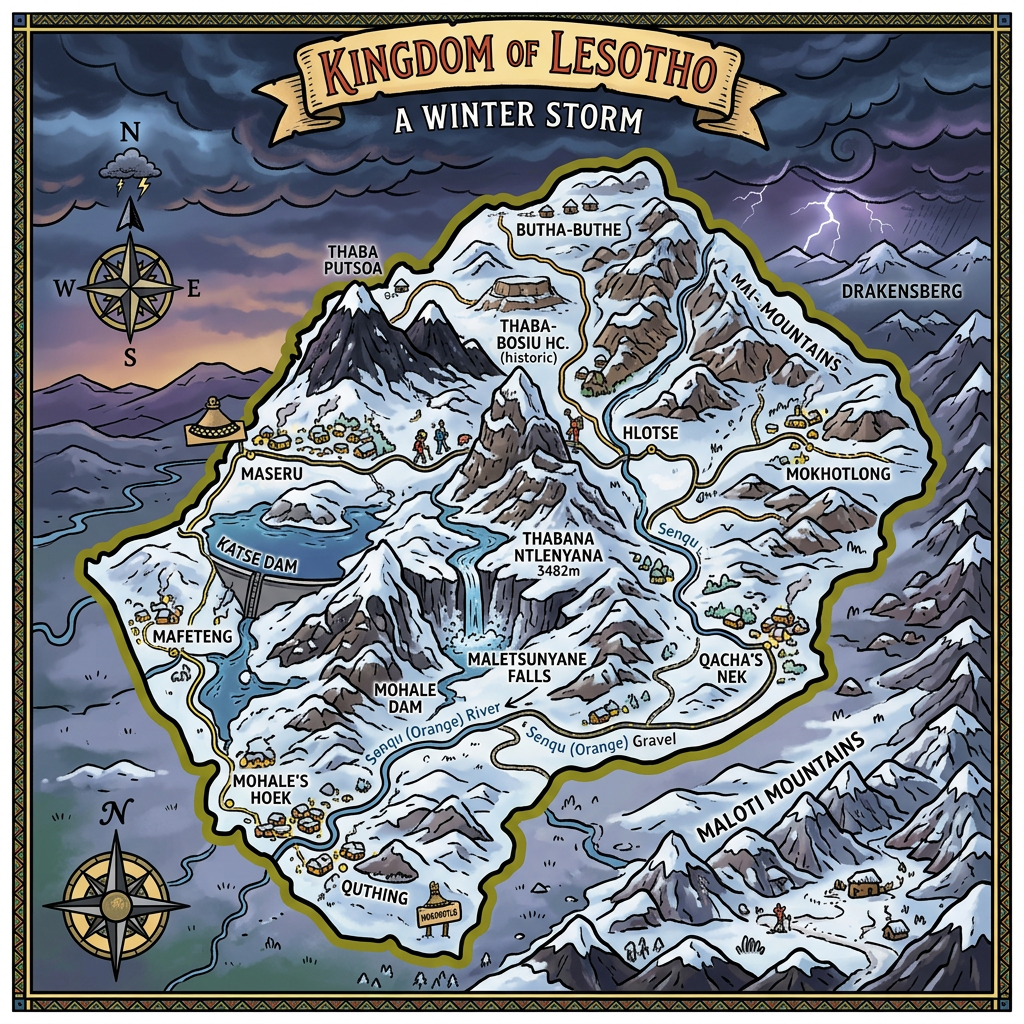
Nestled in the heart of South Africa, Lesotho intrigues with its uniqueness. This small landlocked country fascinates as much for its rugged mountains as for its singular history. Discovering Lesotho on a map is to dive into a geography full of relief, where every river, plateau, or valley tells a piece of adventure. Exploring physical, political, and thematic maps proves particularly valuable for better understanding the secrets of this unique territory.
Geography of Lesotho: What Does the Map Show?
By taking a close look at a map of Lesotho, one immediately notices the omnipresence of mountains. The country even holds the nickname of kingdom in the sky. The physical map quickly highlights the uniqueness of the terrain, characterized by the glaring absence of plains.
The high altitude strongly influences the local climate. Unlike many territories in the region, Lesotho offers a mountainous environment almost everywhere. This atypical configuration is notably explained by the Drakensberg mountain range that dominates the eastern border. As one observes the geography on the map, it becomes clear that Lesotho is unlike any other country in southern Africa.

The map of Lesotho reveals a unique country, entirely landlocked within South Africa. Its mountainous terrain, dominated by the Maloti Mountains, earned it the nickname “Kingdom in the Sky.” The capital Maseru and inhabited areas are mainly concentrated in the valleys, contrasting with the high mountains and plateaus of the rest of the territory.
Table – Lesotho: key information
| Element | Key Information |
|---|---|
| Total Area | 30,355 km² |
| Capital | Maseru |
| Neighboring Country | South Africa (entirely landlocked) |
| Estimated Population | ~2.3 million inhabitants (2025) |
| Population Density | About 75 inhabitants/km² |
| Relief | Mountainous country, nicknamed the “Kingdom in the Sky” |
| Average Altitude | 1,400 m (all territories above 1,000 m) |
| Official Languages | Sesotho, English |
| Climate | Temperate highland, cold winters and mild summers |
| Economic Resources | Agriculture, livestock, textiles, remittances, water |
The Landlocked country, a reality visible on all maps
Lesotho has a rare characteristic: it is entirely surrounded by a single other state, South Africa. This situation of a landlocked country is very clear when viewed on a political map. It is impossible to find any maritime coasts or borders with another African state.
Being landlocked profoundly shapes economic exchanges, population movements, and national identity. Traveling to or from Lesotho necessarily passes through South Africa, making this peculiarity omnipresent in daily life. On road or railway maps, all major routes converge towards the South African network, reinforcing this unique geographical dependence.

Additional points on the map of Lesotho
- Lesotho is the only country in the world entirely located above 1,000 meters in altitude.
- Its complete landlocked position within South Africa makes it a unique case on maps of Africa.
- The Maloti mountain region is one of the highlights of the relief shown on the map.
- The country is an important water reserve for South Africa thanks to the Lesotho Highlands Water Project.
- Its demographic map shows a population concentrated in the Caledon valley and around Maseru.
Mountainous relief through the physical map
A physical map of Lesotho illustrates the rugged nature of the territory, with altitudes mostly ranging between 1400 and 3500 meters. Some peaks, such as the Thabana Ntlenyana, the highest point in southern Africa, even approach 3482 meters.
This topography influences not only the climate but also the distribution of villages and towns. Here, there are few large traditional urban centers: mostly scattered settlements are found, often nestled in valleys or on accessible plateaus. Any exit to the outside requires crossing passes or rivers, which the map makes perfectly visible.
Political and administrative maps: Lesotho, its cities and organization
To understand the social and administrative distribution of Lesotho, nothing beats a political or administrative map. These representations highlight the main internal divisions as well as the location of urbanized areas.

Each district bears its own cultural imprint, visible not only on the map but also during direct immersion in these rural and urban regions. Maseru, the vibrant capital, naturally holds a prominent place on all maps related to Lesotho.
Maseru, the capital at the heart of the country
On any political map of Lesotho, Maseru stands out. Located in the west, near the South African border, this city concentrates administrations, businesses, and major infrastructures. It is the main crossroads of the country, attracting residents and visitors from surrounding districts.
Maseru also plays a driving role in the local economy, benefiting from its proximity to Bloemfontein (in South Africa). Its urban growth contrasts sharply with that of the rest of the country, which is much more rural and fragmented. A simple observation of the map allows one to see this precarious balance between modernity and rural traditions.
Other towns and points of interest visible on the map
Besides Maseru, a few names frequently appear: Teyateyaneng, Mafeteng, Mohale’s Hoek, or Quthing occupy certain strategic places, sometimes administrative, sometimes commercial. On the maps, several road axes connect these secondary hubs, outlining the essential network for Lesotho’s economic life.
Many small localities also appear on detailed maps. Their location often reflects the need for access to water, arable land, or certain major crossing points. Traveling through these various points on a map sometimes transforms the classic vision of a country crossed only by rocky massifs into a dynamic mosaic where life bubbles.
National symbol on the map: the flag and visual identity of Lesotho
A detail sometimes catches the attention of cartography enthusiasts: the appearance of the flag on certain official maps. Often, it appears near the box presenting the country, or to distinguish the national capital. The flag, composed of blue, white, and green, proudly displays a traditional shield called “mokorotlo.”

This graphic symbol evokes the protection and unity of the Basotho people. Finding it on the map reinforces the sense of belonging and constantly reminds of the identity pride of a often little-known country. The map, a tool for orientation, becomes a vector of culture as much as an informative document.
- Physical map: highlights the mountainous relief and hydrography of Lesotho.
- Political map: specifies territorial boundaries, the status of landlocked country and lists major cities such as Maseru.
- Main cities: Maseru (capital), Teyateyaneng, Mafeteng, Mohale’s Hoek, Quthing.
- National flag: present on various official maps, a strong symbol of Basotho identity.
- Landlocked country: bordered only by South Africa, which greatly influences travel and exchanges.
The impact of geography on life and thematic maps
The mountainous geography of Lesotho logically conditions human and economic development. Several thematic maps thus address the issue of difficult roads, watersheds, or the dispersion of settlements.
Due to the relief, some villages remain difficult to access during the rainy season. This is clearly seen on road infrastructure maps, where few major routes connect distant hamlets. In winter, snow temporarily isolates certain communities located at high altitude, a phenomenon noticeable by cross-referencing different cartographic sources.
Water and rivers on the map of Lesotho
Hydrological maps reveal all the water wealth of the country. Several rivers and tributaries originate there, such as the famous Orange (or Senqu). Their course shapes both the landscape and social organization, offering irrigation, electricity, or recreation according to local needs.
The management of water resources is moreover a central issue for Lesotho, whose major part of energy comes from hydroelectric installations. On a detailed map, these reservoirs and dams often attract attention due to their regional impact, sometimes extending to neighboring South Africa.
Transport networks and challenges related to the relief
Building a road in Lesotho is almost a technical feat. Road maps show very few highways or continuous expressways. Because of the succession of peaks, steep slopes, and rapid descents, constructing modern infrastructures is costly and time-consuming.
Some ancient trails help compensate for this lack by connecting isolated rural areas. As for the railway network, it remains anecdotal, while the road remains preferred for daily transport as well as for export, still oriented towards South Africa. The specialized maps used to plan the networks necessarily take into account this very particular relief.
Observing Lesotho through different maps
Consulting a map of Lesotho offers a direct view of this unique country in southern Africa. Whether physical, political, or thematic, each representation reveals a distinct facet of the kingdom. Through reading these cartographic documents, one quickly perceives that geography influences absolutely everything, from climate to trade exchanges.
From the flag to the smallest mountain folds, Lesotho displays its diversity, its wealth but also its constraints. For those wishing to explore this astonishing country, the map remains an essential first step, revealing much more than simple outlines: an identity forged by nature, history, and the will of a mountain people.
FAQ – Lesotho map: 3 questions
Lesotho is completely landlocked within South Africa, making it a unique country due to its situation.
Because its entire territory is situated at more than 1,000 m altitude, with peaks exceeding 3,400 m.
The capital is Maseru, located near the border with South Africa, on the banks of the Caledon River.
