
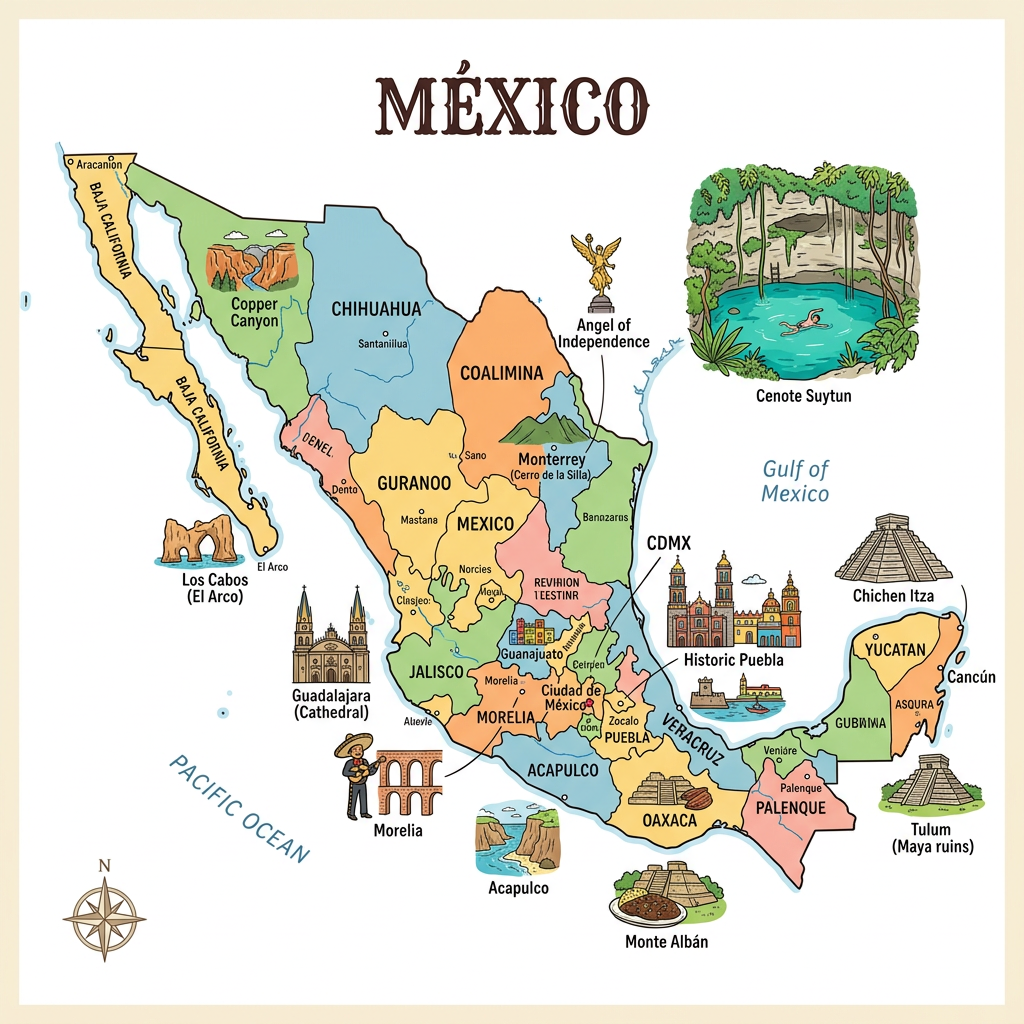
What you need to know about Mexico ?
The State of Mexico is also known as the United Mexican States. It is a federal constitutional presidential republic. The area of Mexican territory is currently 1,972,550 square kilometers, making it the 13th largest country in the world by area. Its population is 126,014,024, making it the 10th most populous Spanish-speaking nation in the world.
However, the territorial organization of Mexico includes states similar to those of the USA. Its largest city and capital is Mexico City, but it also has other equally popular cities such as Monterrey, Tijuana, Puebla, Toluca, Guadalajara, etc. The country’s currency is the Mexican peso and the telephone country code is 52.
Map of Mexico: key figures to read on the map
| Indicator | Key Figure | Fun & Useful Reading |
|---|---|---|
| Total Area | 1,964,375 km² | 4× France |
| World Ranking | 14th largest country | Highly varied geography |
| North ↔ South Length | ≈ 3,000 km | Very diverse climates |
| East ↔ West Width | ≈ 1,900 km | Two maritime fronts |
| Number of States | 32 | Federal organization |
| Capital | Mexico City (CDMX) | Political & economic heart |
| Total Population | ≈ 129 million | 10th most populous country |
| Average Density | ≈ 66 inhabitants/km² | Strong regional disparities |
| Total Coastline | ≈ 9,300 km | Beaches on 2 oceans |
| Bordering Oceans | 2 | Pacific & Atlantic |
| Highest Point | Pico de Orizaba – 5,636 m | Volcano visible on relief map |
| Average Altitude | ≈ 1,100 m | High central plateaus |
| Time Zones | 4 | Very large country |
| Dominant Climate | Tropical & desert | Strongly depends on the region |
Where is Mexico located on the world map?

On the world map, Mexico is located on the American continent. It is a country in North America, precisely situated in the lower half of it. Three countries border Mexico: the United States with a 3,141 km border, Guatemala, and Belize with borders totaling 1,152 km. Mexico borders the North Pacific to the west and the Gulf of Mexico to the east.
Tourist map – Meaningful distances
| Route | Distance | Estimated Time |
|---|---|---|
| Mexico City → Cancún | ≈ 1,600 km | 2h30 by plane |
| Mexico City → Guadalajara | ≈ 550 km | 6h by road |
| Cancún → Tulum | ≈ 130 km | 2h by road |
| Oaxaca → San Cristóbal | ≈ 600 km | 10h by road |
Colors of Mexico and their meanings
The flag of Mexico is a rectangular flag composed of three vertical bands of equal size. From left to right, green, white, and red. In the center of the white band, the national coat of arms is depicted, representing a golden eagle grasping a serpent and a prickly pear cactus.
This flag is the national symbol of the republican independence movement. The white color symbolizes faith and the purity of Christian beliefs, the red color symbolizes the Spaniards who helped the country during the war, but it can also signify the blood of martyrs. The green color represents the movement for independence. Finally, the national coat of arms represents the country’s heritage.

What are the best cities in Mexico?

Cancun
Famous especially for the turquoise color of its sea, the city of Cancun attracts many tourists who come to enjoy its pearly white sandy beaches. This destination combines an idyllic setting and a festive atmosphere.
Visitors also appreciate Cancun for its seaside resorts, charming hotels, spas, and restaurants offering South American cuisine rich in seafood. Behind the waterfront stand modern residences with white facades that give the city architectural uniformity.
Food lovers can savor local specialties thanks to numerous inexpensive restaurants, street vendors, or food stands. Cancun is also the ideal starting point to explore the remains of the Mayan civilization, notably at Cobá or Chichén Itzá, generally accessible via day trips.
Mexico City
The Mexican capital is a huge and modern metropolis, equipped with an efficient metro and anti-pollution systems. Mexico City captivates with its energy and diversity: lively and cosmopolitan neighborhoods coexist with quieter and more traditional areas.
You will find impressive colonial architecture, large museums such as the National Museum of Anthropology, as well as a multitude of local restaurants and markets. During the day, explore its parks, squares, and historic districts; in the evening, let yourself be carried away by its vibrant atmosphere in its bars, pubs, and nightclubs.
Cabo San Lucas
Located on the Baja California peninsula, Cabo San Lucas is a prime spot for relaxation and entertainment. Known for its beach parties at Land’s End, it offers a wide range of resorts, fine dining restaurants, and lively clubs.
Cabo San Lucas is also a city of adventures: boat trips to observe dolphins, horseback rides in the desert, scuba diving, snorkeling, or jet skiing in crystal-clear waters. A perfect setting for travelers seeking thrills and unique marine landscapes.
Guadalajara
The second largest city in Mexico, Guadalajara is the birthplace of two worldwide symbols of the country: the mariachi and tequila. Its historic center is full of architectural treasures such as the Guadalajara Cathedral and the Degollado Theater. You can also visit the Tlaquepaque district, known for its crafts and markets.
Mérida
Capital of the Yucatán Peninsula, Mérida is an elegant colonial city, nicknamed the white city due to its bright facades. It is ideal for discovering Maya culture with its museums, colorful markets, and proximity to major archaeological sites like Uxmal. Mérida is also renowned for its warm atmosphere and traditional Yucatecan cuisine.
Population of Mexico
Population of Mexico (2025)
- Estimated total population: about 131.95 million inhabitants, or 1.6% of the world population.
- World ranking: 11th most populous country.
- Average density: about 68 inhabitants/km².
- Median age: 29.6 years.
Demographic rates (2024–2025)
- Annual growth rate: about 0.7%.
- Birth rate: about 12.1 births per 1,000 inhabitants.
- Death rate: about 6.2 deaths per 1,000 inhabitants.
- Total fertility: about 1.6 children per woman.
- Life expectancy:
- Total: 74.6 years
- Men: 71.6 years
- Women: 77.7 years
Composition and urbanization
- Urban population: about 76% in urban areas.
- Total sex ratio: about 0.96 men per 1 woman.
Languages and ethnicities
Ethnic origins: majority Mestizos, followed by populations of Amerindian and European origin, with an Afro-Mexican minority of about 2%.
Official language: Spanish (spoken by 99.4% of the population).
Indigenous languages: 68 recognized languages, mostly spoken by about 6.1% of Mexicans, including Nahuatl, Yucatec Maya, Tzeltal, and Totonac.
Economic information about Mexico

The Mexican economy is considered a developing economy. It is primarily based on a market economy and has recently reached 16th place in terms of nominal GDP and 11th in purchasing power parity.
The Mexican government constantly works to improve the foundations of the Mexican macroeconomy. This has allowed the country to overcome the Covid-19 health crisis and maintain positive economic growth rates. The only issue in this Mexican economy is the gap between the urban and rural populations:
Here are some economic data concerning Mexico
- Official currency: Mexican peso
- GDP in nominal parity: 2.274 trillion USD
- GDP in purchasing power parity: 3.616 trillion USD
- Annual GDP growth rate
- Nominal: 2.2%
- Purchasing power parity: 3.3%
- GDP per capita in nominal parity: 10,118 USD
- GDP per capita in purchasing power parity: 20,868 USD
- HDI: 0.779
- Unemployment rate as % of active population: 5.3%
- Population below poverty line: 41.9%
- Main industries: agri-food, tobacco, chemical industry, mining, clothing and textiles, automobile manufacturing, tourism
- Imports: 467.2 billion USD
- Exports: 491.6 billion USD
Climate information on Mexico

Since the Mexican territory is very vast, its climate varies according to the regions. Indeed, on the west coasts and the highlands in the center-north, the climate resembles an arid-dry climate. In contrast, the mountainous areas and southern plateaus experience a humid tropical climate.
Temperatures gradually increase from north to south, with the latter displaying a tropical climate. Elevation also plays a major role, as cities at high altitude (such as the capital) are cooler. The northern zones mainly experience a cold winter when a cold breeze comes from the USA, mainly affecting the center-north area.
Average coastal zone
This zone includes the cities of Tijuana, Rosarito, and Ensenada. The climate is moderately warm towards the eastern coasts. Year-round summer temperatures hover around 24 to 25 °C and in winter drop to as low as 19°C. Sunshine throughout the year is more or less constant, and rains generally occur between November and March: 200 to 250 mm of annual precipitation.
Sonora Desert
This is the westernmost part of the Mexican desert. Temperatures are hot in summer, between 32 and 36°C, and less hot in winter, between 22 and 25 °C. This zone includes the Gulf of California, Mexicali, and La Paz.
Cool lands or tierras frías
They are located in the very center of Mexico and include the capital, Mexico City. This area experiences dry and sunny winter periods with cold nights; daytime temperatures are 21 to 23°C and nighttime between 6 and 7°C. Annual rainfall ranges from 160 to 710 mm per year.
Administrative Subdivisions of Mexico
In brief, Mexico is a federal state and is divided into 32 federal entities which are 31 sovereign and autonomous states and Mexico City, which is divided into 16 boroughs or territorial demarcations. The federal states or entities are then divided into municipalities (2,454 municipalities).
Here are the 32 states of Mexico:
- Aguascalientes
- Baja California
- Baja California Sur
- Campeche
- Coahuila
- Colima
- Chiapas
- Chihuahua
- Durango
- Mexico City
- Guanajuato
- Guerrero
- Hidalgo
- Jalisco
- Mexico
- Michoacan
- Morelos
- Nayarit
- Nuevo León
- Oaxaca
- Puebla
- Queretaro
- Quintana Roo
- San Luis Potosi
- Sinaloa
- Sonora
- Tabasco
- Tamaulipas
- Tlaxcala
- Veracruz
- Yucatán
- Zacatecas
- Here are the 16 boroughs of Mexico City
- Álvaro Obregón
- Azcapotzalco
- Benito Juárez
- Coyoacán
- Cuajimalpa
- Cuauhtémoc
- Gustavo A. Madero
- Iztacalco
- Iztapalapa
- La Magdalena Contreras
- Miguel Hidalgo
- Milpa Alta
- Tláhuac
- Tlalpan
- Venustiano Carranza
- Xochimilco
Mexico’s Linguistic Demographic Data
Population composition
About 90% of the Mexican population speaks Spanish, representing 36% of the world’s Spanish speakers. The Mexican population is composed of 65% mestizos (mixed race in English) who are of mixed Amerindian and Hispanic descent. There are also Amerindians and whites who represent 20% and 15% respectively. Mexico also has more than 9.5 million indigenous people who represent 9.2% of the total population.
Languages and dialects
Besides English and Spanish languages, the Mexican people also speak Amerindian languages considered indigenous languages. There are about 295 such languages in Mexico, but the most used number 60. Here are the 11 most dominant language families in the country:
- Algic
- Maya
- Cochimi-Yumana
- Yuto-Nahua
- Tarascan
- Mixe-Zoque
- Seri
- Chontal of Oaxaca
- Otomanguean
- Huave
- Totonac-Tepehua
Mexico shares its land borders with the United States to the north, and with Guatemala and Belize to the south. For an overview of the terrain and major routes of the continent, complete your orientation with the map of America.
FAQ – Mexico map
Mexico is located in North America, between the United States and Central America, with coasts on the Pacific and the Gulf of Mexico.
The capital is Mexico City (Ciudad de México), a megalopolis of over 20 million inhabitants.
A varied territory ranging from the deserts of the north to the jungles of the south, with high plateaus and a rich maritime frontage.
