
What you need to know about Uruguay ?
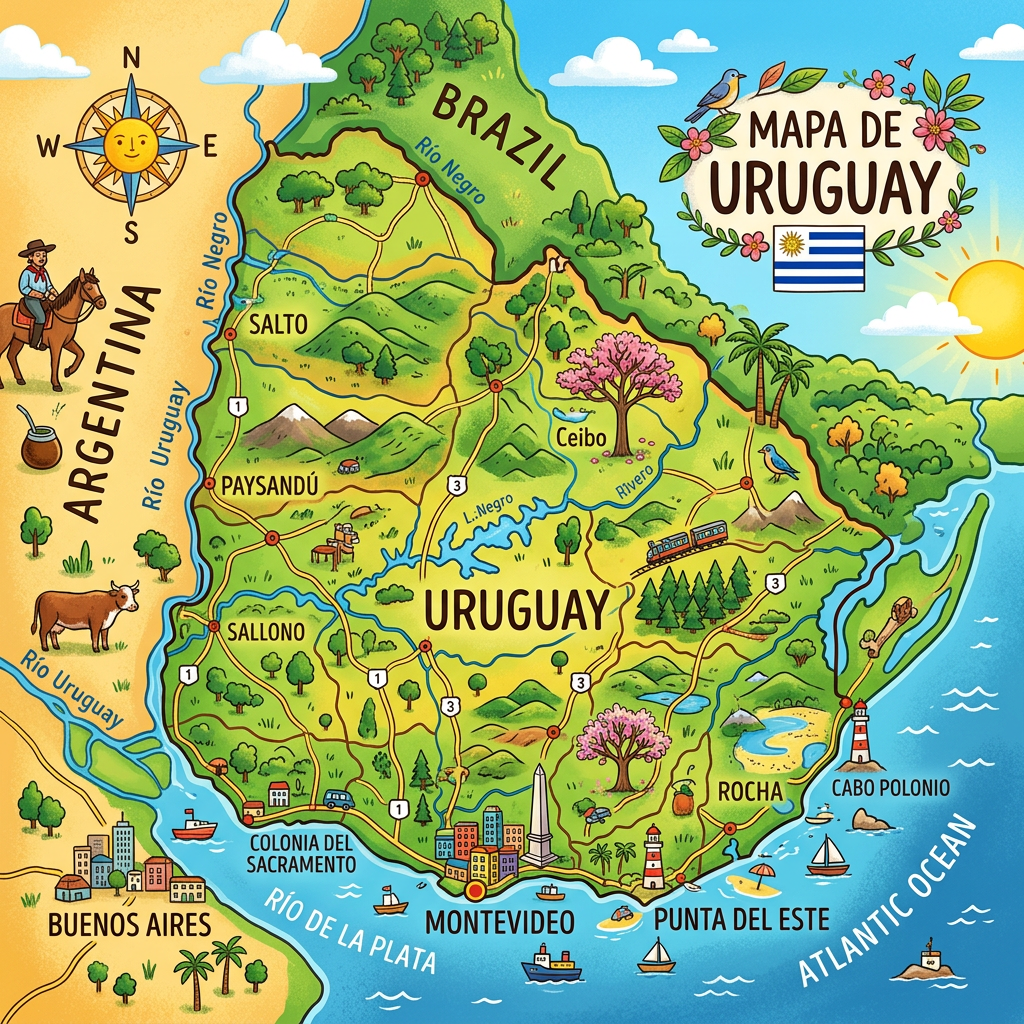
Officially called the Eastern Republic of Uruguay, this country is located in South America, precisely on the southern coast. It is situated south of Brazil and east of Argentina. Its area extends to 176,000 km2 and it is the second smallest country in South America.
Uruguay is a country located in South America, bordered by Brazil and Argentina. Its population is estimated at about 3.5 million inhabitants in 2025, with nearly 1.4 million people living in the capital, Montevideo. A large share of the population is concentrated in the southern part of the country, especially in coastal and urban areas.
The official language is Spanish. The country is highly urbanized, with most of the population living in cities, particularly around Montevideo.
Countries bordering Uruguay
Uruguay borders Brazil to the north and Argentina to the south. The nation is located in the southeast of Latin America. Its 660 km coastline borders the Atlantic Ocean to the east.
The colors of Uruguay
The Uruguayan flag consists of 9 stripes alternating blue and white. The first and last colors are white. These 9 stripes represent the 9 departments that make up the country. In the western section is placed a design of the Sun of May depicted with 16 rays; it is a national Uruguayan emblem because according to their beliefs, the sun represents Inti, the sun god of Inca mythology.

Map of the best cities in Uruguay
La Paloma
It is indeed a small town located on the seafront, that is, the Atlantic Ocean. It is a seaside resort much appreciated by Uruguayans because it is a very beautiful place to enjoy sunbathing by the sea. The beaches are wonderful and the town is as relaxed as it is pleasant, and it is even possible to do water sports. The best beach to visit is Anaconda Beach; it is the perfect place for those who want to relax a bit and enjoy their vacation.
Carmelo
It is an excellent destination for tourists, and there are many old buildings to visit there, and even the town’s decor with its cobbled streets is magnificent. In Carmelo, it is also a wonderful place if you want to go to the beach, take boat rides, and even enjoy some activities like fishing or windsurfing and water sports.
Montevideo
Montevideo is the Administrative and economic capital of Uruguay; it is a city, but it also has a bay named Montevideo. The city was once built around a Spanish settlement called “Independence Square.” From there, you can go to the old town which is full of buildings dating from colonization, such as Salvo (an old palace), Teatro Solis (a theater). There is also an old port with a “Port Market,” where you will find several restaurants.
Financial map of Uruguay
Uruguay has a relatively open and stable economy within Latin America. Its economic freedom score is estimated at around 69–71 out of 100, placing it roughly between 35th and 40th globally, and among the highest-ranked countries in the Americas.
The country is often ranked among the top 5 most economically free countries in the Americas in regional assessments, thanks to its stable institutions and relatively business-friendly environment.
Uruguay’s economy is mainly based on services, agribusiness, and agricultural exports (beef, soybeans, dairy products, timber). A significant share of its exports goes to its main regional partners, especially Argentina and Brazil, which together absorb a large portion of its trade flows.
- Official currency: Uruguayan Peso
- Nominal GDP: approximately USD 77 billion
- Gross Domestic Product (PPP): approximately USD 92 billion
- Annual GDP growth: approximately 3.0%
- Inflation rate: approximately 5.9%
- Population living below the poverty line: approximately 9.2%
- Labour force: approximately 1.8 million people
- Unemployment rate: approximately 7.1%
- Exports of goods: approximately USD 11.2 billion
- Imports of goods: approximately USD 10.9 billion
- Public debt: approximately 58% of GDP
Uruguay climate map

Uruguay has a mild climate, with clear winter and summer seasons. Uruguay is located in a bio-realistic transition zone and thus hosts significant biodiversity, with regions that are both eco-provincial and eco-foundational. Grasslands are the predominant biome, covering more than 70% of the area, and include one of the regions with the best “abundance of grasses or fields”.
The inclusion of local forests amounts to about 4.8% of the territory. Environmental risks such as dry season, floods, rising temperatures, heat waves, and string storms increase Uruguay’s vulnerability to environmental changes.
By nature calm, the environment allows for very mild winters (from June to September), with normal temperatures between 10 and 16°C, and pleasant summers (from December to March) (between 21 and 28°C), cooler inland than on the seashores, where humidity is sometimes stifling. The austral summer, from November to April, is the best season to visit the entire country.
Uruguay demographic and administrative Map
Demographics
The population of Uruguay is estimated at around 3.5 million inhabitants in 2025. The annual population growth rate is low, at about 0.2%. The birth rate is approximately 11 per 1,000 inhabitants, while the death rate is close to 9 per 1,000 inhabitants.
Life expectancy at birth is among the highest in Latin America, at around 78.5 years, including 75.8 years for men and 81.2 years for women. The fertility rate is about 1.5 children per woman, and the infant mortality rate is approximately 7 per 1,000 live births.
Finally, the sex ratio slightly favors women, at about 95 men for every 100 women.
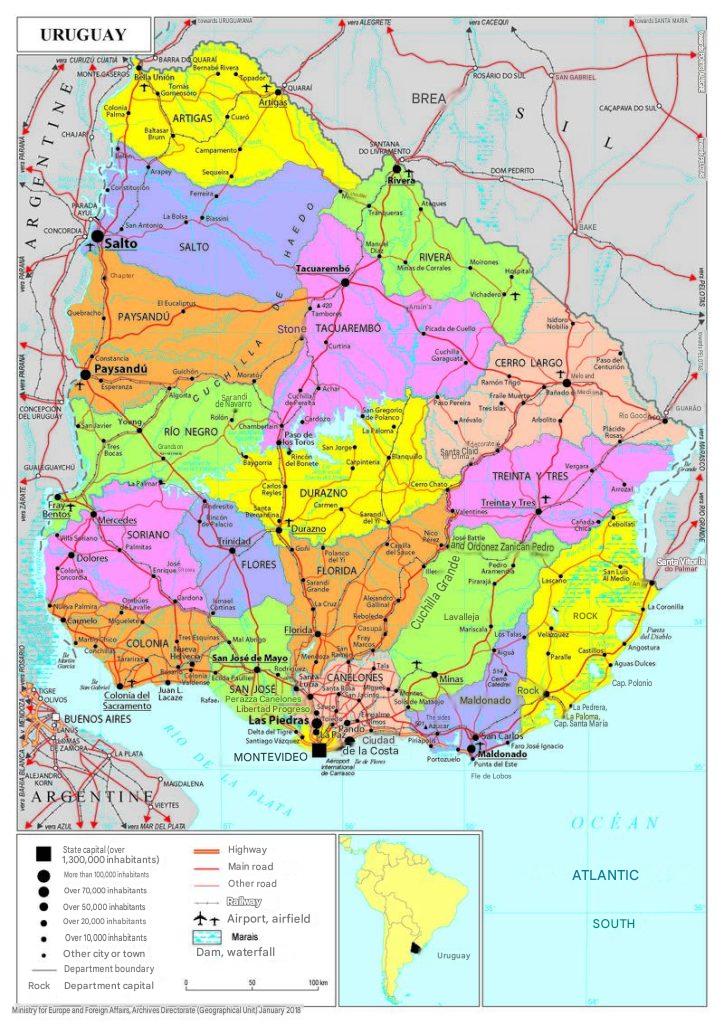
Administrative division
Uruguay is divided into 19 departments and each department is subdivided into a legislature called the Departmental Council. Then, the Uruguayan departments are subdivided into municipalities. Here are the 19 departments.
- Artigas
- Canelones
- Cerro Largo
- Colonia
- Durazno
- Flores
- Florida
- Lavalleja
- Maldonado
- Montevideo
- Paysandú
- Río Negro
- Rivera
- Rocha
- Salto
- San José
- Soriano
- Tacuarembó
- Treinta y Tres
Uruguay demolinguistic data
Uruguayans are composed of several racial groups: White Uruguayans or Europeos, descendants of European pioneers, making up 86% of the population, Mestizos (8%) or mixed-race, Mulattos (6%), or Mulatos, Blacks or Afro-Uruguayans or Afrouruguayos (2%), as well as two or three hundred Amerindians called Indios or Indígenas. For the public authority, Amerindians practically do not exist, with their number ranging between 300 and 1000.
Mestizos are descendants of Whites and Indians, while Mulattos are descendants of Whites and Blacks. Hypothetically, one could add the Zambos, descendants of Blacks and Indians. In any case, Mestizos, Mulattos, Zambos, and Indios constitute unfortunate minority groups within the Uruguayan population.
Notwithstanding the large number of dialects spoken in the country (about thirty), Uruguay remains exceptionally homogeneous etymologically, since more than 87.3% of the population communicates in Spanish as their mother tongue, which includes Uruguayans (whites), Afro-Uruguayans, Argentinians, Spaniards, Spanish-speaking Jews, Chileans, and detribalized (or acclimated) Amerindians.
Uruguay map FAQ
Uruguay is located in the southeastern part of South America. It is bordered by Brazil to the north, Argentina to the west, and the Atlantic Ocean to the south and east.
A map of Uruguay helps locate the country’s main cities, departments, rivers, and coastline. It also highlights population distribution and the country’s territorial organization.
A map is useful for understanding Uruguay’s geography and administrative structure. It also helps when planning a trip or studying the country’s demographic and economic characteristics.
