
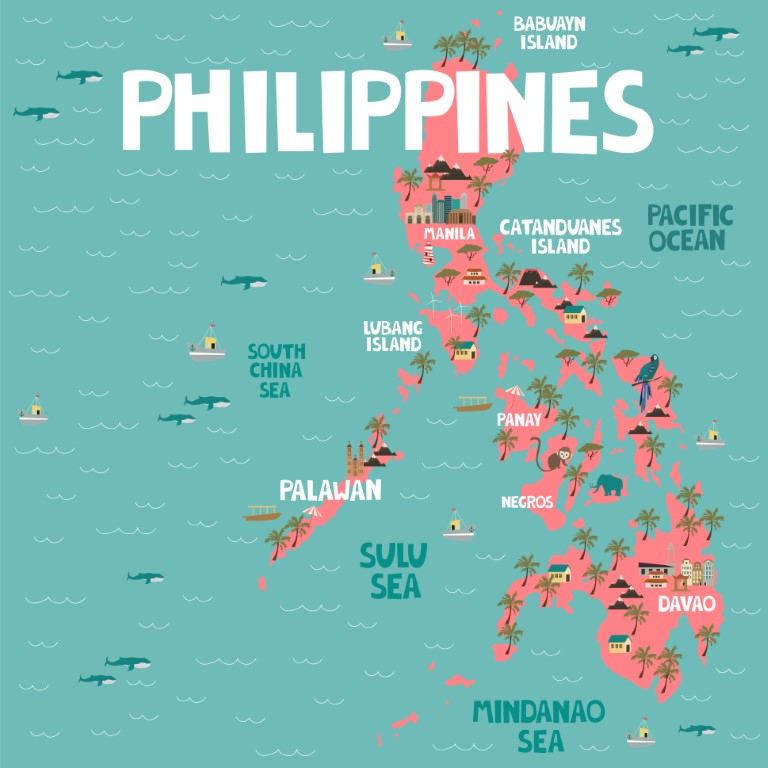
What you need to know about the Philippines ?
The Philippines, officially called the Republic of the Philippines, is an island country located in Southeast Asia. Geographically, the Philippine territory is an archipelago of 7,641 islands with mainly (90%) unoccupied land, the remaining 2,000 islands are populated.
The island with the largest area is Luzon, it is the northernmost Philippine territory and home to Manila, the largest metropolitan area and the capital of the country. The total area of the Philippines is 300,400 km2 and the Filipinos currently number 1,009,180,815 inhabitants. The country’s telephone code is 63, either 0063 or +63.
Which countries border the Philippines?
The Philippines are separated from Borneo to the northeast. The island of Luzon is also separated from Taiwan by 360 kilometers of sea to the south.
Population of the Philippines
Currently, the Philippine population stands at 110,364,364 inhabitants according to the latest United Nations data. This figure represents about 1.41% of the world population, placing the country 13th in terms of population density. Moreover, this density currently amounts to 952 inhabitants per km2 and just under half, or 47.5%, live in large cities. The Philippine population is young as the average age in the country is 25.7 years.
What are the colors of the country?

The Philippine flag is composed of three colors: red, blue, and white. The blue is arranged in a band above the red, and on the hoist side stands an equilateral white triangle. On the triangle is a yellow sun with 8 rays bordered by three 5-pointed stars.
- The blue color represents calm, sincerity, and frankness
- The white color signifies autonomy, balance, and friendship
- The red color represents patriotism and courage
- The stars and the golden sun represent the three main territories in the country.
What are the best cities to visit in the Philippines
Manila
The city of Manila is the most populated city in the country, which implies an increase in urban poverty, more traffic jams, and a higher crime rate than other cities. There are very few green spaces in Manila. However, it is pleasant to live there because of its inhabitants who are both welcoming and warm. The city has some historical architectures that can still be visited today. These monuments are scattered throughout the city, but the most interesting aspect is the daily routine of the capital’s residents.
Makati
Cradle of the Philippine economy and finance, the city of Makati is a modernized city that hosts many expatriates. It is actually a Europeanized city that welcomes Westerners, but this greatly influences its culture. In this city, one can see Filipino traditions combined with hints of modernity. It is also an industrial city with several foreign executives working in the country’s major firms. As a result, the city attracts many people and is also one of the most appreciated cities by Filipinos because of its European design.
Puerto Princesa
Once in Puerto Princesa, one realizes that the city is very popular with tourists. Flea markets, street vendors, and tourism operators working here and there can also be seen. Slums are also visible, indicating the stark social disparity to which Filipinos are subjected. Tourism is the only sector that sustains the city, both for informal vendors and for the tourism sector itself. This sector also contributes to business creation, which will be the government’s future project with the contribution of the United Nations.
Davao
It is the most spacious city in the Philippines. Famous for being the birthplace of the current leader of the country, Duterte, it is a city that tourists have always appreciated. The restaurants are very welcoming and offer delicious dishes reflecting the country’s colors. The climate is livable and the inhabitants friendly. The strong point of the city of Davao? It is the safest city in the country.
Where the cities are located on the map of the Philippines ?

Manila
On the map of the Philippines, the city of Manila is located in the western part of the island of Luzon. Geographical coordinates: 14° 35′ north, 120° 58′ east
Makati
Makati is a small village located in the southern section of the capital municipality. Geographical coordinates: 14° 33′ north, 121° 02′ east.
Puerto Princesa
The city of Palawan is a city located on the island of the same name which belongs to the Province of Palawan. Geographical coordinates: 9° 44′ 00″ north, 118° 44′ 00″ east.
Davao
On the map of the Philippines, the city of Davao is located in the southeastern section of the island of Mindanao. Geographical coordinates: 7° 04′ 05″ north, 125° 36′ 39″ east
Philippines climate map
Since the country is composed of several thousand islands, the climate is strongly influenced by the sea. This results in two particularly dominant seasons:
The first takes place from December to February: it is a cool and humid season strongly influenced by winds coming from the northeast.
The second is the hot and humid season which occurs between May and November: this season is marked by the influence of the monsoon coming from the southwest.
Between the two previous seasons unfolds the inter-season which precedes the arrival of the monsoon. This season takes place between March and May. During this time, temperatures reach their peak especially in the northern sectors and inside the large islands.
Luzon Island is subject to the influence of cool air coming from Asia. Consequently, nighttime temperatures range between 10 and 15°C. On the other hand, in the southern islands, temperatures remain constant throughout the year.
The eastern parts of the islands facing the Philippine Sea experience constant precipitation throughout the year. This is one of the characteristics of an equatorial climate. Winter in these regions is dry, summer is humid, but rains generally occur in the afternoon.
The northeast section of the archipelago shows an annual rainfall above 2,500 mm; in cases of heavy rains influenced by northern winds, precipitation reaches 4000 mm. The less rainy areas of the Philippines are located in the west and center because the zones influenced by the monsoons are the western areas.
Economic map of the Philippines
In terms of nominal GDP according to the IMF and the World Bank, the Philippine economy is the 32nd most performing in the world and the 13th most performing in Asia. The Philippines can therefore be considered an emerging country; moreover, it is the third in the Southeast Asia region. Additionally, its nominal GDP is slightly lower than that of Thailand or Indonesia.
The Philippine economy is based on the Primary sector, which is developing. This is why the country is called an NPI or (Newly Industrialized Country).
Trade exchanges with neighboring countries mainly include: high-tech, travel accessories, clothing, decorations, and jewelry. These exchanges are conducted with Japan, China, the United States, Singapore, South Korea, etc. As for forecasts, this economy will be the 5th most performing in Asia and the 16th in the world in over 30 years. Here are some economic indicators:
- Official currency: Philippine Peso
- Nominal GDP: 367 billion USD
- GDP at Purchasing Power Parity: 933 billion USD
- Annual GDP growth rate: 6.3%
- Nominal GDP per capita: 3,372 USD
- GDP per capita at PPP: 8,574 USD
- Unemployment rate: 8.7% of the active population
Administrative and demolinguistic data
Administrative subdivisions
The Philippine territories are divided into 4 distinct administrative levels.
- The first territorial subdivision in the Philippines is the region. There are 17 regions and one autonomous region: Bangsamoro in Mindanao.
- The second subdivision is the province. (81)
- The third is the component city or municipality
List of administrative regions of the Philippines:
Luzon Island Group
Ilocos Region (Region I)
- Ilocos Norte
- Ilocos Sur
- La Union
- Pangasinan
Cagayan Valley Region (Region II)
- Batanes
- Cagayan
- Isabela
- Nueva Vizcaya
- Quirino
Central Luzon Region (Region III)
- Aurora
- Bataan
- Bulacan
- Nueva Ecija
- Pampanga
- Tarlac
- Zambales
CALABARZON Region (Region IV-A)
- Batangas
- Cavite
- Laguna
- Quezon
- Rizal
MIMAROPA Region (Southwestern Tagalog Region, Region IV-B)
- Marinduque
- Occidental Mindoro
- Oriental Mindoro
- Palawan
- Romblon
Bicol Region (Region V)
- Albay
- Camarines Norte
- Camarines Sur
- Catanduanes
- Masbate
- Sorsogon
Cordillera Administrative Region (CAR)
- Abra
- Apayao
- Benguet
- Ifugao
- Kalinga
- Mountain Province
National Capital Region (NCR)
- Metro Manila
Visayas Island Group
Western Visayas Region (Region VI)
- Aklan
- Antique
- Capiz
- Guimaras
- Iloilo
- Negros Occidental
Central Visayas Region (Region VII)
- Bohol
- Cebu
- Negros Oriental
- Siquijor
Eastern Visayas Region (Region VIII)
- Biliran
- Eastern Samar
- Leyte
- Northern Samar
- Samar
- Southern Leyte
Mindanao Island Group
Zamboanga Peninsula Region (Region IX)
- Zamboanga del Norte
- Zamboanga del Sur
- Zamboanga Sibugay
Northern Mindanao Region (Region X)
- Bukidnon
- Camiguin
- Lanao del Norte
- Misamis Occidental
- Misamis Oriental
Davao Region – Region XI
- Compostela Valley
- North Davao
- Davao del Sur
- Davao Oriental
SOCCSKSARGEN Region (Region XII)
- Cotabato
- Sarangani
- South Cotabato
- Sultan Kudarat
Caraga Region (Region XIII)
- Agusan del Norte
- Agusan del Sur
- Dinagat Islands
- Surigao del Norte
- Surigao del Sur
Autonomous Region in Muslim Mindanao (ARMM)
- Basilan
- Lanao del Sur
- Maguindanao
- Sulu
- Tawi-Tawi
Demolinguistic data
Spanish was the official language used in the Philippines before Filipino. Currently, the official language is subdivided into 182 dialectal variants.
The 4 most used dialectal variants (9 million speakers) are:
- Tagalog
- Cebuano
- Ilocano
- Hiligaynon
The other less used variants (3 million speakers)
- Waray
- Bikol
- Kapampangan
- Pangasinan
- Maranao
- Tausug
- Maguindanao
- Chavacano
- Karay-a
- Surigaonon
FAQ – Philippines map: Geographic and demographic information
The Philippines is an archipelago located in Southeast Asia, in the western Pacific Ocean, between the South China Sea and the Philippine Sea. The country consists of more than 7,600 islands grouped into three main regions: Luzon, the Visayas, and Mindanao.
The Philippines has a population of over 115 million people, making it one of the most populous countries in Southeast Asia. Its population is relatively young, and demographic growth remains strong, especially in major urban areas.
The Philippines is known for its thousands of islands, mountain ranges, active volcanoes, and extensive coastlines with beaches and coral reefs. The country has a tropical climate but is frequently affected by typhoons and significant seismic activity.
