
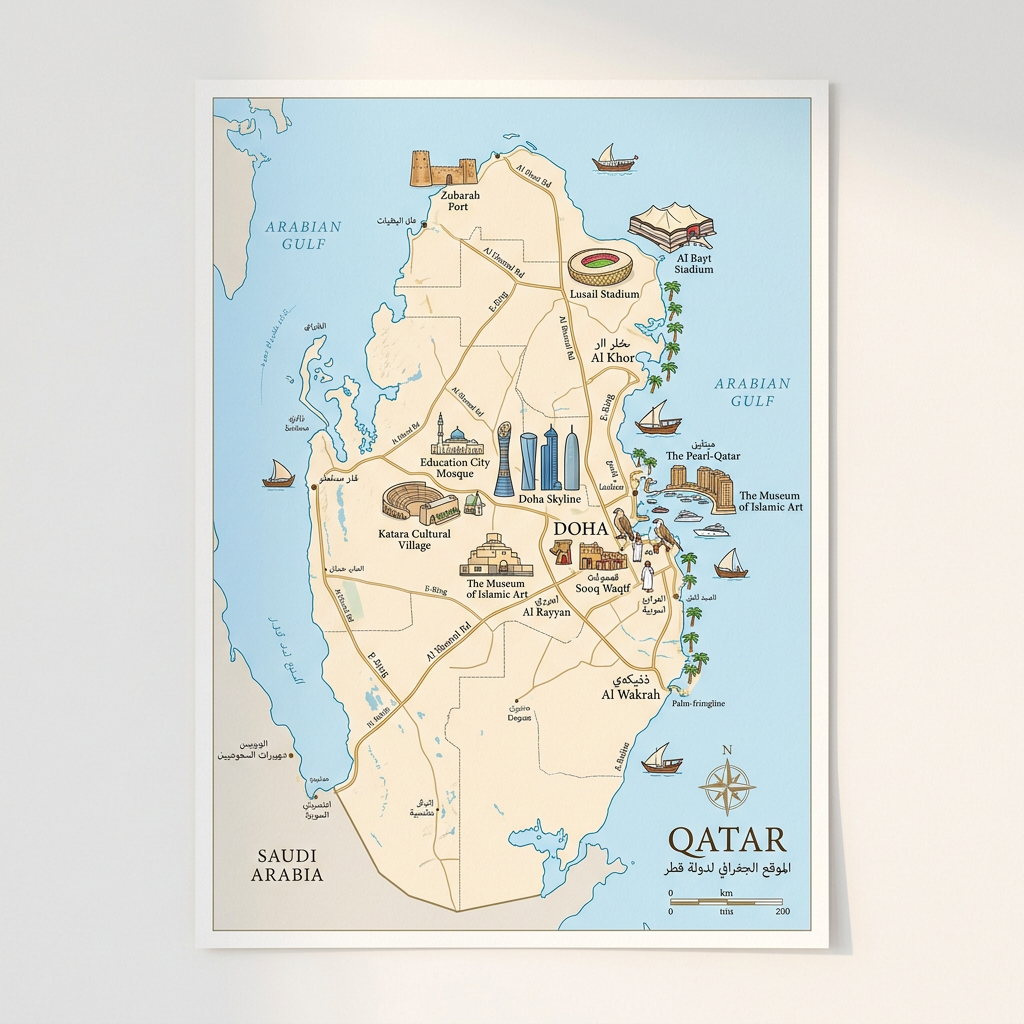
Located in the heart of the Arabian Peninsula, Qatar is a small Middle Eastern state whose map reveals major strategic and economic importance. Bordered by Saudi Arabia and bathed by the waters of the Persian Gulf, this modestly sized territory nonetheless hosts one of the highest concentrations of wealth in the world. Studying the map of Qatar means discovering a country of striking contrasts, between arid desert, modern coastline, and futuristic capital: Doha.
What you need to know about Qatar ?
The State of Qatar is an absolute monarchy located in the Arabian Peninsula. Essentially a desert country, it occupies a strategic position on the Persian Gulf and has become globally known for its energy wealth and modern infrastructure.
- The territory’s area is 11,586 km², making it the 165th largest country in the world.
- The population is estimated at about 2.74 million inhabitants in 2025, placing it around the 142nd rank worldwide.
- The average density is about 236 inhabitants/km², mostly concentrated in the capital.

The official language is Arabic, and the capital Doha is also the largest city in the country, serving as the political, economic, and cultural center.
Qatar is a member of several international organizations, including the AIIB, the FPEG, the GGGI, and the Gulf Cooperation Council (GCC).
The international dialing code is +974.
Table – Qatar: Geographic and demographic information
| Element | Key Information |
|---|---|
| Total area | 11,586 km² |
| Capital | Doha |
| Neighboring countries | Saudi Arabia (south), coastline on the Persian Gulf |
| Estimated population | ~3 million inhabitants (2025) |
| Population density | ~260 inhabitants/km² |
| Relief | Flat desert, some hills, sandy coasts |
| Climate | Arid: very hot summers, mild winters |
| Official language | Arabic |
| Economic resources | Oil, natural gas, finance, air transport |
| Special feature | Very wealthy country with one of the highest GDP per capita in the world |
Additional points on the map of Qatar
- Qatar is a peninsula of the Persian Gulf, surrounded by water on three sides.
- It shares a single land border with Saudi Arabia.
- Its capital Doha is located on the east coast, facing the Persian Gulf.
- The country is known for its natural gas reserves, among the largest in the world.
- The urban map shows a high population concentration along the coast.
Colors of Qatar
The Qatari flag is composed of two colors: white on the hoist side and maroon on the fly side. At the junction between the two, the maroon part shows sawtooth edges with 9 points.
The white color represents peace and the maroon color represents the blood of the martyrs during the Alzubara war against the Al-Khalifa Royal family. The points symbolize the 9 emirates of the Gulf, that is to say the 7 United Arab Emirates plus Bahrain and Qatar.

Best places to visit in Qatar

Doha: The capital is a city rich in famous monuments. You can engage in many activities there, including water sports, dining, and various hikes. You can also visit the Doha Corniche and then take a walk along the waterfront that stretches along Doha Beach. The city also hosts festivities such as the National Sports Day.
Al Rayyan: Located a few kilometers north of the capital, this city is also a very large urban area. The city has a very large equestrian organization. There are also educational centers as well as guided tours to understand how these equestrian centers operate. Several international concerts also take place there, and finally, explore the country’s historic centers and ancient fortifications.
Al Wakra: Previously, it was a fishing town but now it has become a famous trading city. Here, there are old forts and a famous gallery that retraces the history of the city. You will also see a maze of alleys and the Al Wakrah souk that beautify the city.
Where is Qatar located on the world map?
The map of Qatar highlights a small peninsula in the Persian Gulf. It shares its only land border with Saudi Arabia to the south and has long coastlines on the gulf, facing Iran. The capital, Doha, is a major economic and financial center in the region.

Climate in Qatar
The Qatari climate is characterized as desert. This translates to a cool winter and a very hot summer with maximum sunshine. Moreover, the entire Qatari territory has a uniform topography which results in a more or less constant climate throughout the country.
This climate is divided into two distinct seasons: the first occurs between December and February, which is the cold season, and the second occurs between April and October, which is the hot and dry season. The country also has a transition season that normally takes place between March and November.
As a result, the capital shows temperatures ranging between 18 and 37°C. It is subject to a prevailing humid wind but also a wind coming from the south. The latter can raise the temperature up to 40°C in summer. Rainfall generally occurs during the cool season and averages around 100 mm annually.
Administrative division of Qatar
Currently, the Qatari territory is subdivided into 8 municipalities or Baladiyat, or Baladiyah in the singular. These municipalities are in turn composed of 98 zones, then districts, and then blocks.
- Municipality of Ad Dawhah (52 zones)
- Municipality of Al Rayyan (10 zones)
- Municipality of Al Daayen (2 zones)
- Municipality of Umm Salal (1 zone)
- Municipality of Al Khor (3 zones)
- Municipality of Al Shamal (3 zones)
- Municipality of Al Shahaniya (10 zones)
- Municipality of Al Wakrah (7 zones)
Economy of Qatar
The Qatari economy is one of the high-yield and high-income economies. As a result, the GDP growth rate has been one of the highest in the world over the past 10 years. Indeed, the main activities on which the country’s economy is based are oil and natural gas exploitation. Together, they contribute to 80% of the country’s revenues. Consequently, here are some economic data of Qatar:
- Official currency: Qatari Riyal
- GDP nominal parity: 166.3 billion USD
- GDP purchasing power parity: 341.7 billion USD
- Annual GDP growth rate: 2.5%
- GDP per capita purchasing power parity: 124,900 USD
- Inflation rate: 0.9%
- HDI: 0.856
- Unemployment rate: 0.6%
- Public debt: 56.8% of GDP
- External debt: 168 billion USD
- Public revenues: 41.47 billion USD
Population and linguistic data of Qatar
The population of Qatar is currently 2,363,569 inhabitants and the demographic growth rate is 1.95%. The fertility rate of the population is 1.89 children per woman. The birth and death rates are respectively 9.5 ‰ and 1.6 ‰.
The life expectancy of the population at birth is however 79 years and the average age is 33.4 years. The male/female ratio in the country is 341 men to 100 women. The languages spoken in the country are Arabic as the official language and English as the administrative and educational language.
The ethnic groups composing the population are: Arabs (40%), Indians (18%), Pakistanis (18%), Iranians (10%), Others (14%). The religions practiced are: Islam (77.5%), Christianity (8.5%), and others (14%).
FAQ – Qatar map: 3 questions
Qatar is located on a peninsula in the Persian Gulf, south of Iran and northeast of Saudi Arabia.
The capital is Doha, a modern and highly urbanized city.
The country is essentially desert, with a sandy coastline and an arid climate.
