
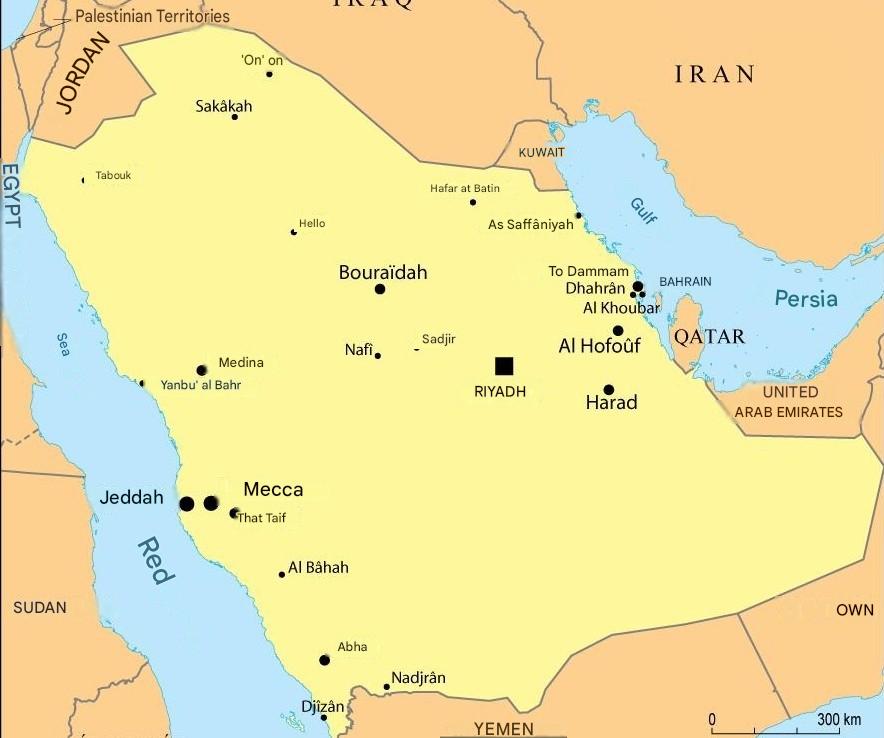
Located in the heart of the Arabian Peninsula, Saudi Arabia holds a strategic position at the crossroads of Asia, Africa, and Europe. Its map reveals a vast territory dominated by immense deserts, mountain ranges to the west, and two maritime fronts: the Red Sea and the Persian Gulf. As the birthplace of Islam, with Mecca and Medina, the country is also one of the economic pillars of the Middle East thanks to its oil resources and its diversification ambitions.
Table – Saudi Arabia: Geographical and demographic information
| Element | Key Information |
|---|---|
| Total area | 2,149,690 km² (largest country in the Middle East) |
| Capital | Riyadh |
| Neighboring countries | Jordan, Iraq, Kuwait, Qatar, United Arab Emirates, Oman, Yemen |
| Coastline | Red Sea (to the west), Persian Gulf (to the east) |
| Estimated population | ~37 million inhabitants (2025) |
| Population density | ~17 inhabitants/km² |
| Relief | Deserts (Rub al-Khali), plateaus, mountains to the west (Asir, Hejaz) |
| Climate | Desert: extreme heat, very low rainfall |
| Official language | Arabic |
| Economic resources | Oil, gas, petrochemicals, developing renewable energies |
| Special feature | Birthplace of Islam (holy cities Mecca and Medina) |
What you need to know about Saudi Arabia ?

Saudi Arabia is an absolute monarchy whose territory is located in the Arabian Peninsula in the Middle East. Officially, the country is called the Kingdom of Saudi Arabia. The country is ruled by the Saudi dynasty and currently has a population of 33 million inhabitants. Its territory is the largest in the Middle East, covering more than 2,000,000 km². Compared to Arab countries, Saudi Arabia is the largest. The official language of the country is Arabic, and the largest urban area as well as the capital of the country is Riyadh. The Saudi telephone code is 966, that is 00966 or +966.
Additional points on the map of Saudi Arabia
- Saudi Arabia occupies a large part of the Arabian Peninsula.
- Its religious map is marked by Mecca and Medina, two of the most sacred places in Islam.
- The Rub al-Khali desert, also called the “Empty Quarter,” is one of the largest sand deserts in the world.
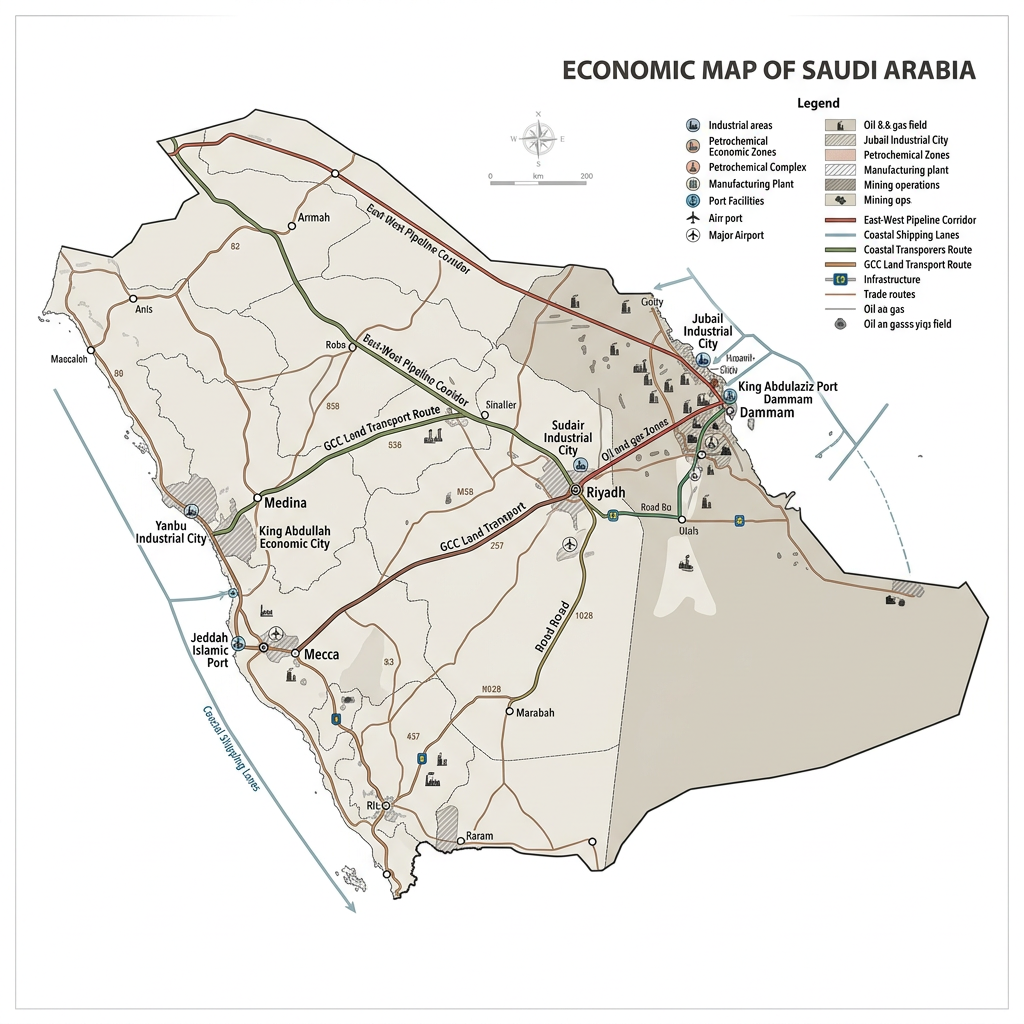
- The economic map highlights the concentration of oil fields in the east of the country.
- Riyadh, the capital, is located in the center of the country, in the heart of the Najd plateau.
Which countries border Saudi Arabia?

The map of Saudi Arabia highlights a vast territory occupying most of the Arabian Peninsula. It shows its borders with Jordan and Iraq to the north, Qatar and the United Arab Emirates to the east, Oman and Yemen to the south. The country is bordered by the Red Sea to the west and the Persian Gulf to the east, giving it a major strategic position.
Population of Saudi Arabia
Currently, the Saudi population numbers 33,091,113 inhabitants with an annual growth rate of 1.63%. The fertility rate in the country is 2.04 children per woman according to 2015 data. The birth rate in the country is higher than the death rate, being respectively 1.56% and 0.33%. The life expectancy of a Saudi at birth is 75.7 years, with 74.2 for women and 77.3 years for men. This population is young with an average age of 29.9 years. For the male/female ratio, there is a rate of 130%, including 104% for children under 14 years, 111% for adults between 15 and 24 years, and 152% for adults over 54 years. The population is mainly composed of Arabs at 90%, Africans and Westerners at 10%.
What are the colors of the country?

The flag of the kingdom of Saudi Arabia is a green background flag with a white Arabic inscription on top meaning: “There is no god but God and Muhammad is his prophet.” Below the inscription is depicted a white sword. The white sword signifies justice in the country and the green color represents the main religion: Islam.
The main things to visit in Saudi Arabia
Riyadh
The capital of Saudi Arabia is a magnificent city. With its 6 million inhabitants, it is a metropolitan city with unique architecture consisting of shops, shopping centers, and several historic sites. You can visit the Kingdom Center, which is a building towering over 311m with on its 99th floor the best view of the sunset. You can also enjoy luxury boutiques. Walk around the Masmak Fort, which is located in the middle of the old city. Around it, you will see the exhibition museum of weapons and antique costumes.
Jeddah
The city of Jeddah is located on the coast of the Red Sea. It is the most popular attraction in the kingdom of Saudi Arabia. The city is attractive and the inhabitants friendly; tourists prefer to go there to see the magnificent beaches. Moreover, the coral reefs will delight diving enthusiasts. It is also the birthplace of Al-Balad, which is an emblematic monument of Jeddah that displays the history of the entire region. In fact, it is listed as a UNESCO World Heritage site. You can also visit other architectural settings including the Nasseef House Museum or the floating mosque. It is in the latter that the most popular and organized visits of tourists and pilgrims to Mecca take place every year.
Dammam
The city of Dammam is a city in the eastern section of the country just a few kilometers from the Bahraini kingdom. It is a small town with only two million inhabitants; you will find all kinds of attractions there, including mountain biking, paragliding, and boat crossings. You can even go diving on Marjane Island. There are also several shopping centers in the city catering to all types of people.
Where the cities are located on the map of Saudi Arabia
Riyadh
On the map of Saudi Arabia, the city of Riyadh is located in the central section of the country, on the Nejd plateau. Geographic coordinates: 24° 40′ 57″ north, 46° 44′ 16″ east.
Jeddah
The city of Jeddah, Djeddah or Gedda, is located on the coast of the Red Sea. Geographic coordinates: 21° 32′ 34″ North, 39° 10′ 22″ East.
Dammam
On the map of Saudi Arabia, the city of Dammam is located in the eastern section of the Arabian Peninsula. Geographic coordinates: 26° 26′ north, 50° 06′ east
Climate map of Saudi Arabia
The Climate of Saudi Arabia is characterized by a hot and dry summer with very high daytime temperatures and milder temperatures at night. This is one of the characteristics of a dry desert climate. The summer periods are marked by temperatures around 45°C, and during heatwaves, temperatures reach around 54°C.
Winter is quite mild, meaning that temperatures throughout the territory rarely fall below 0°C. The other two seasons, autumn and spring, show temperatures oscillating around 29°C. Rainfall in the country is relatively rare and ranges between 300 and 500 mm annually.
The western section of the country borders the Red Sea, which is why the climate is strongly influenced by the sea breeze. The climate in this part of the country is therefore a dry subtropical climate. The regions surrounding Jeddah and Mecca experience extreme summers, except that the relative humidity is high and mitigates the heat waves. Winters in this area, however, are mild with humidity lower than in summer.
Rainfall in this region is low but unpredictable; sometimes the rains turn into storms and are intensified by cold winds coming from the south of the country. Occasionally, there are sandstorms and violent storms that cause flooding in very low-lying areas. Summer temperatures reach around 45°C or even 49.6°C. In winter, the western zones experience temperatures around 10°C but rarely below.
Economic map of Saudi Arabia
Two years ago, Saudi Arabia was ranked the 18th most performing economy in the world and the 6th most performing economy in Asia. The country is also a member of OPEC thanks to its national oil company Saudi Aramco. It holds the first place among oil-producing countries. Saudi Arabia has always exported crude and refined oil with an added value of 337 billion USD.
In 2015, the price of a barrel of oil had dropped from about 97 USD per barrel, which created a deficit in state revenues and a drop of more than 12% in GDP. Moreover, oil export and exploitation in the country represent about 30% of GDP. It is therefore one of the most important sources of income for Saudi Arabia’s economy.
A significant part of Saudi Arabia’s industry is dominated by the chemical industry, which is the country’s second most important industrial sector. Moreover, Saudi Arabia is one of the world’s major producers of chemical products and ranks 10th among international suppliers of chemical products. Here are some important economic data for Saudi Arabia
- GDP at nominal parity: 782 billion USD
- GDP at purchasing power parity: 1,857 billion USD
- GDP per capita at nominal parity: 20,775 USD
- GDP per capita at purchasing power parity: 48,996 USD
- Unemployment rate as % of active population: 5.92%
- Public debt: 50 billion USD
- Human Development Index: 0.853 (56th rank in the world)
- Official currency: Saudi Riyal (SAR)
- International organizations of which the country is a member: AfDB, AIIB, G20
Administrative and demolinguistic data
Administrative subdivisions
Saudi Arabia has 13 provinces as its primary territorial subdivision. The 13 provinces are then divided into 118 governorates. In turn, the governorates are subdivided into several centers.
Here are the 13 provinces of Saudi Arabia
- Al Bahah
- Al-Hudud ach-Chamaliya
- Al Jawf
- Medina
- Al Qasim
- Riyadh
- Ach-Charqiya
- Asir
- Ha’il
- Jizan
- Mecca
- Najran
- Tabuk
Here are the governorates of Saudi Arabia
- Riyadh
- Diriyah
- Al-Kharj
- Dawadmi
- Al Majma’ah
- Al-Quway’iyah
- Wadi ad-Dawasir
- Al Aflaj
- Al Zulfi
- Shuqrah
- Hotat Bani Tamim
- Afif
- Comme Sulayyil
- Dhurma
- Al-Muzahmiyya
- Rumah
- Thadig
- Huraymila
- Al Hariq
- Al-Ghat
- Mecca
- Jeddah
- Ta’if
- Al Qunfudhah
- Al Lith
- Rabigh
- Al Jumum
- Khulays
- Al Kamil
- Al Khurmah
- Ranyah
- Turubah
- Medina
- Yanbu
- AlUla
- Mahd adh Dhahab
- Badr
- Khaybar
- Al Hinakiyah
- Buraidah
- Unaizah
- Ar Rass
- Al Mithnab
- Al Bukayriyah
- Al Badayea
- Asyah
- Al Nabhaniyah
- Uyun AlJiwa
- Riyad Al Khabra
- Al Shimasiyah
- Dammam
- Al Ahsa
- Hafar Al-Batin
- Jubail
- Qatif
- Khobar
- Khafji
- Ras Tanura
- Abqaiq
- Al Nairyah
- Qaryat al-Ulya
- Abha
- Khamis Mushait
- Bisha
- Al-Namas
- Muhayil
- Sarat Abidah
- Tathlith
- Rojal
- Ahad Rafidah
- Dhahran Al Janub
- Balqarn
- Al Majaridah
- Tabuk
- Al Wajh
- Duba
- Tayma
- Umluj
- Haql
- Saluer
- Baqaa
- Al Khazaiah
- Al Shinan
- Arar
- Rafha
- Turaif
- Jizan
- Sabya
- Abu `Arish
- Samtah
- Al Harth
- Damad
- Al Reeth
- Baish
- Farasan
- Al Dayer
- Ahad al Masarihah
- Al Edabi
- Al Aridhah
- Al Darb
- Najran
- Sharurah
- Hubuna
- Badr Al Janub
- Yadamah
- Thar
- Khubash
- Al Kharkhir
- Al Bahah
- Baljurashi
- Al Mandaq
- Al Makhwah
- Al Aqiq
- Qilwah
- Al Qara
- Sakakah
- Qurayyat
- Dumat al-Jandal
Demolinguistic data
The country currently has two dominant ethnic groups: Arabs who represent 90% and the rest composed of Afro-Asiatic peoples. The foreign population amounts to about 5 million in Saudi Arabia, or more than 25% of the population.
This minority population is mainly composed of Egyptians, Pakistanis, Filipinos, Bangladeshis, and Yemenis.
The Arabs are the ethnic groups native to Saudi Arabia; however, they are not affiliated with a single ethnicity, so there are:
- Gulf Arabs
- Yemeni Arabs
- Egyptian Arabs
- Palestinian Arabs
- Lebanese Arabs
- Syrian Arabs
- Tihama
- Sudanese Arabs
- Jordanian Arabs
- Omani Arabs
- Saharan Arabs
- Fayfa
- Mahra
The Arabic language is just as diverse; there are two types of speakers
- Those who speak Najdi Arabic, representing 46.5%
- Those who speak Hijazi Arabic, representing 35%
- Those who speak Gulf Arabic, representing 1.6%
The country’s minority languages are Hindi and Urdu
FAQ – Saudi Arabia map: 3 questions
Saudi Arabia is located in the Middle East, at the heart of the Arabian Peninsula, between the Red Sea and the Persian Gulf.
The capital is Riyadh, but the cities of Jeddah, Mecca, and Medina are also important.
The country is dominated by deserts, notably the Rub al-Khali, with mountains to the west and an extreme desert climate.
