
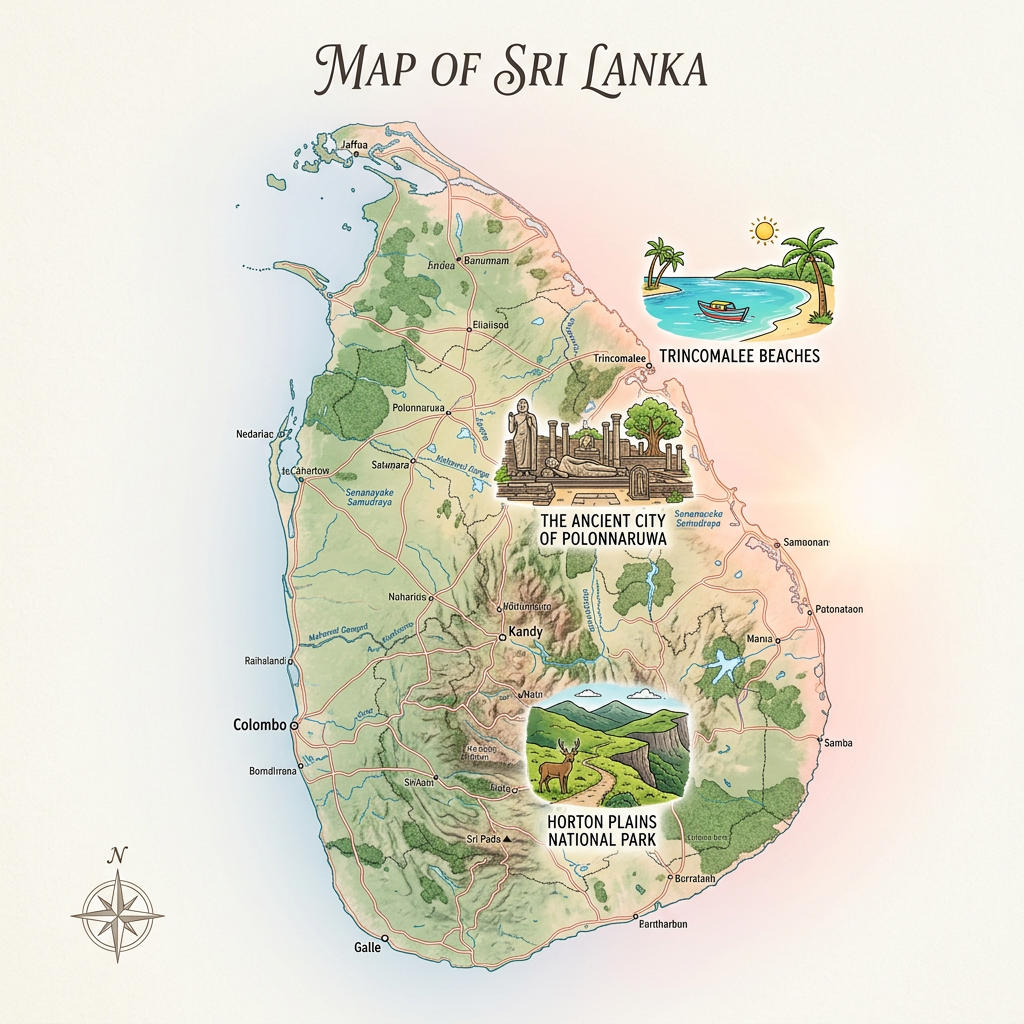
A map of Sri Lanka allows you to visualize its key regions: southern beaches, central mountains, national parks, and cultural sites such as Anuradhapura or Sigiriya. Ideal for planning an itinerary between sea, nature, and heritage.
What you need to know about Sri Lanka ?
Sri Lanka is a country in South Asia and an island state. It is also called the Democratic Socialist Republic of Sri Lanka. The area of Sri Lanka amounts to 65,610 km and the Sri Lankan population is 22,889,201 inhabitants. This indicates that Sri Lanka is the 120th largest country in the world and the 57th most populous country.
The capital of the country is Sri Jayawardenapura Kotte and its largest urban area is Colombo. The country calling code is 94, either 0094 or +94, and the current currency is the Sri Lankan rupee.
Which countries border it?
The closest neighbor of Sri Lanka is India, which is connected by the Adam’s Bridge. India is located to the northwest of the country.
Population of Sri Lanka
| Category | Key Information |
|---|---|
| Official Name | Democratic Socialist Republic of Sri Lanka |
| Area | ~65,610 km² |
| Population | ~22 million inhabitants |
| Capital | Sri Jayawardenapura Kotte (administrative capital) |
| Main City | Colombo (economic capital) |
| Official Languages | Sinhala and Tamil |
| Bordering Countries | None (island) – close to India (Palk Strait) |
| Coastline | Entirely bordered by the Indian Ocean |
| Climate | Humid tropical, influenced by monsoons |
| Relief | Coastal plains, mountains in the center and south |
| Time Zone | UTC+5:30 |
| Currency | Sri Lankan Rupee (LKR) |
The population of Sri Lanka currently amounts to 22,576,592 inhabitants and its demographic growth rate is 0.73%. The fertility rate in the country is 2.05 children per woman and the birth rate is significantly higher than the death rate. Respectively 14.8 ‰ and 6.3 ‰. The life expectancy of a Sri Lankan at birth is 77.1 years, 73.7 years for men and 80.8 years for women.
The population of Sri Lanka is a young population with an average age of 33.1 years. The male/female ratio is 95% for the population, with 104% at birth and 95% in adulthood. The official and national language of the country is Sinhala, spoken by 74% of the population, and the national language is Tamil, spoken by 18% of the population.
What are the colors of the country?
The flag of Sri Lanka consists of two clearly defined sections. The first is represented by two bands of equal size arranged horizontally, one green and the other orange. In the second part on the right, there is a yellow lion holding a sword in its paw with fig leaves in the corners of the rectangle. Both parts are set on a yellow background.
- The left section of the flag represents the Sri Lankan Islamist people, the second part represents the Tamil people.
- The lion depicted on the right holding a sword signifies the power of the state, the fig leaves represent well-being, happiness, friendliness, and delicacy.
The best places to visit in Sri Lanka

Sri Jayawardenapura Kotte
This city is the official capital of the country, where you will find several attractions and interesting things; the most important thing is to go there in summer. In this city, you can enjoy the beaches for diving.
There are also charming water parks with dining areas where you can savor exquisite cuisine with an admirable view of the illuminated well. You can also have a picnic by the Diyawanna lake.
Regarding architecture, in the city center, there is the parliamentary building. In addition, there is also the Royal Colombo Golf Club located right in the center of Kotte. Finally, don’t forget to visit the Mahamevnawa Amawthura monastery as well as the Royal Temple of Ranawana, which are remnants of the country’s monarchical era.
Colombo
This city is the country’s second capital, also called the economic capital. It is also the most populous city in the country. It is a port city where you can enjoy several ancient monuments during your visits.
First, there is the National Museum dating from 1876, which is the largest in the country. This museum still displays relics of the ancient civilization (masks, statues, and firearms).
There are also several colonial buildings located outside the city. You will see the Gangaramaya Temple: it is a complex of many buildings adorned with various artifacts. Inside this temple, there are many souvenirs and representations of Buddha.
Next to this temple is Beira Lake, colored turquoise blue-green with an islet at its heart where you can go. Finally, don’t forget to visit the Independence Memorial Hall, the old Dutch hospital, and the Pettah markets.
Kandy
The city of Kandy is located among the heights, notably the banks of Bogambara Lake. It is listed among UNESCO World Heritage sites. It is also a very lively city and a tourist destination because of its many attractions. Among them is the Temple of the Tooth, dating from the 16th century.
This monument was once one of the holiest architectures of Buddhism. Periodically, especially in August, there is a very popular religious celebration called Kandy Esala Perahera, which lasts about 10 days and allows tourists to discover one of the most famous Buddhist events.
Where the cities are located on the Sri Lanka map ?
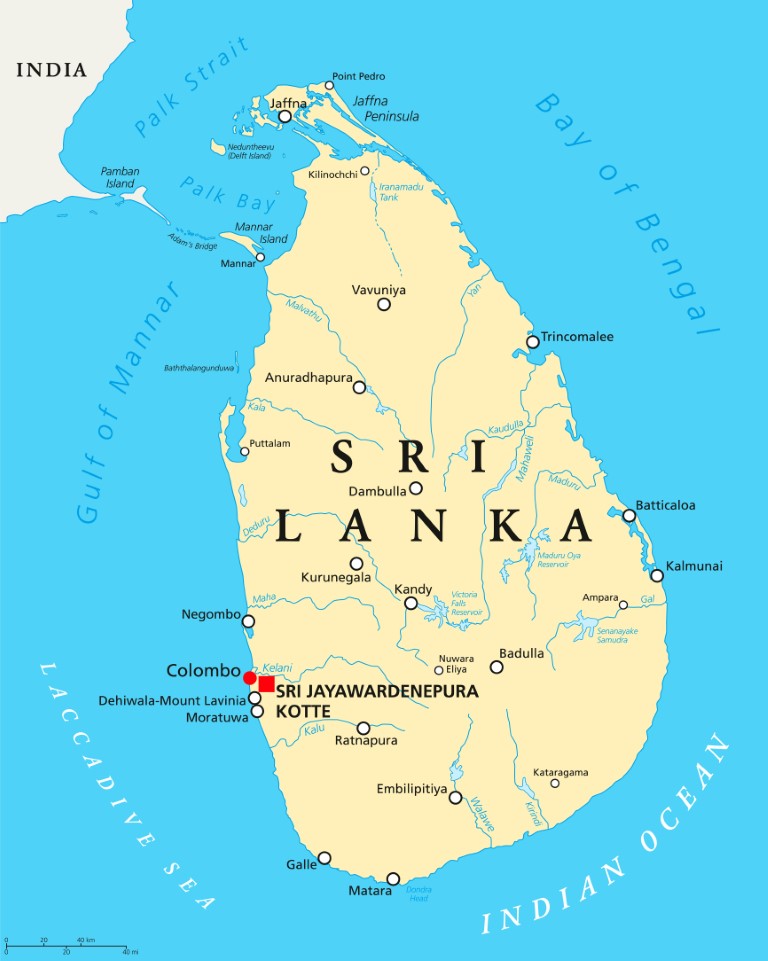
Sri Jayawardenapura Kotte
On the Sri Lanka map, the city of Sri Jayawardenapura Kotte is located in the southwest section of the country, that is in the suburbs of the economic capital. Geographic coordinates: 6° 54′ 39″ north, 79° 53′ 16″ east
Colombo
On the map of Sri Lanka, the city is located in the southwestern section of the country and in the province of the same name. Geographic coordinates: 6° 55′ 00″ north, 79° 50′ 00″ east.
Kandy
On the map of Sri Lanka, the city of Kandy is located in the western section of the country, about 100 km from the economic capital. Geographic coordinates: 7° 17′ 37″ north, 80° 38′ 25″ east
Climate map of Sri Lanka
The climate of Sri Lanka is defined by temperatures averaging around 16°C. This type of climate is characterized as humid tropical. In the Nuwara Eliya area, winter can be marked by frost and lasting snowfalls. Summer temperatures are high, around 32°C on average, especially in the Trincomalee region in the northeastern section.
Throughout the Sri Lankan territory, average temperatures range between 28 and 30°C. The coldest periods occur between December and January, and the summer periods are also subject to the monsoon.
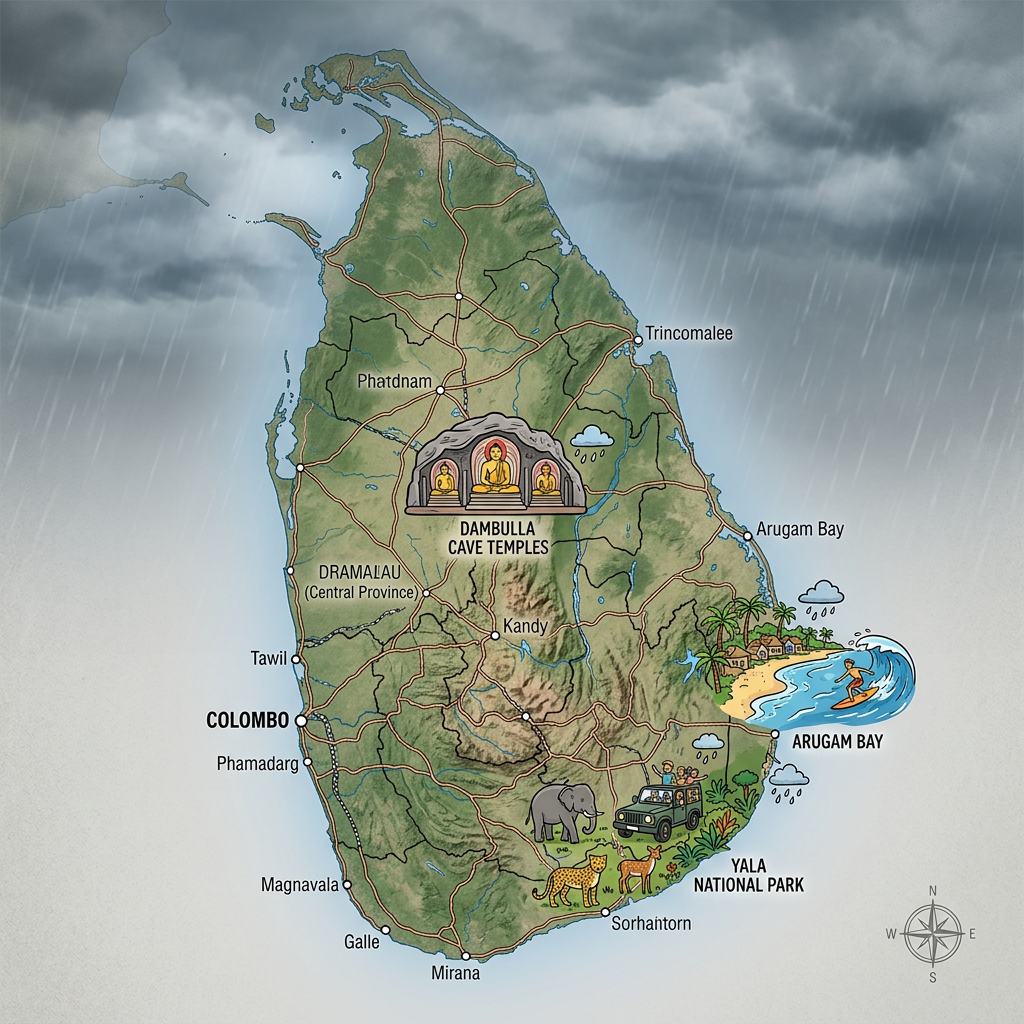
Rainfall in Sri Lanka is strongly influenced by the monsoon. The heaviest rains occur between May and October. The monsoon brings moisture especially to the southwestern coastal area. In this part of the country, rainfall is therefore heavy and can sometimes reach 2500 mm per month.
The second monsoon occurs between October and November, and during this period, there are several occasional storms or sometimes tropical cyclones. In winter, the wind blows strongly and the northern sections of the island are influenced by winds coming from the Bay of Bengal.
In the southwestern parts, the territory is dominated by mountain ranges. These are the wettest areas of the country, with relative humidity in this section ranging between 60% and 80%.
Economic map of Sri Lanka
Recently, Sri Lanka’s GDP was counted at 84 billion USD in collective parity and 296,959 billion USD in purchasing power parity. Sri Lanka’s economy is among the fastest-growing annual economies in Asia, with a rate of 6.4%. Its per capita income is also high, at 13,620 USD in purchasing power parity and nominal value: 3,852 USD.
Besides these economic performances, Sri Lanka is classified among low-income or middle-income countries.
The government of Sri Lanka has launched a policy to reform the country’s economy. This maneuver aimed to reduce the rate of population still living in extreme poverty.
Moreover, they have created numerous commercial and technical growth zones, diversifying through several sectors including tourism, industry, and even the primary sector. However, this project could induce economic discomfort with increasing debt due to state investments exceeding the country’s stock market assets. Here are some economic data of Sri Lanka:
- Current currency: Sri Lankan Rupee
- Trade organizations the country is a member of: WTO, WCO, SAFTA, IOR-ARC, SCO, BIMSTEC, AIIB
- GDP in nominal parity: 81.120 billion USD
- GDP in purchasing power parity: 287.671 billion USD
- Annual GDP growth rate: 5.3%
- GDP per capita in nominal parity: 3,698 USD
- GDP per capita in PPP: 13,114 USD
- Human Development Index: 0.780
- Unemployment rate as % of active population: 8.4%
Administrative and demolinguistic data
Administrative subdivisions
Sri Lanka is divided into 9 provinces, then into 25 districts, and into 331 divisional secretariat divisions, and finally into Grama Niladhari divisions numbering 14,022.
Here are the 9 provinces of Sri Lanka:
- Central Province
- Eastern Province
- North Central Province
- Northern Province
- North Western Province
- Sabaragamuwa
- Southern Province
- Uva
- Western Province
Here are the 25 districts of Sri Lanka:
- Ampara
- Anuradhapura
- Badulla
- Batticaloa
- Colombo
- Galle
- Gampaha
- Hambantota
- Jaffna
- Kalutara
- Kandy
- Kegalle
- Kilinochchi
- Kurunegala
- Mannar
- Matale
- Matara
- Monaragala
- Mullaitivu
- Nuwara Eliya
- Polonnaruwa
- Puttalam
- Ratnapura
- Trincomalee
- Vavuniya
Demolinguistic data
The population of Sri Lanka is very diverse; however, the two most significant groups are the Sinhalese and the Tamils.
- The Sinhalese represent the majority of the people, about 69%, and they live in the southern part of the country.
- The Tamils represent 25.2% of the Sri Lankan population. This ethnicity is subdivided into:
- Adi Dravida
- Sri Lankan Moors
- Proper Tamils
- Vellalan
- Agamudaiyan
- Viswakarma
- Maravan
- Brahmins
- Indian Moors
- Malayali
- Kuravan
There are also two types of Tamils: Indian Tamils and indigenous Tamils.
Regarding the languages of the country, they are also divided into two, with an international language (English).
- Sinhala is part of the Indo-European family, meaning it is a variation of Sanskrit or the northern languages of India.
- Tamil is part of the Dravidian family, meaning it is a variation of the southern language of India.
- English is a minority language in Sri Lanka, used by the administration, education, as well as commercial exchanges.
Sri Lanka is an island located in the Indian Ocean, southeast of India. On a map, it appears as a tear drop detached from the southern tip of India, separated by the Palk Strait. It is a popular destination for its beaches, Buddhist culture, and mountainous landscapes.
Yes, an electronic visa (ETA) is required for most foreign travelers, including French citizens. It is obtained online before departure, usually lasts 30 days, and costs about 50 USD. An extension is possible on site.
The best time depends on the regions visited:
West and South Coast : December to March (dry season)
East Coast : May to September
Since the climate is tropical, it is advisable to avoid the monsoon seasons if you want to fully enjoy the beaches and hikes.
