
What you need to know about Austria ?
Austria is a landlocked country in Central Europe. Its name is Republik Österreich or Republic of Austria due to its status as a Federal State. The country shares borders with Germany, Slovakia, Hungary, Slovenia, Switzerland, Liechtenstein, the Czech Republic to the north, and Italy.
Austria has been a member of the European Union since 1995 and has belonged to the eurozone since the euro was introduced in 1999 (with euro banknotes and coins entering circulation in 2002). German is the country’s official language, while several minority languages are officially recognized, including Croatian, Hungarian, Slovene, Slovak, Czech, and Romani, depending on the region.
Austria covers an area of approximately 83,879 km² (32,386 sq mi) and is now home to around 9.2 million people. Its capital is Vienna, which is also the country’s main political, economic, and cultural center. Austria’s international telephone calling code is +43
The best cities in Austria
Main Attractions in Austria
Vienna
The capital of Austria is the largest city but also the most populated in the country. Firstly, the city has three palaces, the first being the Imperial Palace of Hamburg with 2,600 rooms and a dozen courtyards. The next is Schönbrunn Palace, which includes the imperial apartments and the Palm House. The last is the Belvedere Palace, which is full of artworks in its gallery. The capital also includes stunning museums such as the Museum of Art History, the Sissi Museum, and the Natural History Museum for lovers of works by Rembrandt or Michelangelo.
Salzburg
This city is especially famous for its historic architectural layout and Mozart’s house, which has been converted into a musical art museum. In this place, you will see original compositions, musical instruments, and theaters dedicated to the artist.
You can also visit the Residenzbrunnen fountain and the Salzburg Residenz royal residence. Speaking of palaces, don’t forget the Hohensalzburg Castle with its old Gothic appearance, built about 20 centuries ago. The city of Salzburg also includes a curious garden and several religious sites such as Saint Peter’s Church and Salzburg Cathedral.
Graz
After the capital, the city of Graz is the second largest Austrian city. This city reflects European history and culture; that is why it is listed as a UNESCO World Heritage site. You will see ancient architectures such as Haus am Luegg, the Landhaus, and the Rathaus or city hall. The Franciscan Church is also a structure that reflects the Gothic period.
Graz also hosts several museums such as the Apothecary Museum, the Main Museum, the Robert Stolz Museum (related to the composer), and finally, the large Armory Museum. To finish, don’t forget to visit Saint Giles Cathedral and Schloss Eggenberg Palace, which all reflect the ancient civilizations that once ruled the city.
Innsbruck
The city of Innsbruck is especially famous for having the best ski resort in the world. Indeed, the Austrian Nordkette slopes are the most difficult to ski. At these resorts, you can use the cable car to get an aerial view of Innsbruck and enjoy the landscape. Also visit the Tyrolean architectural buildings such as the Helbinghaus building, the Goldener, and the Burgriesenhaus, all buildings dating from the 15th century.
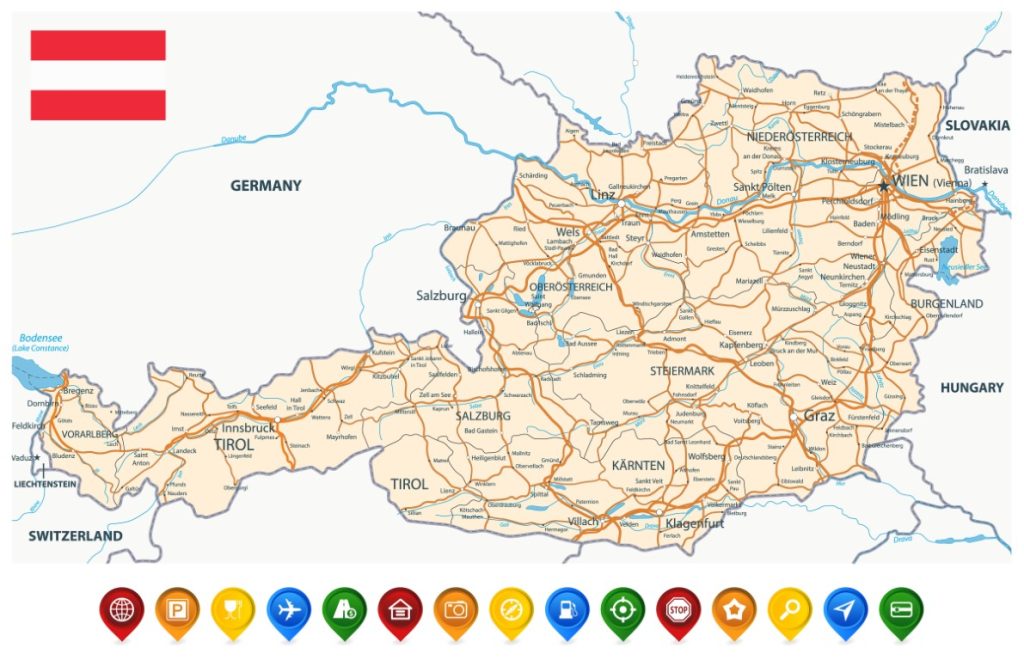
Where the cities are located on the map ?

Vienna
On the map, the capital is located in the eastern section of Austria. Geographically, it is situated in the middle of Central Europe. Geographic coordinates: 48° 12′ 30″ N, 16° 22′ 23″ E.
Salzburg
On the map, the city of Salzburg is located in the northwest section of the country. It is the city closest to the German border. Geographic coordinates: 47° 48′ 09″ north, 13° 02′ 45″ east.
Graz
Graz is located in the southeastern section of the map. It is about 145 km away from the capital in the southwest direction. It is a city along the banks of the Mur River. Geographic coordinates: 47° 04′ 14″ north, 15° 26′ 17″ east.
Innsbruck
Nestled in the heart of the Alpine mountain range, Innsbruck is an Austrian city located in the western section of Austria. Geographic coordinates: 47° 16′ 00″ north, 11° 23′ 00″ east.
Financial map of Austria
The Austrian economy is based on international and infranational free trade. It is a system called a free market economy. Thus, the country has established various political and geographical partnerships with neighboring countries.

This has allowed the industry and service sectors to grow. The tertiary sector is more efficient in mechanical industry, chemical industry, and automotive industry. On the other hand, the primary sector is dominated by organic farming. In fact, data shows that 22% of farms are recognized by the EU.
Moreover, the resources and raw materials used in industry are not imported; the Austrian soil is rich in minerals, metals, and agricultural resources. Imports are therefore solely focused on hydrocarbons, although the country possesses oil and gas resources. The tourism sector also constitutes an important part of the country’s economy because the country has numerous natural and cultural reserves.
Some economic indicators of the country
- The current currency of Austria is the Euro
- Austria’s GDP: approximately US$535 billion
- Gross Domestic Product per capita: approximately US$58,000
- Unemployment rate: approximately 5.3% of the labor force
- Public debt: approximately 78% of GDP
- Annual GDP growth rate in %: approximately 1.2
- Human Development Index: 0.930, among the highest in the world
- Active population: approximately 4.8 million people
Climate Map of Austria
Since 60% of Austrian territory is dominated by mountain ranges, notably the Alps, the climate varies according to the sections of the country.
- The type of climate in the flat areas is characterized by freezing winters and hot, dry summers. This region is located in the eastern section of the country.
- The mountainous areas are characterized by a temperate continental climate. This results in fairly cold winters. However, summers are hot with heavy rains in the early afternoon.
- Finally, cities located at high altitudes are characterized by frequent snowfall during the winter period. However, summers are hot but stormy.
In general, the Austrian territory experiences heavy precipitation throughout the year. In mountainous areas, the annual rainfall is 1000 mm. In contrast, the plains and low-altitude areas have an annual rainfall of 550 mm.
Summer across the territory is quite warm, dry in some places, but generally, rains are abundant in the afternoon. Winter is freezing; however, some areas are snowier than others.
Summer in Austria is characterized by persistent heat waves that raise the temperature up to 26°C. Night temperatures are cool, whereas the days are sunny in the morning and stormy in the late afternoon. In the southern parts of the country, summer temperatures can reach 38°C.
Austrian winter is often snowy. Throughout almost the entire country, temperatures are quite low, but the coldest regions are located at high altitudes. In the mountains, frost can occur as temperatures drop to -22°C.
Climate in the capital: Vienna
Winter temperatures in the capital hover around -3.5°C, especially at the beginning of the year. During this period, fogs are frequent, with an average of 5 to 10 foggy days per month. It snows generously in the capital, and icy winds coming from Russia further lower the temperature down to -20°C.
Summer, on the other hand, is quite warm with average temperatures between 25 and 26°C. Sunshine is maximal in the morning, but in the afternoon, the sky becomes cloudy and storms occur. Some places in the city experience stifling heat, and the temperature can reach 30°C.
Demographic and administrative map of Austria
Demographics in Austria
The population of Austria is now estimated at around 9.2 million people. This represents approximately 0.11% of the world’s population. With a total area of 83,879 km² (32,386 sq mi), Austria has an average population density of about 110 people per square kilometer, distributed across its Alpine regions and major urban centers.
Austria is a highly urbanized country, with nearly 60% of its population living in its main cities, particularly Vienna, as well as Graz, Linz, Salzburg, and Innsbruck. The country also has a relatively high median age of around 44 years, reflecting the demographic aging observed across much of Europe.

The population growth of Austria is currently modest and is driven mainly by international migration, while the birth rate remains relatively low, as in many other European countries. Life expectancy at birth is approximately 82 years, reflecting the country’s high standard of living and excellent healthcare system. The gender balance is generally even, with a slight majority of women due to their longer life expectancy.
Austria has a multicultural population. Although Austrian citizens make up the majority of residents, the country is also home to significant communities from Germany, Türkiye, Bosnia and Herzegovina, Romania, and several other European countries.
In terms of religion, Roman Catholicism remains the largest religious denomination, although its share of the population has gradually declined. Austria also has Protestant, Orthodox, Muslim, Jewish, and other religious communities, while a growing proportion of the population identifies as having no religious affiliation.
Administrative map
The levels that make up the country are primarily the federal state, also called the federated state depending on the context. This main division is then subdivided into districts, which in turn are divided into municipalities.
All administrative divisions of the federal state of Austria are subject to legislation and mainly governed by elected civilians. There are nine sovereign states led by an autocratic government and autonomous but non-liberal districts. The leaders of the latter are politicians appointed as governor or magistrate.
Here are the nine states:
- Burgenland
- Carinthia
- Lower Austria
- Upper Austria
- Salzburg
- Styria
- Tyrol
- Vorarlberg
- Vienna
Austria demolinguistic data
Austrians are divided into two categories based on their language. There are German speakers and national minorities.
The German speakers
These are Austrians who simply speak German. However, the dialects differ from one region to another. For example, people in large cities speak Hosprache or Standard German, unlike rural inhabitants who speak Hochalemanisch or Bairisch. In Austria, dialects vary into 3 types depending on the regions: Northern Bavarian, Central Bavarian, and Southern Bavarian.
The national minorities
These are mainly immigrants or people of foreign origin. They include: Hungarian, Croatian, Slovak, Czech, Romani, and Slovenian.
FAQ-Austria map: Practical information and country overview
Austria is a Central European country surrounded by eight neighboring nations and has no coastline. Its location makes it an important crossroads between Western and Eastern Europe.
A map of Austria shows the country’s main cities, borders, mountain ranges, rivers, and transportation routes. It also helps identify the country’s nine federal states.
A map of Austria helps you plan your itinerary and locate the country’s main tourist attractions. It also makes it easier to understand the distances between cities and the different regions of the country.
