
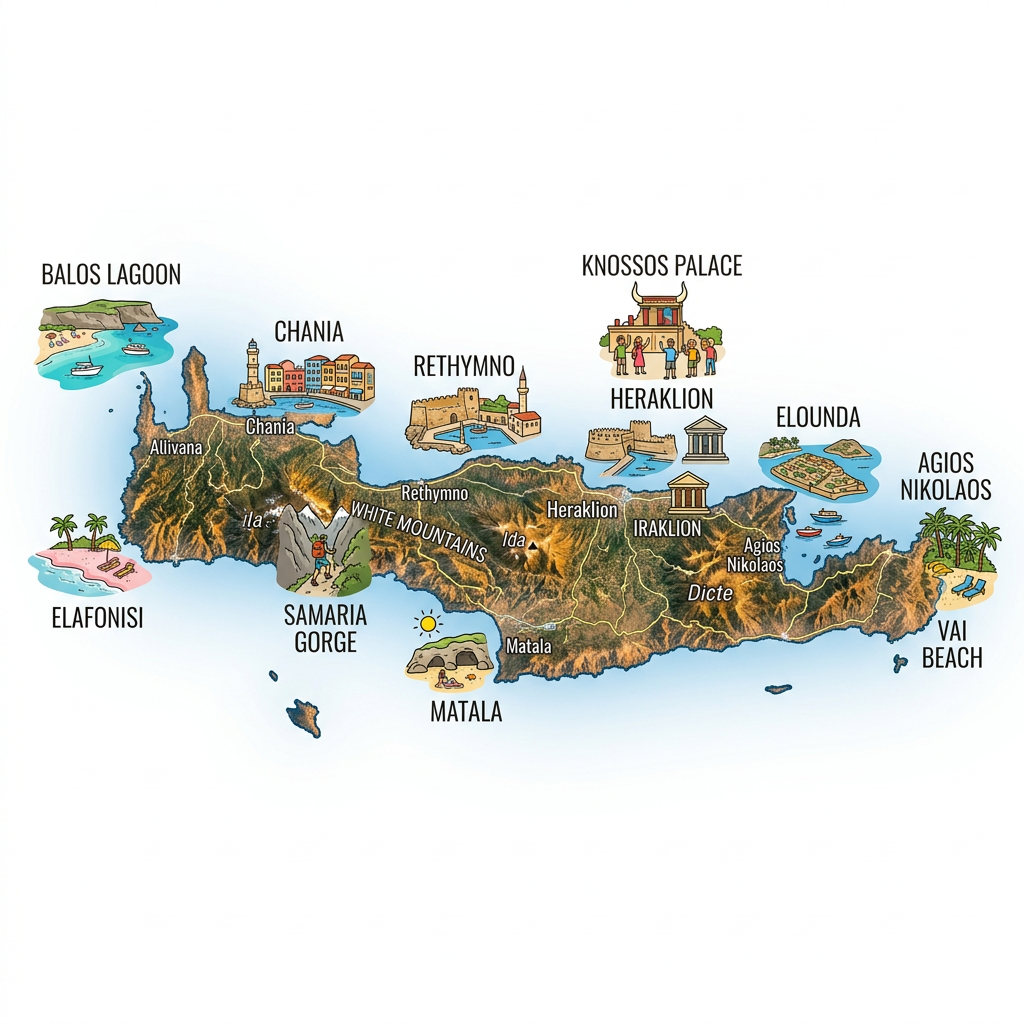
The ultimate guide to the map of Crete
Crete is the largest island of Greece and the fifth largest in the Mediterranean. It attracts thousands of tourists each year seeking history, culture, and beautiful beaches.
To fully enjoy your stay, it is important to carefully prepare your itinerary by equipping yourself with a detailed map of Crete. In this article, you will discover how to choose a map suited to your needs and the various practical information for a successful trip on this fascinating Greek island.
How to choose the right map of Crete?
General maps vs thematic maps
First of all, know that there are two main types of maps to plan your stay: general maps, which cover the entire territory of Crete, and thematic maps, which focus on a specific area—such as cultural heritage, hiking trails, or natural sites.
Depending on your interests and the purpose of your trip, you should therefore choose one or the other type of map, or even a combination of both.

Resolution and Scale
When choosing your map of Crete, also ensure that it is sufficiently precise and detailed (that is, with an appropriate scale) to allow you to plan your excursions and visits.
The ideal scale depends on your needs: if you plan outdoor activities, such as hiking, it might be wise to opt for a large-scale map (1:25,000 or 1:50,000). On the other hand, for cultural or urban tourism, a more general map (1:100,000) may suffice.
Practical information on a map of Crete
A map of Crete must contain several essential elements to facilitate your stay:
- Main road networks: highways, national roads, and local roads must be clearly indicated to help you easily navigate and plan your car journeys.
- Topography: since the island is mountainous, it is important that the map represents the reliefs, altitudes, and valleys to better understand the territory and choose your routes.
- Points of interest: historical monuments, archaeological sites, museums, beaches, natural parks… having these major places visible greatly facilitates organizing your trip.
- Services: hotels, restaurants, car rental agencies, gas stations, parking lots… All these elements are valuable for properly organizing your day and avoiding unpleasant surprises.
It is obviously possible to complement a paper map with online information and mobile applications dedicated to tourism, hiking, or water activities, for example.
How to make the most of the available cultural information?

Crete is a true paradise for history and culture enthusiasts. To fully enjoy this heritage richness, it is important to know the must-see sites as well as the different guided tour options and organized circuits offered on site.
- Archaeological sites: Among the most famous remains are the Palace of Knossos and the site of Phaistos. There are also many other lesser-known but equally interesting places to discover.
- Museums: Crete has several museums of historical and cultural interest, such as the Heraklion Archaeological Museum, the Maritime History Museum of Chania, and the Cretan Folklore Museum of Agios Nikolaos.
- Historical and religious monuments: Byzantine churches, monasteries, Venetian fortresses… The island is full of buildings bearing witness to its rich past.
- Traditional villages: Take the time to immerse yourself in local life by visiting the many small Cretan villages, where traditions and customs are still very much alive.
A good cultural map of Crete should not only indicate these places of interest but also offer thematic itineraries and routes to help you organize your visits according to your desires and the time you have available.
Moreover, it can contain information on opening hours, prices, and access to tourist sites – a valuable time saver when planning your trip.
The importance of a city map during your stay in Crete
Finally, don’t forget that Crete also has several cities worth visiting, such as Heraklion (the capital), Chania, Rethymno, or Agios Nikolaos. To fully enjoy the cultural, gastronomic, and nightlife offerings of these cities, it is essential to have a detailed city map.
This should include:
- Main streets, avenues, and squares, as well as traffic directions
- Means of transport (bus stops, bus stations, taxi stands…)
- Monuments, museums, theaters, and art galleries
- Commercial areas, markets, and shopping centers
- Restaurants, bars, and other entertainment venues
With all this information in hand, your stay in Crete will be all the more successful and memorable. Whether you are a fan of relaxing on the beach or eager for cultural discoveries, a map tailored to your needs and preferences is an essential tool to fully enjoy everything this Greek island has to offer.
FAQ – The ultimate guide to the map of Crete
Crete is the largest island in Greece and is located south of the Aegean Sea. It is renowned for its diverse landscapes, rich historical heritage, and beautiful beaches.
Crete is home to must-see attractions such as the Palace of Knossos, the Samaria Gorge, and the cities of Chania and Heraklion. The island also attracts visitors with its traditional villages, picturesque harbors, and crystal-clear waters.
Spring and autumn offer pleasant temperatures and are ideal for exploring the island. Summer is perfect for enjoying the beaches and water sports, although it is warmer and busier.
