
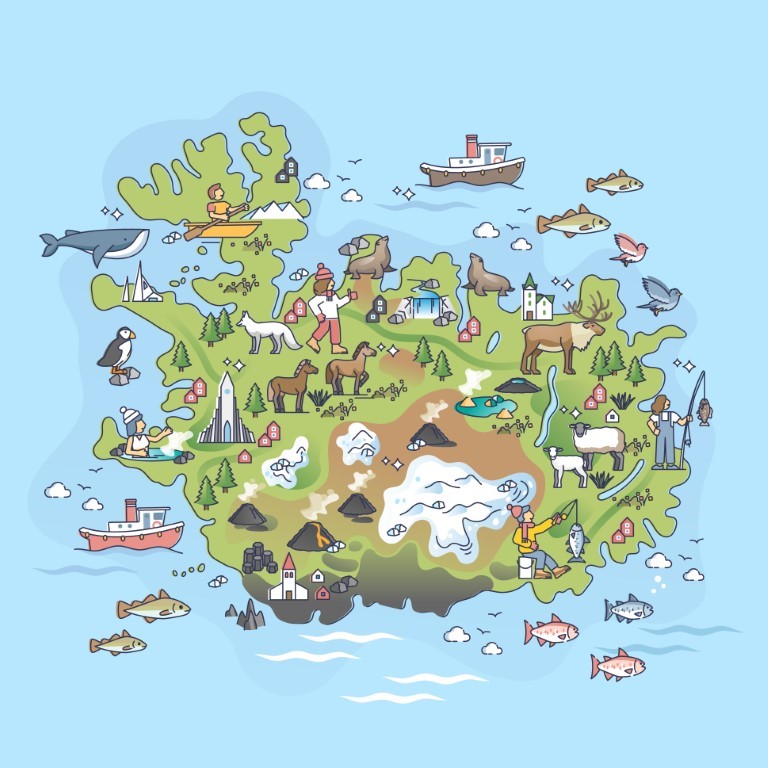
Iceland is an island located in the North Atlantic Ocean, between North America and Europe. It is renowned for its spectacular landscapes, volcanic activity, and remarkable natural diversity. The population is estimated at around 400,000 inhabitants, spread across an area of 103,000 km². This gives the country one of the lowest population densities in Europe.
Iceland has Reykjavík as its capital; it is the largest city in the country located in the Southwest and housing the most inhabitants. The country also has still active volcanoes because its geography consists of sand and lava fields. The climate is characterized by a cool summer and a harsh winter typical of a temperate climate influenced by the Gulf Stream. Iceland’s telephone code is 354, that is 00354 or +354.
The best cities in Iceland
Main attractions in Iceland
Reykjavik
The capital is an excellent city to visit; it is a coastal city gathering two-thirds of the population. It is especially known for its countless music scenes and for being lively all the time, especially during the sunny nights.
Akureyri
It is an agricultural city, pleasant and beautiful. It is full of historical monuments such as museums and the Icelandic botanical garden. It is also a lively city because it offers you concerts and various festivals as well as cultural exhibitions.
Húsavík
It is the most popular tourist city in Iceland because you can go there to see whales. There is also the whale museum. It is also an excellent place for hiking. Some tourists even organize themselves in winter to go for walks in the high mountains during the snowy season.
Vík í Mýrdal
Located in the South of Iceland, Vík is a popular tourist area especially for its black sand beaches. You can then observe the huge cliffs and the tiny buildings built around an elevated church.
Seyðisfjörður
It is an excellent place for hiking especially if you like hills and nature. Artists are also present in large numbers in the streets of the city and you can admire their works.
Siglufjörður
If you like winter sports, Siglufjörður will suit you. It is an excellent place for cross-country skiing, ice skating, and snowmobiling. You can also play golf or go fishing during the summer. The main attractions of the city are the herring museum and the folk music center.

Where the cities are located on the map ?
Reykjavik
On the map, Reykjavik is located in the Southwest part. It is a coastal city located in Faxaflói Bay. The city is bordered on two sides by Kollafjörður and Skerjafjorður, two fjords to the north and south. Geographical location: 64° 08′ 17″ north, 21° 55′ 43″ west
Akureyri
On the map, the capital of the Norðurland region is located in the North. Akureyri is bordered by mountains and crossed by the Glerá river. Its geographical coordinates are: 65° 41′ 00″ north, 18° 06′ 00″ west
Húsavík
On the map, Húsavík is also located in the north of Iceland. Like Akureyri, Húsavík is part of the Norðurland eystra region. Geographic coordinates: 66° 02′ 53″ north, 17° 20′ 00″ west
Vík í Mýrdal
The town of Vík í Mýrdal is located in the south of the country. It is a volcanic town as it is established under the slope of Mýrdalsjökull. Geographic coordinates: 63° 25′ 10″ north, 19° 00′ 35″ west
Seyðisfjörður
On the map, Seyðisfjörður is placed in the East of Iceland, it is a tiny village. Geographic coordinates: 65° 15′ 47″ north, 14° 00′ 32″ west
Siglufjörður
Siglufjörður is a town in Fjallabyggð, located in the north of the Icelandic map, also in Norðurland eystra. Geographic coordinates: 66° 09′ 07″ north, 18° 54′ 32″ west.
Financial map of Iceland
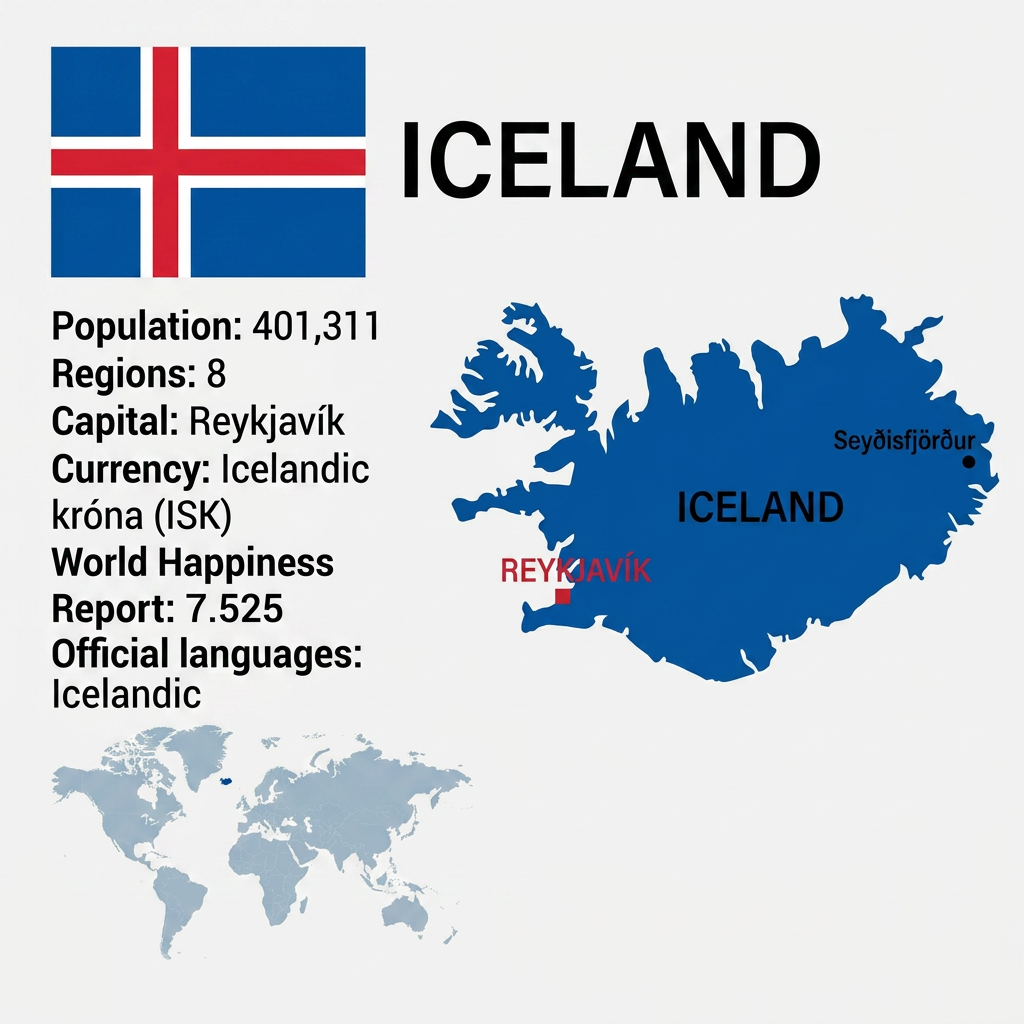
The latest United Nations data states that the Icelandic economy is the 13th freest this year in terms of index. It stands at 77.1 and has not changed since last year. Its development index allowed Iceland to rank 7th among the 45 European countries.
The collected information indicates an interesting growth of the Icelandic economy over the last 10 years. Moreover, GDP growth has followed the same pace.
Here are some indicators
- GDP (PPP): approximately US$31 billion
- GDP Growth: around 0.5% annual growth
- GDP per capita: approximately US$78,000
- Unemployment rate: around 3.6%
- Inflation (CPI): around 5.9%
- FDI flows: approximately US$1.2 billion
Climate map of Iceland
The climate in Iceland is cold and temperate, due to its proximity to the Arctic Circle and the North Atlantic and the runoff of the Gulf Stream which carries warm water northwards. Winters in the country are therefore cold but tempered by higher temperatures.

The climate of Iceland shows similarities with that of all northern countries. However, the regions of the island have different climatic characteristics. For example, the southern part of the island is less cold than the north in winter. This difference is observed by the more frequent heavier falls in the north.
Precipitation
Precipitation is high in the southern part: rainfall is 1,300 mm to 2,400 mm per year. In the northern part, precipitation is low, about 500 mm each year. In the eastern part, precipitation is about 800 mm per year or snow. The rainiest parts are the mountainous regions with more than 4,000 mm of rainfall per year.
The center of Iceland is composed of many mountain ranges and plateaus. In this region, summer is colder than elsewhere, while winter is marked by heavier snow cover up to 700 m.
Winter
In the South, snows fall abundantly in this region. The winter period is longer than summer. The snow cover lasts from October to May. In the North, snows are more abundant and last from June to September, it can even snow in summer. In general, the winter temperature ranges between -10 and -15°C. Added to the winds from Greenland, the cold air could lower the temperature to between -20 and -30°C.
Summer
Almost the entire country experiences a cool summer. The months with the highest temperatures are July and August. The overall temperature is about 14°C. The North shows a temperature range from 10 to 12°C. The South, on the other hand, is warmer, between 25 and 26°C. The center shows a maximum temperature of 28°C.
Demographic and administrative map of Iceland
Administration of Iceland
Iceland is made up of 8 administrative regions. Each of these regions has a “capital” similar to French prefectures.
- East Region: Austurland with its capital Egilsstaðir
- South-West Region: Höfuðborgarsvæðið with its capital Reykjavik
- North Region: Norðurland eystra with its capital Akureyri
- North-West Region: Norðurland vestra with its capital Sauðárkrókur
- South Region: Suðurland with its capital Selfoss
- South-West Region: Suðurnes with its capital Keflavik
- North-West Region Vestfirðir with its capital Isafjörður
- West Region: Vesturland with its capital Borgarnes
These 8 regions are subdivided into towns or municipalities. Iceland has 76 municipalities and towns.
Demographics of Iceland
Currently, the Icelandic population is estimated at 342,287 inhabitants according to United Nations estimates. Contrary to the mid-year figure of 341,243, the population has clearly increased.
According to the UN ranking of countries, Iceland ranks 180th on the list of countries and correlations by population.
Iceland is the least populated country in Europe with 9 inhabitants per km2. For an area of 100,2250 km2, the majority of the Icelandic population, that is 322,286 inhabitants, live in large cities, representing 94.4%. Finally, Iceland has a rather young population with an average age of 37.5 years.
Demolinguistic Data:
The official language of Iceland is Icelandic, an ancient language dating back to the 9th century. This language has never changed and is one of the oldest languages used by the Nordics. Icelandic has not been influenced by the languages of neighboring countries. However, Icelandic is classified into two types: Old Icelandic and Modern Icelandic.
Almost 98% of the Icelandic population uses the native language. The rest use the official languages of neighboring countries. Dialects do not exist in Iceland, but there are only regional variations such as that of Reykjavík and other regions of the Northeast or Northwest.
FAQ-Iceland map: Geographical and demographic information
Iceland is an island located in the North Atlantic Ocean, between Greenland and Norway. A map helps illustrate its isolated position near the Arctic Circle.
A map of Iceland shows the main cities, volcanoes, glaciers, fjords, and major roads. It also helps locate the national parks and the country’s most famous natural attractions.
Iceland has a relatively small population, with most residents living in the Reykjavik region. The country has a low population density because of its large territory and natural environment.
