
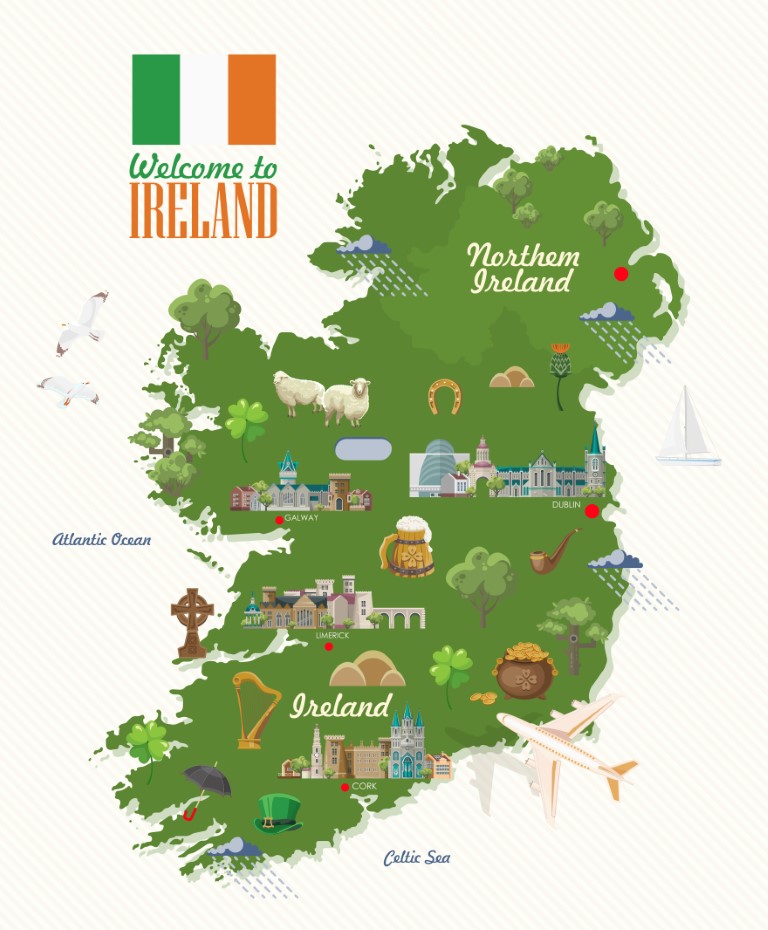
Ireland is an island country located in Western Europe. It occupies the upper portion of the island of Ireland. Politically, the country is governed by a parliament and holds the status of a parliamentary republic.
The official currency in Ireland is the Euro and it is called the Republic of Ireland to distinguish it from the island of Ireland. The capital of Ireland is Dublin, which is also the most populous city in the country.

Ireland covers an area of 70,273 km² and has an estimated population of around 5.4 million inhabitants. As a result, its population density is approximately 77 inhabitants per square kilometre. Ireland’s international dialing code is +353 (or 00353).
The best cities in Ireland
Main attractions in Ireland
Dublin
The city is the capital of Ireland and your first destination in the country. The main attraction in Dublin is the Temple Bar district. There is also Grafton Street which will allow you to connect with street artists. For nature lovers, visit Phoenix Park which is a green park.
Cork
It is the second largest city in Ireland. It stands out for its many colorful houses alongside the tributaries. Enjoy the city by visiting the small shops and also admire the street artists for local paintings or photographs.
Kilkenny
Besides being so close to Dublin (about 150 km), the city of Kilkenny is famous for its medieval image. The city includes an ancient castle located on a height and alleys with very pleasant medieval aspects.
Kinsale
Kinsale is a small village in Ireland that is relaxing to see. To the south of the locality, you can visit the commercial port located south of the town. So walk along the port to observe the unique boats of the harbor. You can also make a detour to Fishy Fishy, an excellent restaurant to taste Ireland’s seafood. Finally, don’t forget to visit Desmond Castle, an ancient castle transformed into an art gallery.
Dingle
Nicknamed the town of the Dolphin Fungie, it is a town located on the coast of Ireland in the Dingle Peninsula. Hikers will find their account by visiting the town’s cliffs. Dingle also offers a distillery called Gallarus Oratory.
Where the cities are located on the map ?

Dublin
Dublin is located on the eastern coast and in the middle of County Dublin. It is situated at the estuary of the Liffey. Geographic coordinates: 53° 20′ 36″ north, 6° 16′ 03″ west.
Cork
The city is located in the extreme southern part of Iceland. Geographic coordinates: 51° 53′ 49″ north, 8° 28′ 41″ west
Kilkenny
This city is located in the Leinster region, that is to say in the southwest direction of the Irish capital. Geographic coordinates: 52° 38′ 52″ north, 7° 15′ 22″ west.
Kinsale
Located at the extreme south of Ireland, Kinsale is part of County Cork. The city is 25 km away from Cork. Kinsale is also situated on the Bandon tributary. Geographic coordinates: 51° 42′ 27″ north, 8° 31′ 50″ west.
Dingle
Located in the southern part of Ireland, Dingle faces the Atlantic and is separated from Tralee and Killarney by 50 and 80 km respectively. Geographic coordinates: 52° 08′ 24″ north, 10° 16′ 18″ west.
Administrative and demographic map of Ireland

Demographics in Ireland
Ireland’s population is currently estimated at around 5.4 million inhabitants, according to the latest estimates. This represents approximately 0.07% of the world’s population. In addition, Ireland now ranks around 120th among the world’s most populous countries.
With a total area of 70,273 km², the country has a population density of about 77 inhabitants per km². More than 63% of Irish residents live in major urban areas, mainly around Dublin, Cork, Limerick, and Galway.
Finally, Ireland has a relatively young population with a median age of around 39 years. Population growth remains positive, supported by natural increase and sustained immigration, despite the gradual ageing of the population.
Some indicators:
- Life expectancy at birth:around 82 years.
- Fertility rate: approximately 1.5 children per woman.
- Male to female ratio: about 99 males for every 100 females.
- Ethnic percentage : around 77% Irish, 10% other White backgrounds, 3% Asian, 2% Black or African backgrounds, with the remainder made up of other ethnic groups and people who did not state their ethnicity.
Administrative subdivisions in Ireland
Administratively, Ireland is subdivided into 30 administrative territories or regions. Each of these regions may or may not be connected to 31 counties (divisions), namely 26 counties, 3 cities, and 2 city-counties.
Here are the 30 administrative divisions of Ireland: Cavan; Clare; Liège; Donegal; Dublin; Dún Laoghaire and Rathdown; Fingal; Galway; Kerry; Kildare; Kilkenny; Laois; Leitrim; Limerick; Longford; Louth; Mayo; Meath; Monaghan; Offaly; Roscommon; Sligo; South Dublin; North Tipperary; South Tipperary; Waterford; Westmeath; Wexford; Wicklow; Carlow.
Here are the 31 counties of Ireland: Antrim, Armagh, Carlow, Cavan, Clare, Liège, Donegal, Down, Dublin, Fermanagh, Galway, Kerry, Kildare, Kilkenny, Laois, Leitrim, Limerick, Londonderry, Longford, Louth, Mayo, Meath, Monaghan, Offaly, Roscommon, Sligo, Tipperary, Tyrone, Waterford, Westmeath, Wexford, Wicklow, Dun Laoghaire-Rathdown, Fingal, South Dublin
Climate map of Ireland
Ireland displays a climate marked by high rainfall and fairly moderate temperatures. It is characteristic of a mild and humid climate or a temperate oceanic climate. Here are the climates of some Irish cities:
Valentia
Located in the southwest part and on a coastal area, the city experiences harsh winters with significant snowfall, even frost. Temperatures at the beginning of the year are around 7°C, and the months of July and August show temperatures around 15.5°C.
The coldest month is December with an approximate temperature of -7.7°C. The hottest month is July with an average temperature of 29°C. Finally, the city is subject to frequent rains reaching up to 1,500 mm per year.
Dublin
The capital experiences a fairly warm summer and compared to other cities, it is by far the warmest in the region. Its coastal location helps reduce its rainfall.
However, rains occur throughout the year. The climate is characterized by less sunshine and a cloudy sky. The month most likely to experience this atmosphere is May. Maritime temperatures range between 15 and 16°C during July and August.
Malin Head
According to climate information, this town has a mild and windy winter and a cool but fairly warm summer. Malin Head is a town located at a height, making it the coldest point in Ireland.
From January to February, temperatures hover around 6°C. Temperatures in July and August are approximately 14.5°C. Finally, rains occur throughout the year with total precipitation reaching up to 1000 mm.
Demolinguistic data Ireland

Current Languages
English is currently the most used language in Ireland. However, some constituencies still use Irish. Here are the percentages of languages currently used in Ireland:
- Local population: English language at 99%, Irish at 1%
- Immigrants: Foreign languages including French at 20%, German at 7%, and Spanish at 3.7%.
Ancient dialects
The ancient Irish dialects are
- The Southern Irish dialect called Munster used in the counties of Cork, Kerry, and Clare.
- The Western Irish dialect called Connacht spoken in the counties of Galway, Mayo, and Sligo.
- The Northern Irish dialect called Ulster spoken in the counties of Donegal, Monaghan, Cavan, Derry, Antrim, Down, Armagh, Fermanagh, and Tyrone.
- Finally, there is another type of dialect called Urban Irish or Leinster Irish.
- Munster: This dialect was formerly used in the counties of Cork, Kerry, and Waterford. Some parts of the Gaeltacht regions also used Munster.
- Connacht: This is an ancient Western dialect used in the central and western sections of Ireland. It was also used in the regions of Mayo, Galway, and Gaeltacht.
- Ulster: This is an ancient dialect spoken in the Gaeltacht counties of Donegal.
- Leinster: Formerly used in the 12 counties of Leinster during the 19th century. Among these counties are Meath, Louth, and Kilkenny.
FAQ-Ireland map: Geographical and demographic information
Ireland is an island located west of Great Britain in the North Atlantic Ocean. A map helps show its location as well as its land border with Northern Ireland.
A map of Ireland shows the main cities, counties, mountains, lakes, and major roads. It also helps locate the coastline, national parks, and the country’s main tourist attractions.
Ireland has a population of just over 5 million people, with a large proportion living in urban areas. Dublin, the capital, is the country’s largest city and its main economic, cultural, and administrative center.
