
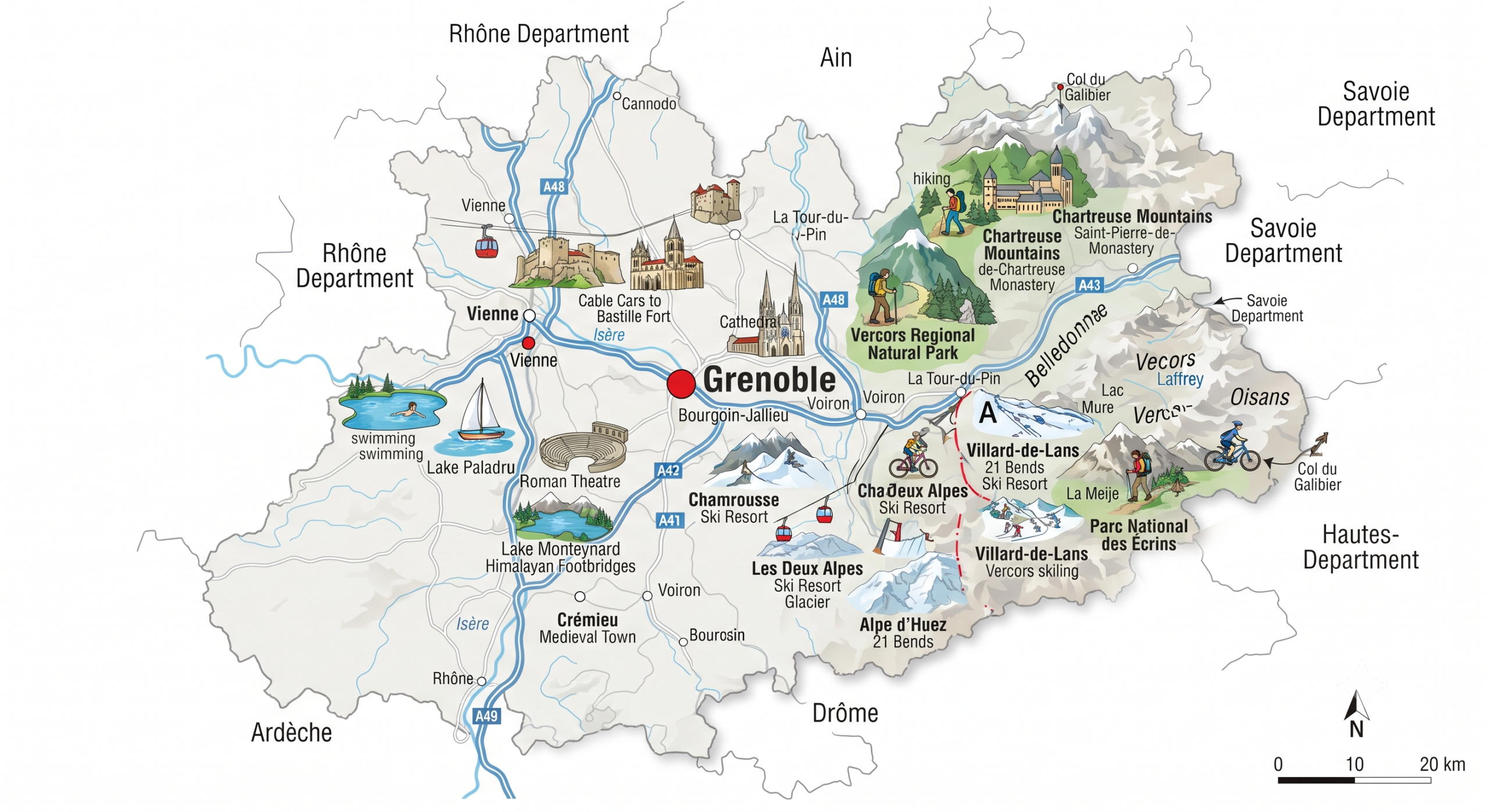
What you need to know about the Isère department ?
Currently, we present to you the Isère department, which is department number 38 in France. Part of the Auvergne-Rhône-Alpes region, it is a landlocked department, meaning an area enclosed in the middle of France without access to the sea.
Its capital, largest city, and prefecture is called Grenoble, and its sub-prefectures are Vienne and La Tour-du-Pin. Geographically, the territory of Isère includes several mountain peaks, including Pic Lory, Barre des Écrins, and finally the summit of La Meije.
These mountains reach heights of 4,088 m, 4,102 m, and 3,983 m respectively. The current population of the Isère department is 1,292,000 inhabitants, and its territory covers an area of 7,431 km². Therefore, the population density of Isère is 174 inhabitants/km², which means that department 38 is the 15th most populated department in France. In addition, the territory of the Isère department is divided into 3 arrondissements, 29 cantons, and 512 communes.

Which departments border the Isère department?
The neighboring departments of Isère are: the Rhône department, the Ain department, the Savoie department, the Alpes department, the Drôme department, and finally, the Ardèche department. These departments border it to the north, east, south, and southwest. There is also the Loire department which borders it to the east. This shows that the territory of Isère encroaches on the territories of the French Alps.
What is the climate like in the Isère department?
The climate of Isère varies greatly depending on its geography (relief and topography) and the extent of its territory. Thus, there is a continental and mountainous climate in the north; in the south, Isère enjoys a Mediterranean climate; and in the southeast, this Mediterranean climate is influenced by the mountainous climate. On the other hand, in the southwest, there is a warm continental climate influenced by the Mediterranean.
The winter period
Indeed, winters in Isère are characterized by cold waves compared to other French departments. Temperatures can even drop as low as -17°C at an altitude of 384 m. And as one ascends in altitude, the cold becomes increasingly persistent. The coldest month is January, especially during the first 10 days, when temperatures are very low, ranging between -1.9°C and 5.4°C. During this winter period, the amount of rainfall is 244 mm. That is to say, 25% of the annual precipitation occurs in winter.
The spring period
Indeed, this period arrives quite early in areas where valleys are numerous. In other words, in high-altitude areas, spring is quite long. Approaching April, temperatures range between 5°C and 16°C, and thunderstorms mainly occur in May. In spring, precipitation amounts to 240.9 mm, which corresponds to about 25% of the annual precipitation.
The summer period
The department, having no access to the sea but being located in the south of France, often experiences hot periods interrupted by thunderstorms. Near the mountain ranges, summers become cooler and sunshine decreases as altitude increases. Also, note that July is the hottest month with temperatures reaching 38°C. During this period, temperatures fluctuate around 27.9°C. The annual rainfall is 236 mm.
During the summer period, the temperature often fluctuates. That is to say, there are warm seasons with temperatures ranging from 26 to 30°C. However, during the hottest periods, the heatwave can even be very intense and reach up to 35°C.
The autumn period is a rainy season. It generally takes place between September and October. This period is the best time if you enjoy mountain hikes on a beautiful sunny day. On the other hand, beware of thunderstorms that occur at the end of the day. Currently, the average temperature is 17.4°C during the autumn periods. And precipitation is low, amounting to 281 mm of annual rainfall.
What are the best cities in the Isère department?
Here are the cities with the most tourist visits in the Isère department, meaning these are the best tourist cities in department 38
- Voiron
- L’Isle-d’Abeau
- Bourgoin-Jallieu
- Échirolles
- Saint-Martin-d’Hères
- Grenoble
- Vienne

What are the largest municipalities in the Isère department?
For this ranking, we chose the 10 largest municipalities in the Isère department
- Saint-Christophe-en-Oisans
- Saint-Pierre-de-Chartreuse
- Roybon
- Vaujany
- Le Haut-Bréda
- Gresse-en-Vercors
- Valjouffrey
- Villard-de-Lans
- Chichilianne
- Tréminis
For this ranking, we chose the municipalities with the highest population densities. So, here are the 10 most populated municipalities in the Isère department
- Grenoble
- Échirolles
- Saint-Martin-d’Hères
- Vienne
- Bourgoin-Jallieu
- Fontaine
- Voiron
- Villefontaine
- Meylan
- Saint-Égrève
FAQ – Isère map
A map of Isère displays the main municipalities, roads, waterways, and the department’s administrative boundaries. It also helps users better understand the geography and territorial organization of this department located in the Auvergne-Rhône-Alpes region.
The prefecture and main city of Isère is Grenoble, a city known for its mountain environment, scientific heritage, and economic dynamism. The department also includes important towns such as Vienne, famous for its historical and cultural heritage.
A map of Isère is useful for planning a trip, locating a municipality, or discovering the department’s Alpine landscapes and tourist attractions. It also makes navigation easier and provides an overall view of this territory made up of mountains, valleys, and plains.
