
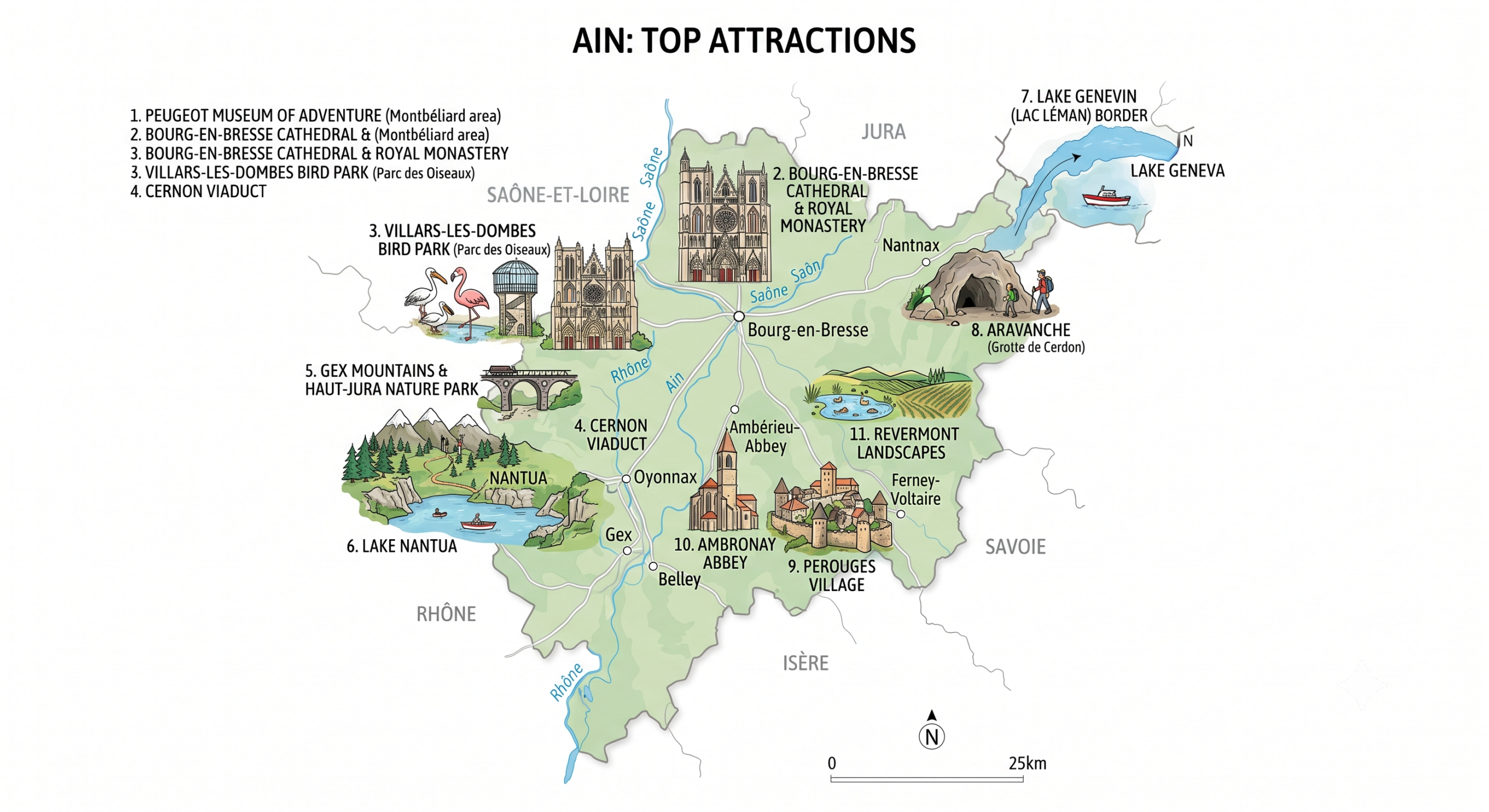
Département carrefour entre Lyonnais, Jura et Genève : l’Ain juxtapose Dombes, Bugey et Pays de Gex. La Carte de l’Ain sert à articuler nature, villages de caractère et grands axes A40 : A42, en optimisant les temps de trajet entre plaines, plateaux et vallées.
What you need to know about Ain ?

The Ain department, numbered 01, is located in eastern France. It takes its name from the Ain river, which flows through part of the territory. The department belongs to the Auvergne-Rhône-Alpes region and is situated at the crossroads of two major rivers: the Saône and the Rhône.
Thanks to its strategic position, Ain benefits from an excellent transport network: major road axes, proximity to the Geneva and Lyon airports, and quick access to Switzerland or major regional metropolitan areas.
The department has approximately 566,740 inhabitants spread over 5,762 km², resulting in an average density of about 98 inhabitants per km².
Which departments border Ain?
Ain is surrounded by several departments:
- Saône-et-Loire (to the northwest)
- Jura (to the north)
- Rhône (to the southwest)
- Isère (to the south)
- Haute-Savoie (to the east)
The best towns and areas to visit in Ain
La Dombes
Located in the northwest of the department, not far from Lyon, La Dombes is a natural region known for its thousands of ponds. It is home to the famous Parc des Oiseaux, one of the most visited sites in the region. The area also houses iconic monuments, such as Notre-Dame des Dombes in Plantay.
Bourg-en-Bresse
The capital of Ain, Bourg-en-Bresse, is surrounded by landscapes combining lakes, rivers, marshes, and traditional agricultural areas. The city is known for its historic center, its Royal Monastery of Brou, and nearby, the Basilica of Ars in Ars-sur-Formans.
Belley – Bugey
The region of Belley and Bugey offers a mountainous setting, composed of wooded hills, vineyards, and picturesque villages. You can discover iconic sites such as:
as well as the remains of the former Bugey Castle.
The Maison d’Izieu, a memorial dedicated to Jewish children refugees during World War II,
The Abbey of Notre-Dame d’Ambronay,
What are the main towns in the Ain department?
Indeed, the Ain department is subdivided into 4 areas: Bresse, Dombes, Bugey, and Gex. These are different zones from a geographical point of view, but they are also diverse in terms of their economy. Here is a list of the main towns of Ain:
Bourg-en-Bresse, Oyonnax, Ambérieu-en-Bugey, Bellegarde-sur-Valserine, Gex, Miribel, Belley, Saint-Genis-Pouilly, Ferney-Voltaire, Divonne-les-Bains, Meximieux, Trévoux, Lagnieu, Montluel, Péronnas, Jassans-Riottier, Viriat, Saint-Denis-lès-Bourg.
| Element | Details |
|---|---|
| Region | Auvergne-Rhône-Alpes |
| Prefecture | Bourg-en-Bresse |
| Sub-prefectures | Belley, Gex, Nantua |
| Population | ~660,000 inhabitants |
| Area | ~5,762 km² |
| Relief: hydrography | Bugey, Dombes with its thousand ponds, Bresse, Pays de Gex: Rhône, Ain, Valserine |
| Climate | Degraded oceanic with continental influence: possible cold winters, hot summers |
| Economy | Agri-food, plastics industry, industrial subcontracting, agriculture and fish farming (Dombes) |
| Key sites | Pérouges, Dombes, Revermont, Ain gorges, Retord plateau, High Jura Chain |
| Access | A42 and A40 towards Lyon and Geneva, TER towards Lyon: Geneva, Bourg-en-Bresse and Bellegarde-sur-Valserine stations |
To set your bearings, start with the map of Ain and identify Dombes, Bugey, and Pays de Gex. If you extend towards the metropolis side, compare the access routes and landscape continuities with the map of Rhône. Towards the alpine reliefs and passes, the map of Haute-Savoie will help you coordinate connections Ain: Savoie: Geneva in the same trip.
FAQ: Map of Ain
The Ain Map juxtaposes Dombes, Bugey, Bresse, and Pays de Gex to connect ponds, viewpoints, and historic towns like Pérouges without detours.
An Ain Map with contour lines and marked trails helps to manage elevation changes, water points, and connections to the Ain gorges.
Yes: the Ain Map identifies A40, A42, interchanges, and TER train stations to coordinate schedules and connections to Lyon and Geneva.
The Ain Map combined with the fishing calendar and birdwatching observations suggests spring and autumn for the ponds and reserves.
