
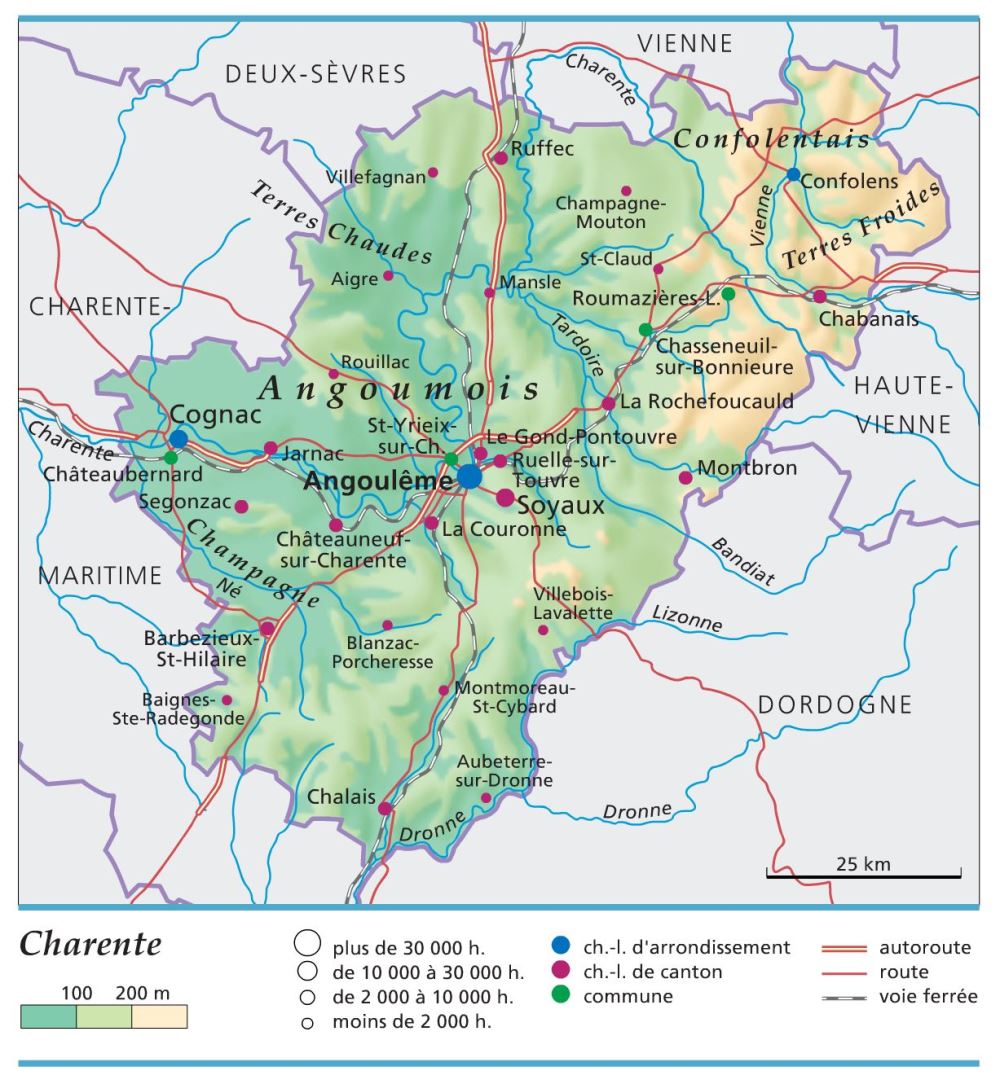
What you need to know about the Charente department ?
Here is department 16 of France, it is part of the Nouvelle-Aquitaine region and is called Charente. In fact, this name was given in honor of the Charente river, which is one of the largest in the department. Moreover, this river is also the watercourse that separates the two most important cities of the department, called Angoulême and Cognac. Thus, the Charente river, from which the department’s name originates, is the longest river in the department.
Geographically, the territory of the Charente department is mostly included in the Aquitaine basin. Its northeast section, however, is part of the Massif Central. So, since there are areas near the department that are heavily crossed by continental waters, they were named Charente-Maritime.

Moreover, the Charente department was originally part of the Angoumois region. Additionally, the Angoumois area (an ancient region) and the ancient regions of Poitou and Saintonge were incorporated as part of the Charente department.
As previously mentioned, department 16 is part of the Nouvelle-Aquitaine region. Its capital and prefecture are located in Angoulême, while its sub-prefectures are Cognac and Confolens. Charente covers an area of 5,956 km² and has around 352,000 inhabitants, giving it an average population density of 59 inhabitants per km². It ranks among the most populated French departments, at around 68th place. The Charente department is currently organized into 365 municipalities, 19 cantons and 3 districts.
Which departments border the Charente department?
Formerly, the Charente department was part of the Nouvelle-Aquitaine region, which was previously called Poitou-Charentes. Therefore, the neighboring departments of Charente are Deux-Sèvres, the Vienne and Haute-Vienne departments, the Dordogne department, and finally, the Charente-Maritime department.
What is the climate Like in the Charente department?
The Charente department has a maritime environment of the Aquitaine type, which is more noticeable in its 66% western part, from Cognac to Angoulême. It shifts toward a degraded maritime environment to the east, toward the low regions of the Massif Central, in the Confolentais area where cold and winter precipitation are more observed.
The environment of Charente is a calm maritime environment of the Aquitaine type, characterized by a truly high normal sunshine. Precipitation is moderate, not exceeding 1,200 mm per year. Temperatures fluctuate relative to the norm from +5 °C in winter to +20 °C in summer. Winters are mild and stormy, but in summer the environment can be very dry, with dry season periods sometimes accentuated during the summer months.
What are the most important cities in the Charente department?
Based on population density per km², here are the most important cities in the Charente department:
- Angoulême,
- Cognac,
- Soyaux,
- Ruelle-sur-Touvre,
- La Couronne,
- Saint-Yrieix-sur-Charente,
- Gond-Pontouvre,
- L’Isle-d’Espagnac,
- Champniers,
- Barbezieux-Saint-Hilaire,
- Jarnac,
- Châteaubernard,
- Roullet-Saint-Estèphe,
- Brie,
- Ruffec,
- Fléac,
- Châteauneuf-sur-Charente,
- La Rochefoucauld.

What are the most important municipalities in the Charente department?
If we refer to the area of the municipalities in Charente, we have listed below the largest municipalities
- Terres-de-Haute-Charente
- Nanteuil-en-Vallée
- Saint-Maurice-des-Lions
- Brigueuil
- Alloue
- Champniers
- Montbron
- Brillac
- Roullet-Saint-Estèphe
- Cellefrouin
If we refer to the population density per km2, the most important municipalities in Charente are:
- Angoulême
- Cognac
- Soyaux
- Ruelle-sur-Touvre
- La Couronne
- Saint-Yrieix-sur-Charente
- Gond-Pontouvre
- L’Isle-d’Espagnac
- Champniers
- Barbezieux-Saint-Hilaire
FAQ-Map of Charente
Charente is a department located in the Nouvelle-Aquitaine region, in southwestern France. It is known for its vineyards, green valleys, and rich historical heritage.
The prefecture of Charente is Angoulême, a city renowned for its International Comics Festival and its architectural heritage. It serves as the department’s main administrative, economic, and cultural center.
A map of Charente helps locate the main towns, roads, rivers, and tourist attractions of the department. It is especially useful for planning a trip, discovering the landscapes of Charente, or exploring the region’s vineyards.
