
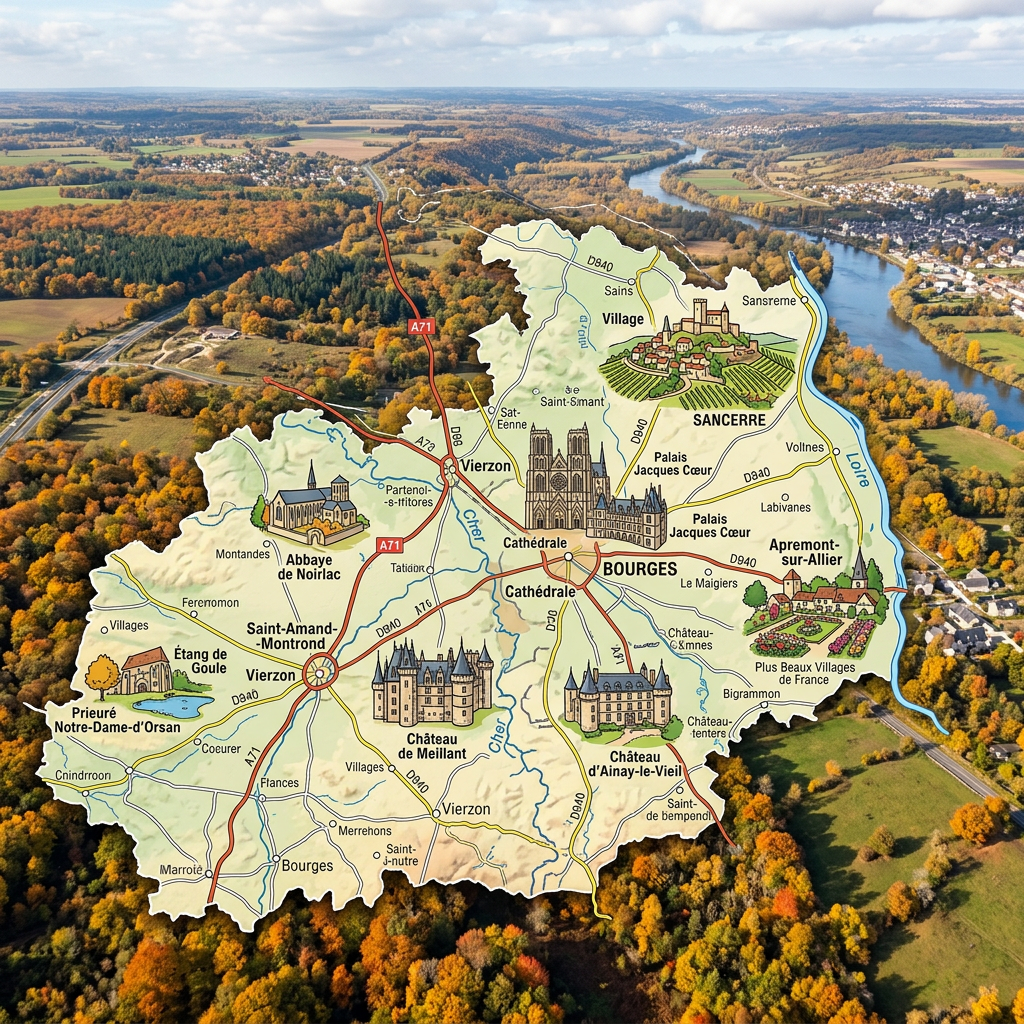
What you need to know about the Cher department ?
Let’s talk about department 18 of France, which is a department that is part of the Centre-Val-de-Loire region. Cher is a very old department; in fact, its origin dates back to the French Revolution in 1790. A major part of this territory is linked to Indre and the Province of Berry.
Currently, the population of the Cher department is around 300,000 inhabitants, known as the Berrichons, who live across a territory covering 7,235 km². This represents an average population density of approximately 41 inhabitants per km². The Cher department is among the least populated departments in France, ranking around 74th in terms of population size. Furthermore, its prefecture and capital is located in Bourges, while its sub-prefectures are Saint-Amand-Montrond and Vierzon.

Which departments border the Cher department?
In fact, there are 6 departments neighboring the Cher department, located in 5 different departments, namely:
Loir-et-Cher, Indre, and Loiret, all located in the Centre-Val de Loire region. Then, there is Creuse bordering it to the south, which is part of the Nouvelle-Aquitaine Region. Next, there is Allier, a department of the Auvergne-Rhône-Alpes region, bordering it to the southeast. Finally, there is Nièvre, part of the Bourgogne-Franche-Comté department, bordering it to the east.
What is the climate like in the Cher department?
Indeed, the territory of Cher is divided into several climatic zones that present various types of weather.
- First, the territory of Sologne: its rainfall varies from year to year. Precipitation can be variable. The driest months are from March to September. The other months are wetter. This is because in the Sologne area, there is much dryness that only occurs in spring and summer. The average annual rainfall is 650-750mm, and frost occurs about 70 days per year. The average temperature in this zone is 10 °C.
- The second climatic zone is the territory of Pays Fort. Located in the northeastern northern section of department 18, its climate is quite harsh. There are many precipitations, although they are evenly distributed throughout the year. The average rainfall is 750-900mm, and frosts occur 84 days. The average temperature throughout the year is 10 °C.
- The third climatic zone is the territory of Boischaut Nord. In this zone, there is a lot of precipitation, but it only occurs at certain times of the year. However, the rainfall in this zone is lower than in the others. Thus, the average rainfall reaches 600-750mm, average temperatures hover around 11 °C, and frosts occur 66 days.
What are the best cities in the Cher department?
Based on population density per km2, here are the most important cities in the Cher department:
• Bourges
• Vierzon
• Saint-Amand-Montrond
• Saint-Doulchard
• Mehun-sur-Yèvre
• Saint-Florent-sur-Cher
• Aubigny-sur-Nère
• Saint-Germain-du-Puy
• Dun-sur-Auron
• Trouy
• La Guerche-sur-l’Aubois
• La Chapelle-Saint-Ursin
• Sancoins
• Avord
• Argent-sur-Sauldre
• Méreau
• Châteaumeillant
• Saint-Martin-d’Auxigny

What are the most important regions in the Cher department?
Referring to the area of the communes in Cher, we have listed below the most important communes.
- Brinon-sur-Sauldre
- Nançay
- Ivoy-le-Pré
- Méry-ès-Bois
- Presly
- Vierzon
- Bourges
- Argent-sur-Sauldre
- Neuvy-sur-Barangeon
- Blancafort

Referring to the population density per km2, the most important communes in Cher are:
- Bourges
- Vierzon
- Saint-Amand-Montrond
- Saint-Doulchard
- Mehun-sur-Yèvre
- Saint-Florent-sur-Cher
- Aubigny-sur-Nère
- Saint-Germain-du-Puy
- Dun-sur-Auron
- Trouy
FAQ-Map of Cher
Cher is a department located in the Centre-Val de Loire region, in the center of France. It is appreciated for its rural landscapes, castles, vineyards, and rich historical heritage.
The prefecture of Cher is Bourges, a city famous for its cathedral listed as a UNESCO World Heritage Site and its historic center. It is the main administrative, economic, and cultural hub of the department.
A map of Cher helps locate the main towns, rivers, roads, and tourist attractions of the department. It is useful for planning a stay, discovering the Berry heritage, or exploring the landscapes of the Centre-Val de Loire region.
