
What you need to know about the Côte-d’Or department ?
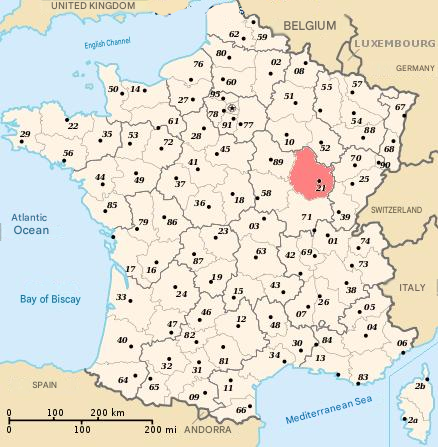
Here is department 21 of France, which is part of the Bourgogne-Franche-Comté region; it is the Côte-d’Or department. It is one of the oldest departments in France, totaling 83, and was established in 1790 following the French Revolution. The capital and prefecture of the department is Dijon, and the sub-prefectures are Montbard and Beaune. Department 21 is located on the territory of the former province of Burgundy, which no longer exists today.
This department 21 is managed by a president of the departmental council. Its area currently covers 8,763 km² and its population is around 538,000 inhabitants, representing an average density of 61 inhabitants per km². Côte-d’Or is one of the most populated departments in the Bourgogne-Franche-Comté region. Administratively, the Côte-d’Or department is divided into 3 districts: Dijon, Beaune and Montbard. These districts are further divided into 23 cantons and 698 municipalities.
Which departments border the Côte d’Or department?
The departments bordering department 21, Côte-d’Or, are the Nièvre department, the Yonne department, the Jura department, the Saône-et-Loire department, the Haute-Saône department, the Aube department, and finally, the Haute-Marne department.
What is the climate like in the Côte-D’Or department?
Regarding its altitude, department 21, Côte-d’Or, is nestled at 435 m above sea level. However, it still faces the sea towards the west, which gives it a maritime climate; therefore, its summers are hot, winters are cold but mild. Regarding temperatures, the average annual temperature is 11.2 °C, meaning that temperatures in Côte d’Or are 0.82 °C lower than the national average. Regarding precipitation in Côte-d’Or, the annual rainfall amounts to 41.5 mm, which means it rains only 31% of the year, or about 31.31% of the time annually.
What are the main cities in the Côte d’Or department?
The largest urban communities in the Côte d’Or department by population according to the 2007 census are:
- Beaune,
- Talant,
- Chevigny-Saint-Sauveur,
- Fontaine-lès-Dijon,
- Saint-Apollinaire,
- Dijon,
- Chenôve,
- Quetigny,
- Longvic,
- Auxonne

What are the main communes of the Côte d’Or department?
Referring to the area of the communes in the Côte d’Or department, we have listed below the largest communes.
- Villiers-le-Duc
- Salives
- Montbard
- Dijon
- Étalante
- La Roche-en-Brenil
- Selongey
- Auxonne
- Laignes
- Saint-Martin-du-Mont
Referring to population density per km2, the most significant communes in the Côte d’Or department are:
- Dijon
- Chenôve
- Chevigny-Saint-Sauveur
- Longvic
- Auxonne
- Beaune
- Talant
- Quetigny
- Fontaine-lès-Dijon
- Saint-Apollinaire

FAQ-Map of Côte d’Or
Côte-d’Or is a department located in the Bourgogne-Franche-Comté region, in east-central France. It is known for its prestigious vineyards, rolling landscapes, and rich historical heritage.
The prefecture of Côte-d’Or is Dijon, a city famous for its gastronomy, architectural heritage, and historical role in Burgundy. It serves as the department’s main administrative, economic, and cultural center.
A map of Côte-d’Or helps locate the main towns, roads, vineyards, and major tourist attractions. It is especially useful for planning a trip, discovering the Burgundy wine route, or exploring the region’s heritage.
