
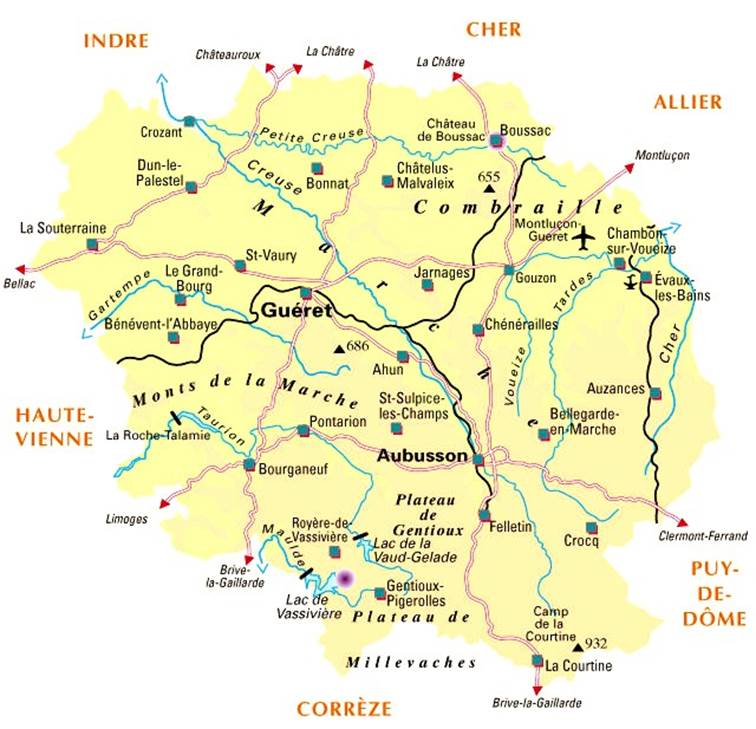
What you need to know about the Creuse department ?
Among the departments of France, there is the Creuse department, which is part of the Nouvelle-Aquitaine region. Indeed, this department previously belonged to the Limousin region before that region ceased to exist. Then, the territory occupied by the Limousin region was taken over by the territory of La Marche.

Creuse, or Department 23, is located in the northern part of the Massif Central. Its name comes from the Creuse River, which flows across the department from east to west. The department currently has 113,711 inhabitants and covers an area of 5,565 km², giving it a population density of 20 inhabitants per km². Its prefecture, administrative center, and largest town is Guéret. In addition, Creuse is one of the French departments with only one sub-prefecture, which is Aubusson.
What are the neighboring departments of the Creuse department?
Although department 23 is part of Nouvelle-Aquitaine, a region of France, there are also other departments neighboring it, namely Corrèze, the Puy-de-Dôme department, the Cher department, the Allier department, and finally, the Haute-Vienne department.
What is the climate like in the Creuse department?
The Creuse has a maritime climate, mostly temperate to the east and south due to rugged plains that block part of the Atlantic showers. This geology, overlapping the Loire basin and the rock level of the Massif Central, benefits from numerous lakes, streams, and water supplies, as well as vegetation of a bright green.
The wettest month is December, with precipitation regularly approaching 150 mm. There can also be a sharp decrease in precipitation between December and January, with about 20 mm of precipitation recorded in January.
Snowfall is regular from late December to the extreme limit of February in the high Creuse (Haute-Marche, Millevaches area, Creuse Auvergne). Daylight lasts: 241 hours in winter, 607 hours in spring, 830 hours in summer, which is above normal, and 334 hours in pre-winter, which is slightly above normal.
What are the most important towns in the Creuse department?
Based on the number of inhabitants in each town, that is, the population density per km2, here are the most important towns in Creuse:
- • Guéret,
- • La Souterraine,
- • Aubusson,
- • Bourganeuf,
- • Sainte-Feyre,
- • Saint-Sulpice-le-Guérétois,
- • Felletin,
- • Saint-Vaury,
- • Ahun,
- • Évaux-les-Bains,
- • Gouzon
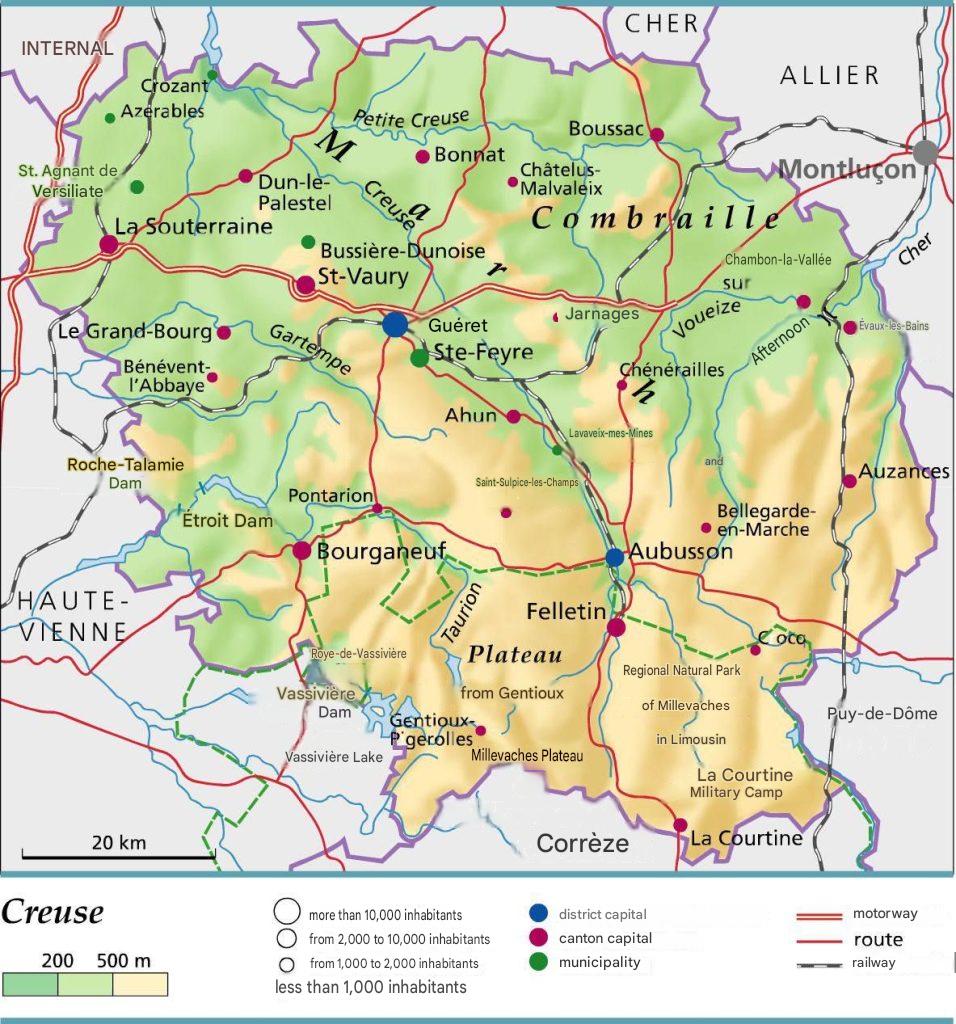
What are the most important communes in the Creuse department?
Based on the population density per km2, here are the most important communes in the Creuse department
- • Le Grand-Bourg
- • Saint-Agnant-de-Versillat
- • Vallière
- • Faux-la-Montagne
- • Lussat
- • Gentioux-Pigerolles
- • Royère-de-Vassivière
- • Gouzon
- • La Nouaille
- • Dontreix
Based on the area of the communes, here are the most important communes in the Creuse department:
- • Guéret
- • Bourganeuf
- • Saint-Vaury
- • Évaux-les-Bains
- • La Souterraine
- • Aubusson
- • Sainte-Feyre
- • Felletin
- • Gouzon
- • Boussac
FAQ-Map of Creuse
The Creuse department is located in the Nouvelle-Aquitaine region in central France. It is known for its natural landscapes, valleys, and rural heritage.
The capital of the Creuse department is Guéret. It serves as the main administrative center and hosts many public services.
A map of Creuse helps you locate towns, roads, and major tourist attractions. It is also useful for planning a trip or exploring the department’s natural areas.
