
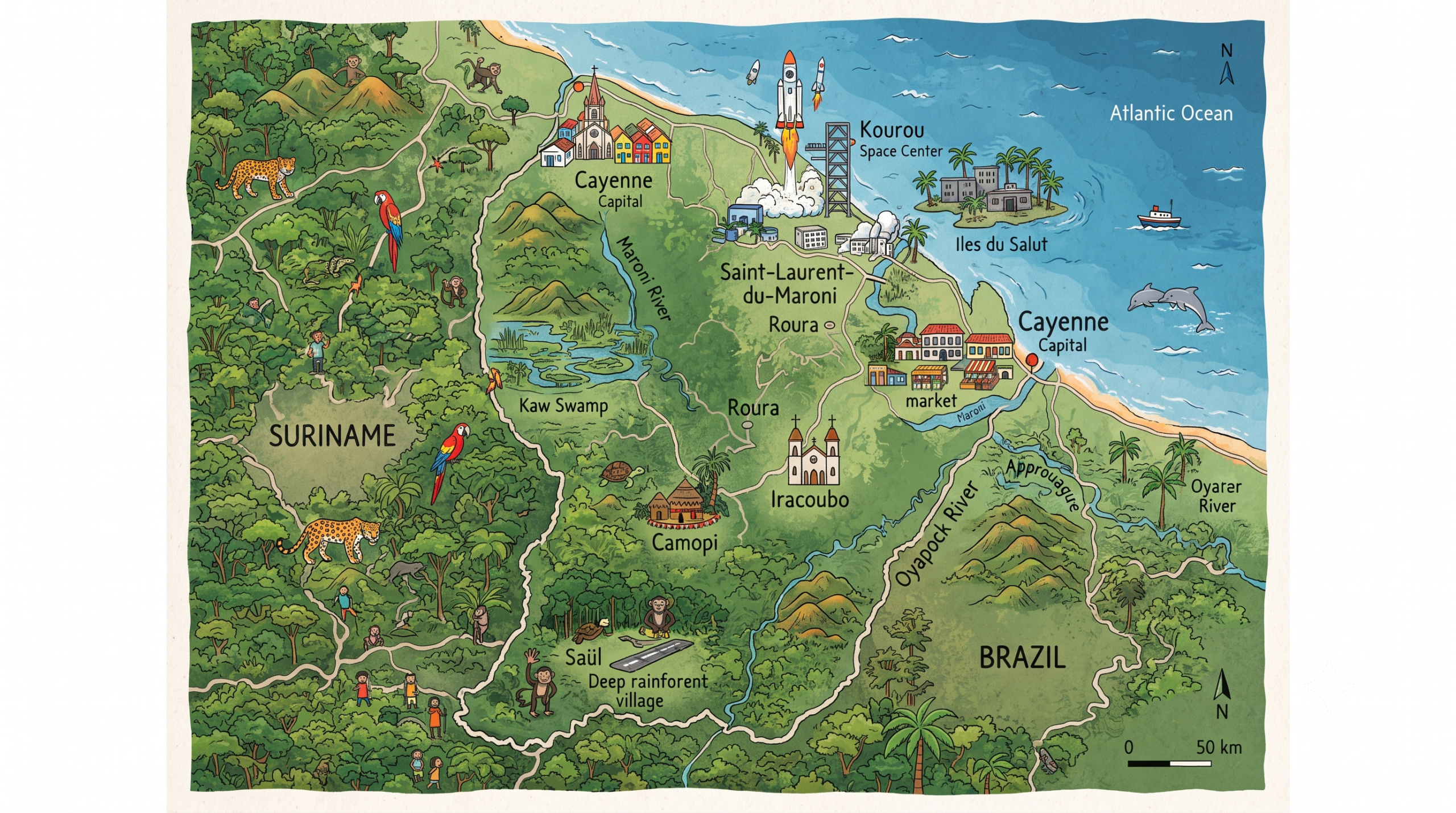
What you need to know about the department of Guyane ?
Indeed, we present to you a French department, more precisely, a single-department region. Geographically, it is called an overseas department, since it is located in South America. This department is actually called: the department of Guyane or also department 973. Another interesting fact about Guyane is that it is the only overseas department attached to a continent.
The fact is that, since this department is located outside mainland France, its region is commonly known as French Guiana or Guyana. In demographic terms, the inhabitants of French Guiana number 296,711 people and have a density of 3.5 inhabitants per square kilometre, making it the least densely populated department in France, given its area of 83,846 km². In addition, the capital of French Guiana and its largest city is called Cayenne. Regarding the administrative subdivisions of territory 973, they include 2 arrondissements (Cayenne and Saint-Laurent-du-Maroni), as well as 22 municipalities and 4 intermunicipal authorities.

What is the geography of Guyane like?
The fact is that the department of Guyane is located on the South American continent. This implies that its neighboring borders are: Brazil and Suriname. And given its area which we already mentioned above, it is the second largest French region after Nouvelle-Aquitaine. When we talk about the topography of Guyane, it is divided into two topographic regions, namely:
- The lowlands: also called the coastal plain. This is the area located within a radius of 10 km off the coast.
- The highlands are mainly made up of the Guyanese plateau and constitute a major part of the 973 territory. It is also here that there is a real diversity of reliefs.
What is the climate of the department of Guyane like?
The department of Guyane being located near equatorial territories, its climate is obviously equatorial. But specifically, it is a humid equatorial climate, a type of climate where temperatures average around 25.5°C throughout the year. So, when we talk about rainfall amounts, this overseas department is very rainy with an annual rainfall that can reach: 2,816 mm
When we talk about seasonal differences: there is a wet season that mainly occurs between December and July, then a hot and dry period during the rest of the months of the year. Approaching July, precipitation gradually decreases.
Then, there is an increase in precipitation as we approach November, the month with 105 mm of rainfall. Consequently, the wettest month of the department continues to be the month with 518 mm of precipitation, that is, the month of May.
What are the most important cities in the department of Guyane?
We have compiled for you a list of the 10 main cities of Guyane.
- Cayenne
- Saint-Laurent-du-Maroni
- Matoury
- Kourou
- Remire-Montjoly
- Macouria
- Maripasoula
- Mana
- Apatou
- Papaichton

What are the largest communes of Guyane?
Here are the largest communes of the department of Guyane in terms of population density per km2
- Cayenne (prefecture)
- Apatou
- Awala-Yalimapo
- Camopi
- Grand-Santi
- Iracoubo
- Kourou
- Macouria
- Mana
- Maripasoula
FAQ – French Guiana map
A map of French Guiana helps you locate the main municipalities, rivers, forests, and natural areas of this territory. It also provides a better understanding of its vast size and geographical organization.
A map helps identify tourist sites, transportation routes, and accessible areas of the territory. It also makes it easier to organize your travels in this region with diverse landscapes.
Yes, it helps discover the Amazon rainforest, nature reserves, and major waterways. It is also a practical tool for exploration activities and geographic research.
