
What you need to know about Guadeloupe ?
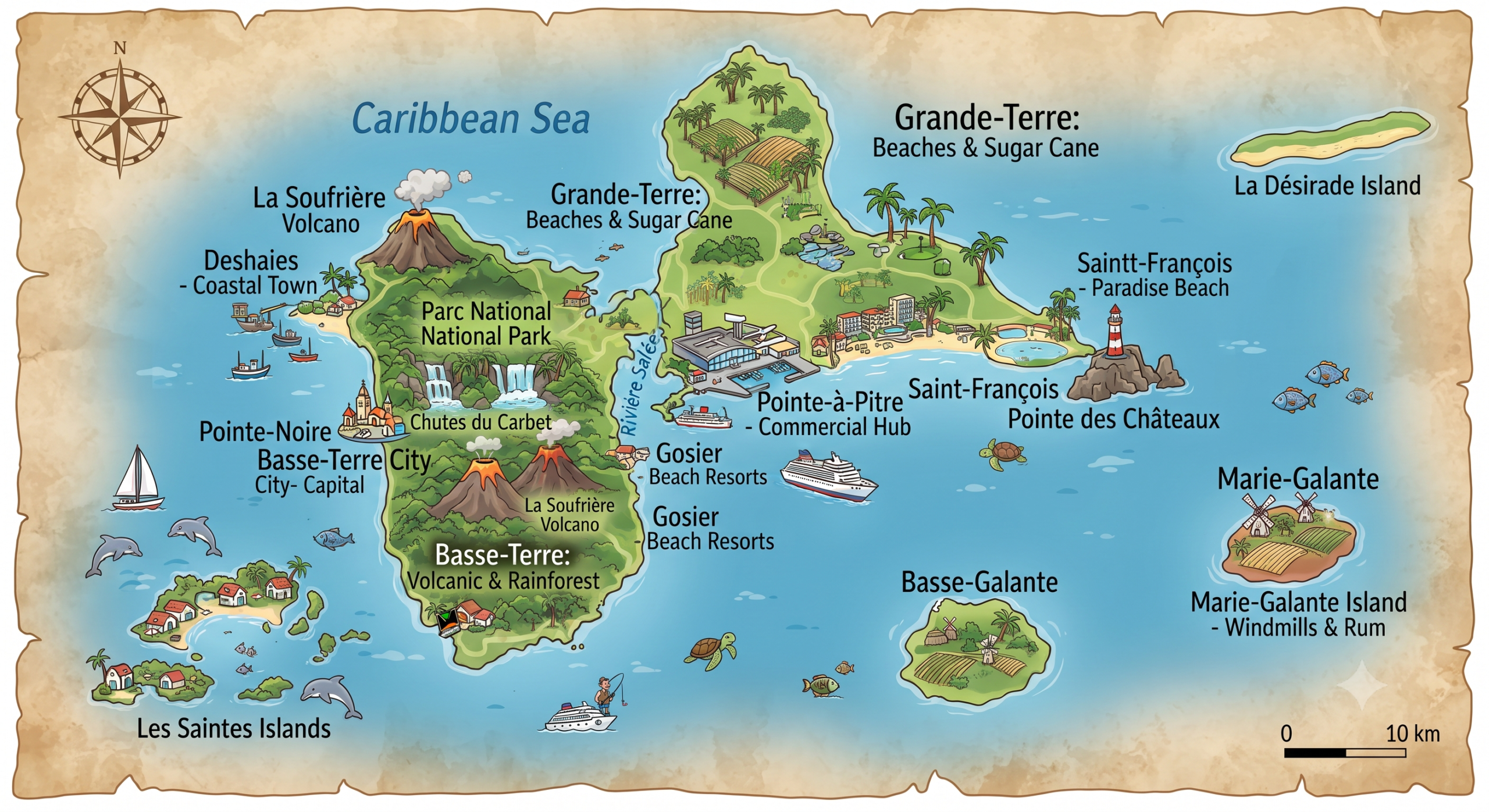
We are currently presenting to you a French overseas department. It is the 971, a department also named Guadeloupe, which is also a region and an archipelago that is part of the Caribbean. The fact is that this department is divided into several islands, namely 7. There are then two main islands called Grande-Terre and Basse-Terre, located respectively to the East and West.
Between these two land masses, there is a small stretch of sea called the Rivière Salée. So, the largest city of this 971 department and also its administrative center and capital is called Basse-Terre. However, its economic capital is Pointe à Pitre. There are also two arrondissements constituting the administrative divisions of 971, named after the two capitals.
The territory of Guadeloupe is made up of 21 cantons, 32 municipalities, and 6 intermunicipal authorities. In terms of demographics, the population of Guadeloupe currently stands at 376,879 inhabitants, with a density of 231 inhabitants per square kilometre. This is due to the fact that the total area of territory 971 is 1,628.43 km². Furthermore, the main languages spoken in this archipelago are Guadeloupean Creole and French.

What is the geography of Guadeloupe like?
When talking about overseas departments, specifically Guadeloupe, the Caribbean Sea borders it to the west. Conversely, to the east, this department is limited by the Atlantic Ocean. Then, Venezuela is the closest to it at about 575 km across the sea. Next comes the Dominican Republic, which is close to 971 at 739 km to the east-southeast. When we then talk about the islands making up the Guadeloupe region, they are:
Continental Guadeloupe: mainly made up of the peninsulas of Grande-Terre and Basse-Terre. The dependent islands are then: Marie Galante, the Saintes Archipelago. The latter is composed of Terre-de-Haut and Terre-de-Bas and La Désirade. When talking about territories near the Guadeloupe department, we distinguish: Puerto Rico, Antigua, Portugal, Belize, Cape Verde, Curaçao, and Barbados.
What is the climate of the Guadeloupe department like?
Since Guadeloupe is located in a tropical territory, its climate is therefore also tropical. But it doesn’t stop there; the climate is also influenced by the sea, so we speak of a kind of temperate tropical climate with maritime influence.
Two main seasons are distinguished: the first season is called (the dry season), also called “Carême.” This season runs from January to June. Also, the cool and humid season is called the “hivernage” season and mainly takes place between July and December.
It is also known that on average temperatures hover around 27°C throughout the year and that the hottest months have steady temperatures (25 to 32°C). Conversely, the coldest months mostly have temperatures of 23-29°C.
There is also the fact that the geography of the archipelago is contrasted, notably between Basse-Terre and Grande-Terre, which generates many particular climates for each island. First, when talking about Grande-Terre, there is a lot of dryness and also trade winds that regulate precipitation.
But in general, the weather across the entire territory tends to be misty and windy. As a result, precipitation is significant and will reach 12,000 mm of rain per year, and when we talk about sea temperature, it averages 28°C. Moreover, it is not negligible that hurricanes could occur between May and November, forming in the Antilles or off the coast of Cape Verde.

What are the most important cities in the department of Guadeloupe?
We have compiled a list of the top 10 tourist cities not to be missed in the department of Guadeloupe
- Sainte-Anne
- Canton du Gosier
- Saint-François
- Sainte-Rose
- Trois-Rivières
- Bouillante
- Pointe-à-Pitre
- Petit-Bourg
- Basse-Terre
- Le Moule
FAQ – Guadeloupe map
A map of Guadeloupe helps you locate the main municipalities, islands, beaches, and natural areas of this archipelago. It also provides a better understanding of the geographical organization of this Caribbean territory.
A map helps identify tourist sites, roads, and must-see places across the different islands. It also makes it easier to organize your travels and fully enjoy the landscapes of Guadeloupe.
Yes, it helps discover beaches, mountains, natural parks, and cultural sites of the territory. It is also a practical tool for exploring the archipelago and planning excursions.
