
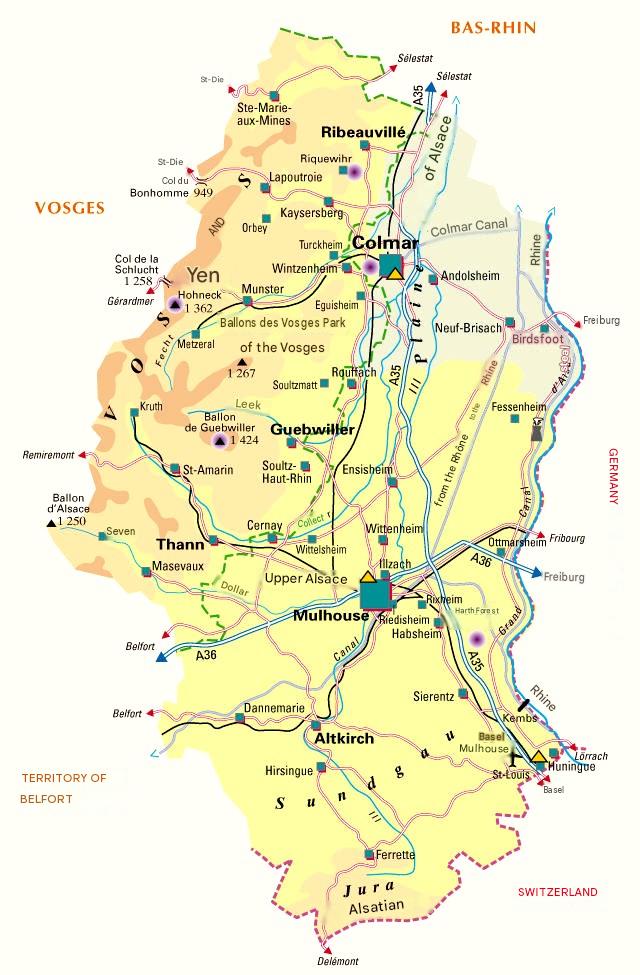
What you really want to know about the Haut-Rhin department ?
We invite you to find here the branch of Haut-Rhin which is a French division located in the upper eastern part of the country. Moreover, this said division is an integral part of the locality (region) Grand-Est. It is indeed the division numbered 68 which is both a regulatory state.
Ultimately, this department is administered by the French State, and its prefecture, which is also its capital, is Colmar. In addition, its subprefectures are Mulhouse, Thann-Guebwiller, and Altkirch. Regarding demographics, department 68 currently has 793,556 inhabitants, and with a total area of 3,525.17 km², its population density is approximately 225 inhabitants per square kilometre.
Furthermore, the Haut-Rhin department is divided into: Arrondissements, Legislative constituencies, Cantons, Intercommunalities, and Communes, with the distinctive quantities of 4, 6, 17, 16, and 366.

Which other departments border the Haut-Rhin department?
Geologically, the branch of Haut-Rhin is located in the southern part of Alsace, more precisely, in low-altitude lands for the majority of its territory. Thus, its adjoining departments are called Bas-Rhin, branch of Vosges, and the department of Territoire-de-Belfort.
Similarly, this said division 68 shares a common border with Germany through its eastern division by the place called: Baden-Württemberg. This office also shares a common border with Switzerland measuring approximately 78.37 km along its southern part.
What is the environment of the Haut-Rhin department like?
Due to the location of the Vosges in the western locality of the country, the typical environment of the said department is semi-continental, characterized by cool and dry winters and scorching and fierce summers. This environment, impacted by the foehn, has the specific consequence that the area of Colmar is one of the driest places in France (with little precipitation).
The area where Sundgau is located is more humid since it is diametrically opposite to the plain of Belfort. Moreover, it is not protected by the Vosges. Its current situation is thus closer to that of Franche-Comté. The Vosges mountains are covered with snow for most of the period from December to early April.
Office 68 is less bright, moreover, there is less usual mist throughout the colder period of the year somewhat like in Bas-Rhin. Thus, the Haut-Rhin department benefits from more sunshine.
The high-altitude region of the department also benefits from sunnier winter atmospheric conditions than those of Bas-Rhin, given their higher altitude. The High Vosges can then have ski resorts.
What are the main cities of the Haut-Rhin department?
The largest metropolises of the Haut-Rhin department in terms of inhabitants per km2 are:
- Mulhouse,
- Colmar,
- Saint Louis,
- Ilzach,
- Wittenheim,
- Kingersheim,
- Rixheim,
- Riedisheim,
- Guebwiller,
- Cernay
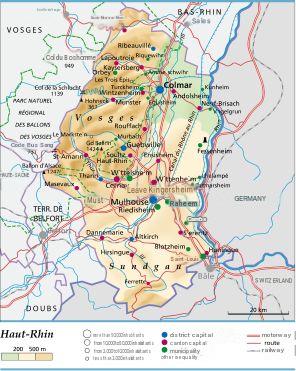
What are the main communes of the Haut-Rhin department?
To make this list, we referred to the density of inhabitants per km2 of each of the communes of Haut-Rhin:
- Colmar
- Sainte-Marie-aux-Mines
- Ensisheim
- Métzéral
- Sainte-Croix-aux-Mines
- Orby
- Rouffach
- Ribeauvillé
- Soultz-Haut-Rhin
- Stoswihr
Regarding this second arrangement of the municipalities in the branch of the Haut-Rhin department, we grouped them according to the density of inhabitants per km2:
- Mulhouse
- Saint Louis
- Wittenheim
- Rixheim
- Guebwiller
- Colmar
- Ilzach
- Kingersheim
- Riedisheim
- Cernay
FAQ – Haut-Rhin Map
A map of Haut-Rhin helps you locate the department’s main towns, roads, mountain ranges, and natural areas. It also provides a better understanding of the geographical organization of this Alsatian territory.
A map helps identify municipalities, tourist attractions, and the main transportation routes. It also makes it easier to plan an itinerary and optimize your travels.
Yes, it helps you discover villages, monuments, vineyards, and remarkable landscapes. It is also an excellent resource for sightseeing and geographic research.
