
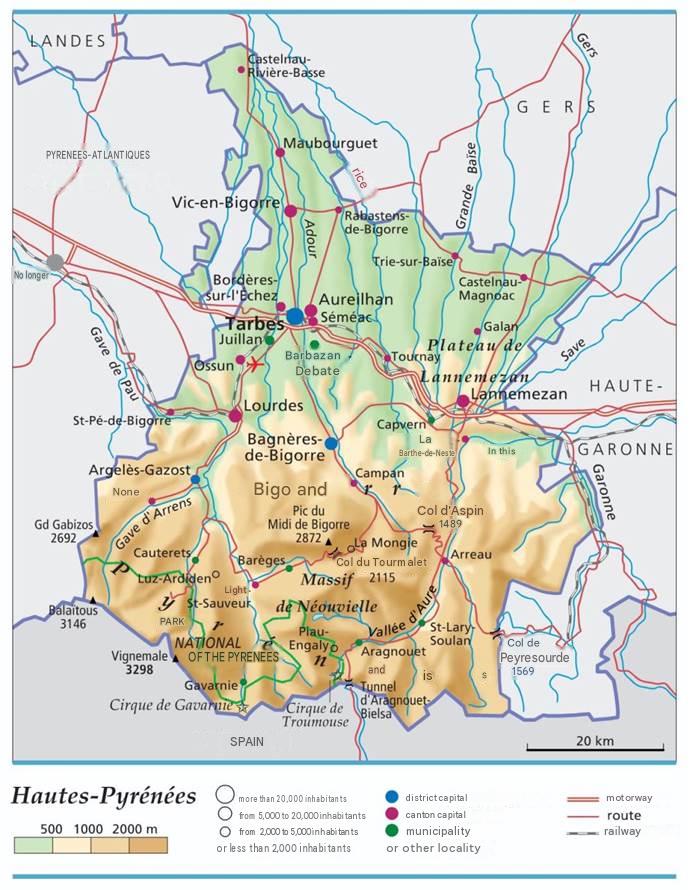
What you need to know about the Hautes-Pyrénées department
We invite you to discover the department 65 of France, which is actually a department that is part of the southern section of the country, that is to say in the Occitanie region.
The Hautes-Pyrénées department is among the oldest French departments dating back before 1790. Furthermore, the prefecture of department 65, which, by the way, is also its capital, is called Tarbes. Its sub-prefectures, on the other hand, are: Argelès, Gazost, and Bagnères-de-Bigorre.
The inhabitants of the Hautes-Pyrénées, known as the Bigourdans or Haut-Pyrénéens, number 232,323 inhabitants and the department’s surface area is 4,464 km². This means the department has a population density of 52 per km². Administratively, department 65 is divided into 3 arrondissements, 2 legislative constituencies, 17 cantons, 9 intercommunal entities, and 469 communes.

What are the neighboring departments of the Hautes-Pyrénées department?
As mentioned, department 65 is part of the Occitanie region; its neighbors are: in the Nouvelle-Aquitaine region, the department of the Pyrénées-Atlantiques. Then, there is the department of the Gers and the department of Haute-Garonne. Finally, department 65 shares a border with Spain, more precisely with the community of Aragon and the province of Huesca.
What is the climate like in the Hautes-Pyrénées department?
The presence of mountains along the southern part of the department and the general west-east orientation of the Pyrenean range create strong climatic contrasts in department 65.
The northern half
The low regions (northern half) benefit from a strong foehn effect due to southwest currents: temperatures can then reach record highs. On the other hand, the mildness causes a retention effect of clouds and heavy rainfall because of the maritime northwest current. This makes precipitation more noticeable in low altitude areas and other Pyrenean plateaus. Likewise, late frosts can occur surprisingly.
Nevertheless, the northern half is mostly mild and calm (median points of 5 or 6° in January to 18 and 19° in July), with normal precipitation increasing near the mountains (normal annual totals of 80 to 120 cm). Fog, strong breeze, and snow are very rare, especially in Lannemezan, which peaks at 600 meters altitude.
The southern half
Due to the variety of reliefs, openings, and significant altitudinal variations (500 to 3,300 meters), the southern half is infinitely more heterogeneous in terms of climate. This offers a large number of microclimates. The low valleys surrounded by high defensive massifs indeed contribute to an environment that is not excessively harsh, such as in Argelès-Gazost or Saint-Lary-Soulan.
Precipitation there is almost identical to that of the Piedmont (900 to 1200 mm/year) and snow cover is short-lived. Located at the border of the Pyrénées-Atlantiques, the Ouzom valley is much more watered. Above 1000 to 1500 meters altitude, called the mountain level, snow remains on the ground for some time each year, allowing for skiing.
At the point where one is at an altitude of 2,500 to 3,000 meters, it is high mountain without vegetation cover: the environment is extremely windy, exceptionally icy from October to June. Temperatures range from -8° in February to 7° in July. Near the Franco-Spanish border, the impact of the south-west wind current is intensified, causing the highest precipitation aggregates in the department.
What are the best towns in the Hautes-Pyrénées department?
Here we present to you the best towns you should visit in the Hautes-Pyrénées department, these are its main tourist towns:
- Tarbes
- Bagnères-de-Bigorre
- Lourdes
- Aureilhan
- Vic-en-Bigorre
- Bordères-sur-l’Echez
- Barbazan-Debat
- Odos
- Lannemezan
- Laloubère

What are the most important municipalities in the Hautes-Pyrénées department?
To make this ranking, we referred to the extent of each of the municipalities in the Hautes-Pyrénées department:
- Cauterets
- Bagnères-de-Bigorre
- Arrens-Marsous
- Saint-Lary-Soulan
- Ferrère
- Gavarnie-Gèdre
- Aragnouet
- Campan
- Estaing
- Luz-Saint-Sauveur
Regarding this second ranking of the municipalities in the Hautes-Pyrénées department, we grouped them according to the density of inhabitants per km2:
- Tarbes
- Bagnères-de-Bigorre
- Lannemezan
- Séméac
- Juillan
- Lourdes
- Aureilhan
- Vic-en-Bigorre
- Bordères-sur-l’Échez
- Barbazan-Debat
FAQ: Hautes-Pyrénées map
The Cirque de Gavarnie is a natural site listed as a World Heritage site. The sanctuary of Lourdes attracts millions of international visitors every year.
Summer is ideal for hiking in the high mountains. Winter allows you to enjoy the ski resorts with abundant snow.
A car is essential for reaching mountain passes and remote valleys. Shuttles run regularly to the most popular tourist sites.
