
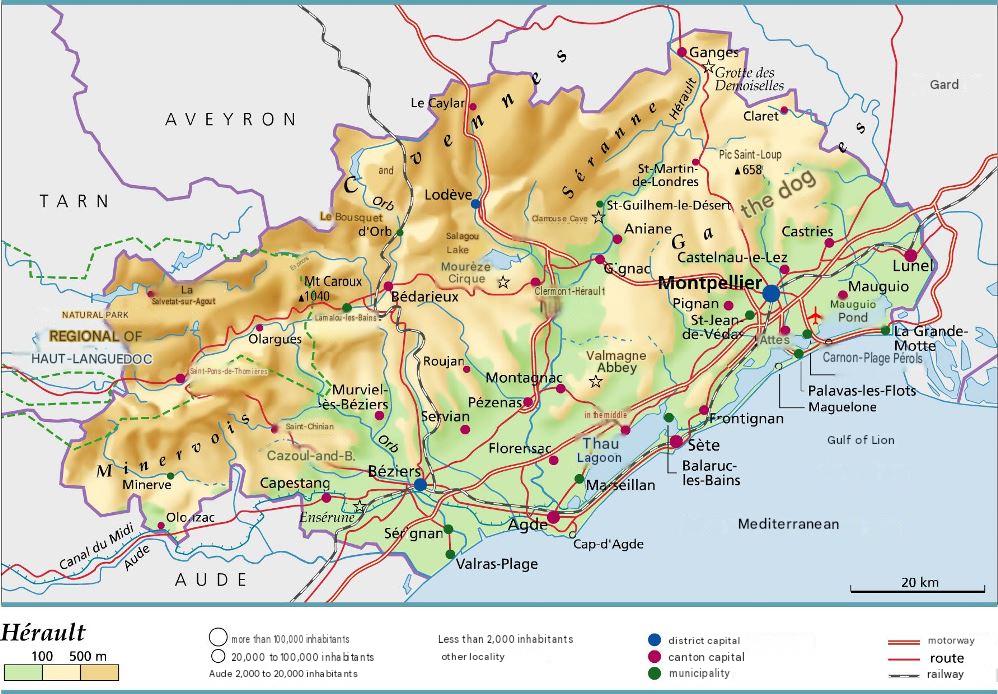
What you need to know about the Hérault department ?
In the Occitanie region, there are several departments including Hérault, which is department number 34 in France. Located in the southern section, this department takes its name from a river that runs through its territory.
Currently, the population of Hérault is estimated at around 1,250,000 inhabitants, who are called Héraultais, and its territory covers an area of 6,224 km². Therefore, the population density is 201 inhabitants per km². The prefecture, departmental capital, and largest city of the department is Montpellier, and its sub-prefectures are Béziers and Lodève.
The department of Hérault is currently divided into 3 arrondissements, 9 constituencies, 25 cantons, 16 intermunicipalities, and 342 communes. The geography of department 34 is highly diverse, including mainly mountains (the Cévennes), beaches (in the southern part) and agricultural lands.
Thus, the Hérault department is likened to a kind of amphitheater overlooking the sea. The landscapes are also very diverse and include southern foothills, coastlines facing the Mediterranean, and finally, areas with Garrigue and plains for vine planting.

What are the neighboring departments of the Hérault department?
In fact, the neighboring departments of department 34 are the department of Aveyron, the Mediterranean department, the Tarn department, and the department of Aude.
What is the climate like in the Hérault department?
Actually, the Hérault department has a Mediterranean-type climate. However, as one moves into the northwest area, the climate becomes increasingly oceanic. Moreover, some parts of the northern Hérault department are strongly influenced by a temperate continental climate.
Furthermore, during the summer periods, the temperature is similar to the average in France. However, in the coastal areas, temperatures approach heatwave levels, and in winter, there is significant frost. So, in summer, temperatures range between 27 and 32 °C in the continental zone. Conversely, during other periods, the lowest temperatures can reach 19 °C in the coastal areas, while in other zones, temperatures are around 15 °C.
Therefore, the best times to visit the Hérault department are from May to September, during which one can enjoy warmth and low precipitation. On the other hand, in department 34, the average temperature is 28 °C in July compared to the coldest month, January, with a temperature of 10 °C.
What are the most important cities in the Hérault department?
The 10 cities we present to you are those with the most tourist interest, meaning that if you want to recharge, these 10 cities in Hérault are the best.
- Montpellier
- Béziers
- Sète
- Saint-Guilhem-le-Désert
- Pézenas
- Clermont-l’Hérault
- Villeneuvette
- Roquebrun
- Agde
- Marseillan
What are the most important communes in the Hérault department?
For this ranking, we have chosen the 10 largest communes in the Hérault department:
- Béziers
- Saint-Maurice-Navacelles
- Fraisse-sur-Agout
- Montpellier
- Rosis
- La Salvetat-sur-Agout
- Avène
- Aumelas
- Riols
- Marseillan
For this ranking, we chose the municipalities with the highest population densities. So, here are the 10 most populated municipalities in the Hérault department:
- Montpellier
- Sète
- Frontignan
- Lattes
- Castelnau-le-Lez
- Béziers
- Lunel
- Agde
- Mauguio
- Mèze

FAQ – Hérault map
A map of Hérault displays the main municipalities, roads, waterways, and the department’s administrative boundaries. It also helps users better understand the geography and territorial organization of this department located in the Occitanie region.
The prefecture and main city of Hérault is Montpellier, a city renowned for its historical heritage, universities, and economic dynamism. The department also includes important cities such as Béziers, known for its cultural traditions and heritage.
A map of Hérault is useful for planning a trip, locating a municipality, or discovering the department’s natural and tourist attractions. It also makes travel easier and provides a clear overview of this area located between the Mediterranean Sea and the inland region.
