
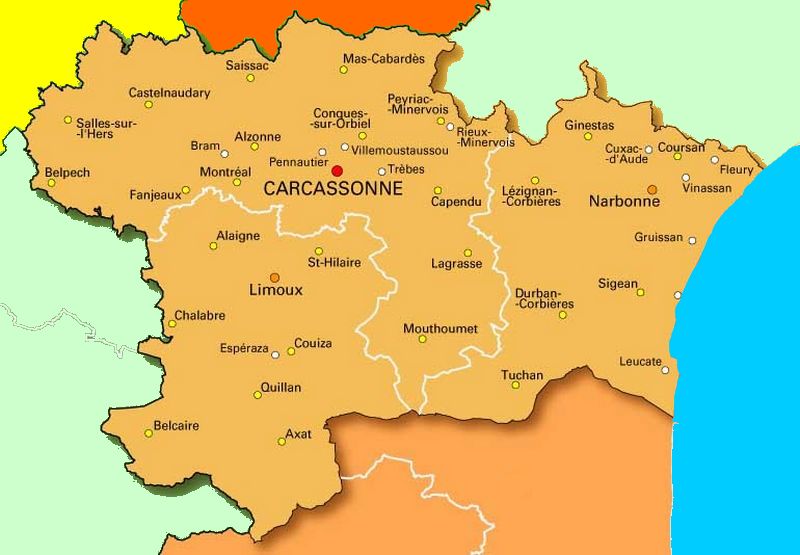
What you need to know about the Aude department ?
Located in southern France, the Aude is the French department numbered 11. It is part of the Occitanie region. The department takes its name from the Aude River, which flows through its territory. Its capital and prefecture is Carcassonne. Today, the department has around 379,000 inhabitants spread over an area of 6,139 km², giving it a population density of approximately 62 inhabitants per square kilometer. This places Aude among the French departments with a moderate population density.

What are the neighboring departments of the Aude department?
Halfway between the Pyrenees and the Mediterranean Sea, the Aude department is a department of the Occitanie region. The department’s borders are shared with those of Pyrénées-Orientales, the Ariège department, the Hérault department, Tarn, and Haute-Garonne. Finally, this department is also bordered by the Gulf of Lion.
What is the climate like in the Aude department?
Although the Aude has many climatic zones, they all have different climates. There are those influenced by the Mediterranean and others by the Atlantic. Therefore, in the Aude department, there are zones with dissimilar climates.
Thus, there is the Mediterranean zone, which extends from the coastal area up to 30 km inland. In this zone, the climate is milder because the hours of sunshine are high, summers are mild and sunny, and winters are less harsh.
As for the zone extending from the western section towards Carcassonne, there the climate is influenced by the Atlantic. There, precipitation is high but not excessive compared to the northern zone. This is why this western area is an agricultural zone, where you will find all kinds of plantations, notably wheat, but also rapeseed.
In the mountainous areas extending from the upper valley towards the Black Mountain, precipitation becomes higher especially during autumn and spring, and in winter, there is heavy snowfall. The vegetation is mainly dominated by conifers.
There are 4 distinct seasons: winter between January and February, spring between March and May, summer between June and September, and autumn starting in September. Winter is rather rainy and snowy at times, but sunshine is always present and temperatures hover around 15°C during sunny hours.
During the spring season, temperatures are quite pleasant, around 25°C, but it sometimes rains. During the summer period, the temperature can be scorching and reach up to 40°C. Finally, during the autumn period, the days are sunny although there are still rainy periods. However, in the evenings, temperatures are pleasant.
What are the most important cities in the Aude department?
Based on population density per km2, here are the most important cities in the Aude department:
- Narbonne,
- Carcassonne,
- Castelnaudary,
- Lézignan-Corbières,
- Limoux,
- Coursan,
- Trèbes,
- Port-la-Nouvelle,
- Sigean,
- Cuxac-d’Aude,
- Gruissan,
- Leucate,
- Quillan,
- Bram,
- Fleury,
- Villemoustaussou,
- Salles-d’Aude,
- Pennautier

What are the 10 largest municipalities in the Aude department?
Referring to the area of the municipalities in Ariège, we have listed below the largest municipalities
- Narbonne
- Carcassonne
- Tuchan
- Saissac
- Montréal
- Fleury
- Val-de-Dagne
- Castelnaudary
- Roquefort-des-Corbières
- Gruissan
Referring to the population density per km2, the largest municipalities in Ariège are:
- Carcassonne
- Cazilhac
- Villemoustaussou
- Trèbes
- Villegailhenc
- Limoux
- Narbonne
- Lézignan-Corbières
- Vinassan
- Berriac
FAQ-Aude map
Aude is a department located in the Occitanie region in southern France. It is bordered by the Mediterranean Sea and the foothills of the Pyrenees.
Carcassonne is the prefecture of Aude and one of its most famous cities. The department has a population of approximately 390,000 people.
A map of Aude helps locate its main towns, historical landmarks, and natural areas. It is also useful for planning a trip and discovering iconic sites such as the medieval city of Carcassonne and the Canal du Midi.
