
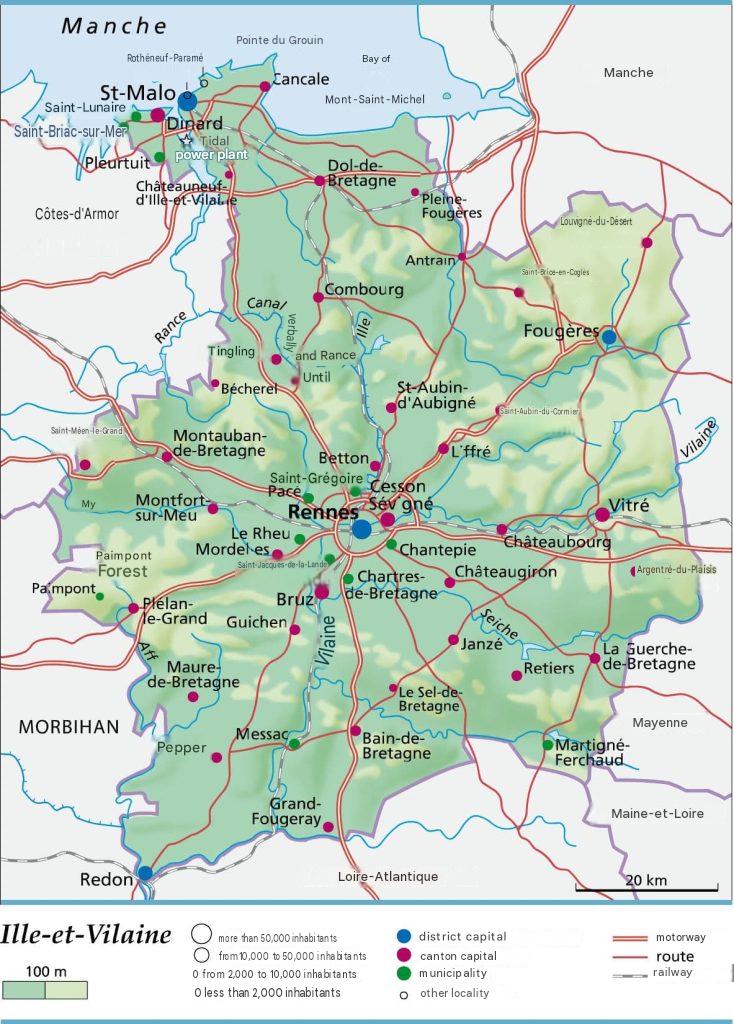
What you need to know about the Ille-et-Vilaine department ?
In the eastern section of the Brittany region, I present department 35, called Ille-et-Vilaine, with the number 35. The Bretilliens currently number 1,125,000 inhabitants, and the population density is 164 inhabitants per km². Its departmental capital and prefecture is called Rennes, and its sub-prefectures are Fougères, Saint-Malo, and Redon. This department is currently divided into 333 communes, 18 intermunicipalities, 27 cantons, and 8 legislative constituencies.
The current area of department 35 is 6,775 km2 and geographically, its coordinates are 1°2°20’ and 47°40’48°4°’ respectively for the west and north parameters. We can therefore say that the Ille-et-Vilaine department is the Brittany department with the least coastline because its beaches are only 100 km long. This distance passes through the towns of Saint-Briac-sur-Mer and Roz-sur-Couesnon.

Which departments border the Ille-et-Vilaine department?
Located in the eastern section of Brittany, the neighboring departments of Ille-et-Vilaine are: the Maine-et-Loire department, the Manche department, the Morbihan department, the Côtes-d’Armor department, the Mayenne department, and the Maine-et-Loire department. Department 35 has a coastline on the English Channel called the Emerald Coast. This coast is in the western section of the department.
What is the climate like in the Ille-et-Vilaine department?
The climate of department 35 is mainly classified as oceanic, slightly different (or altered according to some terms). Annually, the amount of rainfall can reach 700 mm, and during this time, the winter periods, although somewhat humid, are moderately mild. Regarding the summer periods, they are mainly dry, warm, and sunny. As a result, the sun shines for about 1,860 hours in the department. The climate of the Ille-et-Vilaine department is divided into 4 different types:
First, there is the coastal zone which has a climate that is both mild and windy; this zone extends from Saint-Briac-sur-Mer to Roz-sur-Couesnon. Next, there is the southern section, where Saint-Malo is located: this part of Ille-et-Vilaine mainly has a dominant oceanic climate associated with a moderately temperate climate.
In the eastern inland section, the winter periods are mild, the summer periods are warm, and there is still moderate rainfall. Finally, there is the southern section extending from Vitré to Redon, which features hot, dry summers with plenty of sunshine.
Once you move away from the coasts, there is a strong continental influence. That is why there are large temperature fluctuations, as is the case in the western zones of Brittany. This leads to more extreme temperatures, reaching -15 °C or 40 °C.
What are the best cities in the Ille-et-Vilaine department?
We have ranked these cities by tourist attendance, so here are the most visited cities in the Ille-et-Vilaine department:
- Rennes
- Saint-Malo
- Fougères
- Vitré
- Betton
- Dinard
- Bruz
- Cesson-Sévigné
- Pacé
- Redon
- Saint-Jacques-de-la-Lande

What are the largest municipalities in the Ille-et-Vilaine department?
Here are the largest municipalities in the Ille-et-Vilaine department
- Paimpont
- Iffendic
- Val d’Anast
- Combourg
- Grand-Fougeray
- Martigné-Ferchaud
- Liffré
- Bain-de-Bretagne
- Bazouges-la-Pérouse
- Guignen
Here are the municipalities with the highest number of inhabitants, that is to say with the highest population density per km2
- Rennes
- Fougères
- Bruz
- Dinard
- Saint-Jacques-de-la-Lande
- Saint-Malo
- Vitré
- Cesson-Sévigné
- Betton
- Redon
FAQ – Ille-et-Vilaine map
A map of Ille-et-Vilaine displays the main municipalities, roads, waterways, and the department’s administrative boundaries. It also helps users better understand the geography and territorial organization of this department located in the Brittany region.
The prefecture and main city of Ille-et-Vilaine is Rennes, a city recognized for its historical heritage, university life, and economic development. The department also includes important cities such as Saint-Malo, famous for its city walls and coastline.
A map of Ille-et-Vilaine is useful for planning a route, locating a municipality, or discovering the department’s natural and cultural attractions. It also makes travel easier and provides a better overview of this Breton territory.
