
What you need to know about Martinique ?
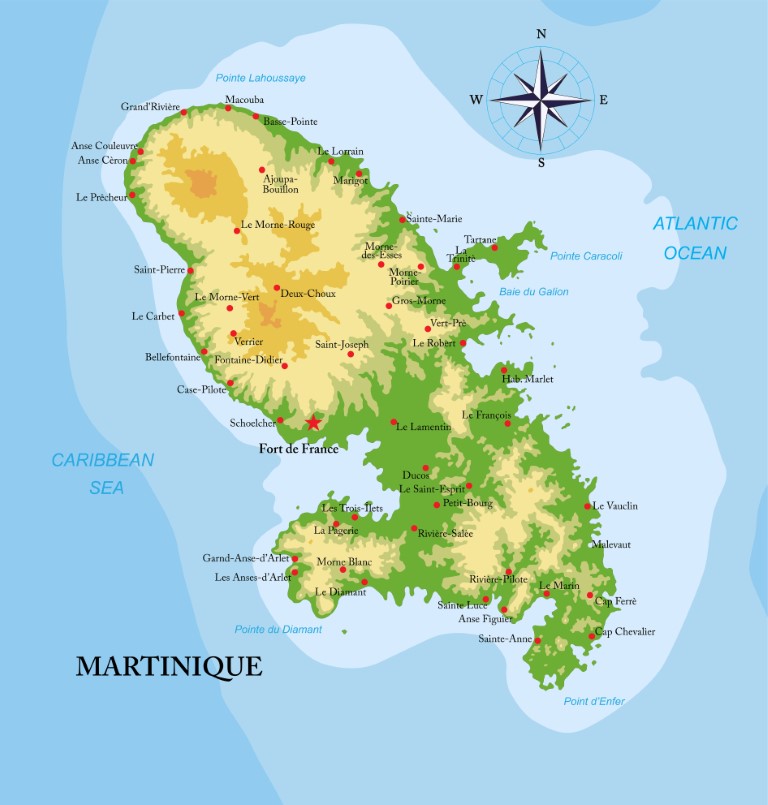
Currently, we present to you a French department located overseas, more precisely in the Caribbean and in an archipelago. This archipelago is called: the Lesser Antilles. Coded 972, this department is called the department of Martinique or simply Martinique.
Administratively, the Martinique territory is managed as a kind of single territorial collectivity and the leadership obviously falls to an Assembly. But in addition, this department is also called an outermost region of the EU, it is also a member of the OECS. In fact, 972 has a capital, which is both its largest city and its prefecture, and this city is called Fort-de-France.
The arrondissements of Martinique are: Fort-de-France, Le Marin, Saint-Pierre, and La Trinité. In terms of demographics, the Martiniquais currently total 361,019 inhabitants, with a population density of 320 inhabitants per km². This density is mainly due to the fact that the area of Martinique is 1,128 km².

What is the geography of Martinique like?
Geographically, the territory of Martinique is located in a kind of Volcanic Arc, an arc situated in the Lesser Antilles. This arc is bordered on all sides by the Caribbean Sea which extends between Dominica and Saint Lucia to its south. The other nearby areas are: the Venezuelan coast, about 420 km to the north-northeast, then there is the Dominican Republic, which is about 865 km from 972.

What is the climate of Martinique like?
Given Martinique’s location under the tropics, it has only two seasons, a very particular characteristic of a tropical climate. Thus, the first season occurs between July and November, it is the cold season also called the “wintering” period. This first season is normally rainy. Furthermore, the second season is what is called the “Lent” season, it is the season characterized by slightly higher temperatures, a bit less humidity (much drier than the other season) and sunshine.
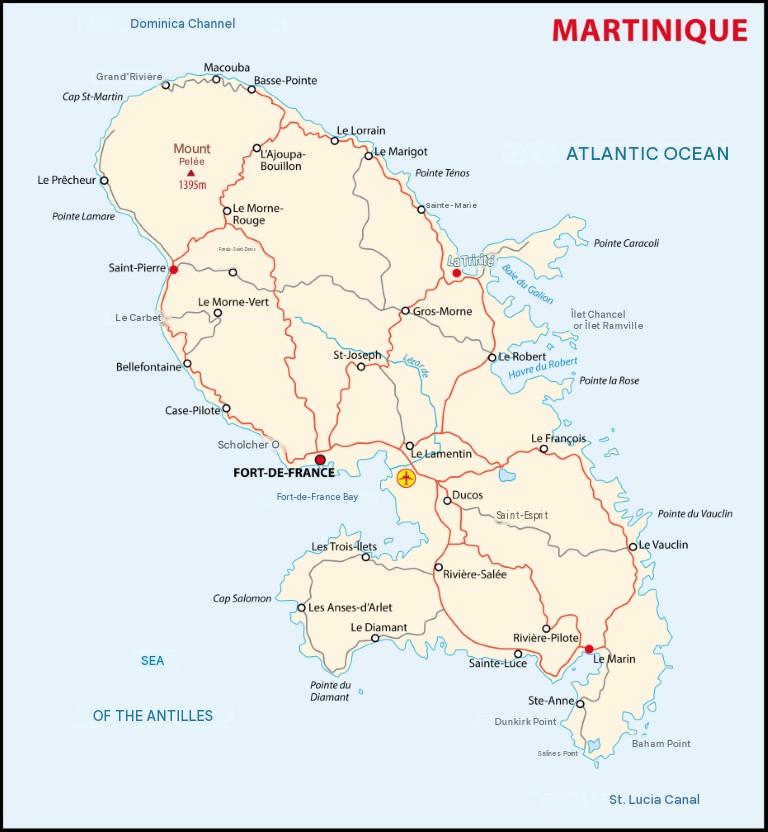
The case is also that 972 is a very rainy department because it receives at least 800 mm of annual rainfall in high altitude areas. On the other hand, for other areas, notably in the city of Lamentin, the annual rainfall is very high, around 2,085 mm per year.
In the capital, more precisely in Fort-de-France, the climate is rather tropical humid. This type of climate mainly presents high temperatures on an annual average. Obviously, we are talking about a climate of around 26.5°C. In this part of Martinique there is also a bit more precipitation, about 1,950 mm per year. The highest temperatures are mainly 31°C during the day and around 24 to 25°C at night.

When we talk about the entire department of Martinique, here are the distinctions between the two seasons:
- First, the Dry Season: it is a season that is both dry and windy because here you can really feel the trade winds, which bring humidity, but not much. Consequently, precipitation averages between 60 and 90 mm per month.
- When we talk about winter (a kind of rainy season), it is a season that mainly takes place from July to October, it is the season when it rains a lot, especially showers that are sometimes very intense. But during the day, the weather is still nice. Moreover, this season is the warmest in the department.
- Finally, there are the interseasons, which mainly occur from November to January and then from May to June. These interseasons have a sort of intermediate climate and are characterized by rainfall instabilities: there are sometimes showers and sometimes also moderate rains.

What are the largest cities in Martinique?
The largest cities in the Martinique region by population according to the 2018 census are:
- Fort-de-France
- Le Lamentin
- Le Robert
- Schoelcher
- Le François
- Sainte-Marie
- Saint-Joseph
- Ducos
- Rivière-Pilote
- La Trinité
- Rivière-Salée
FAQ – Martinique map
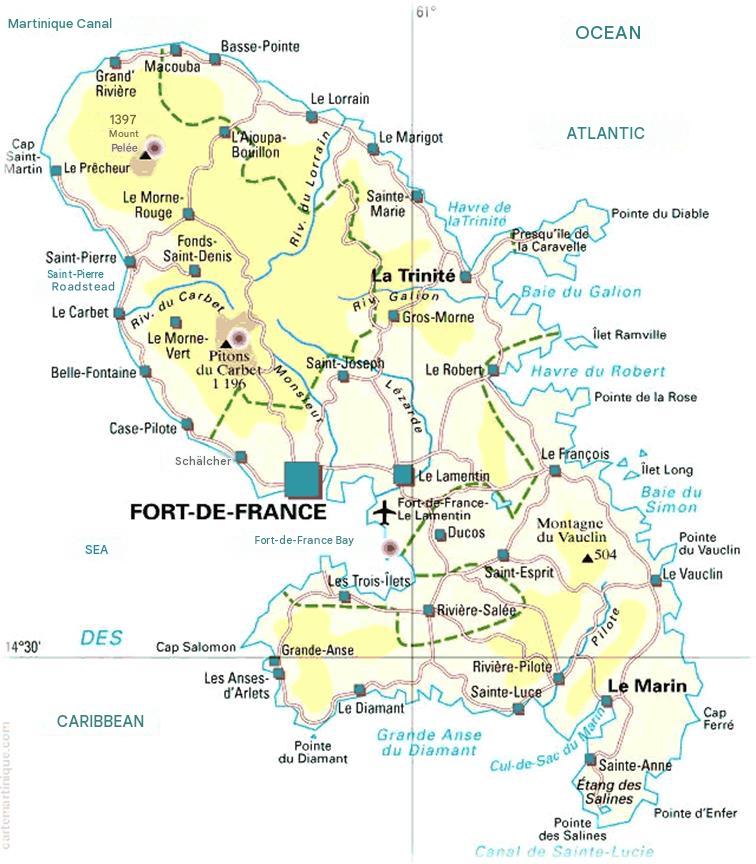
A Martinique map helps locate the island’s main cities, roads, and administrative boundaries. It also provides an overview of beaches, landscapes, natural areas, and neighboring municipalities.
A map is useful for planning a trip, organizing an itinerary, or finding a specific location on the island. It also helps users better understand Martinique’s geography, landscapes, and territorial organization.
A detailed Martinique map is available in printed form from certain organizations or in digital format on various specialized platforms. It may include municipalities, road networks, coastal areas, and the main points of interest.
