
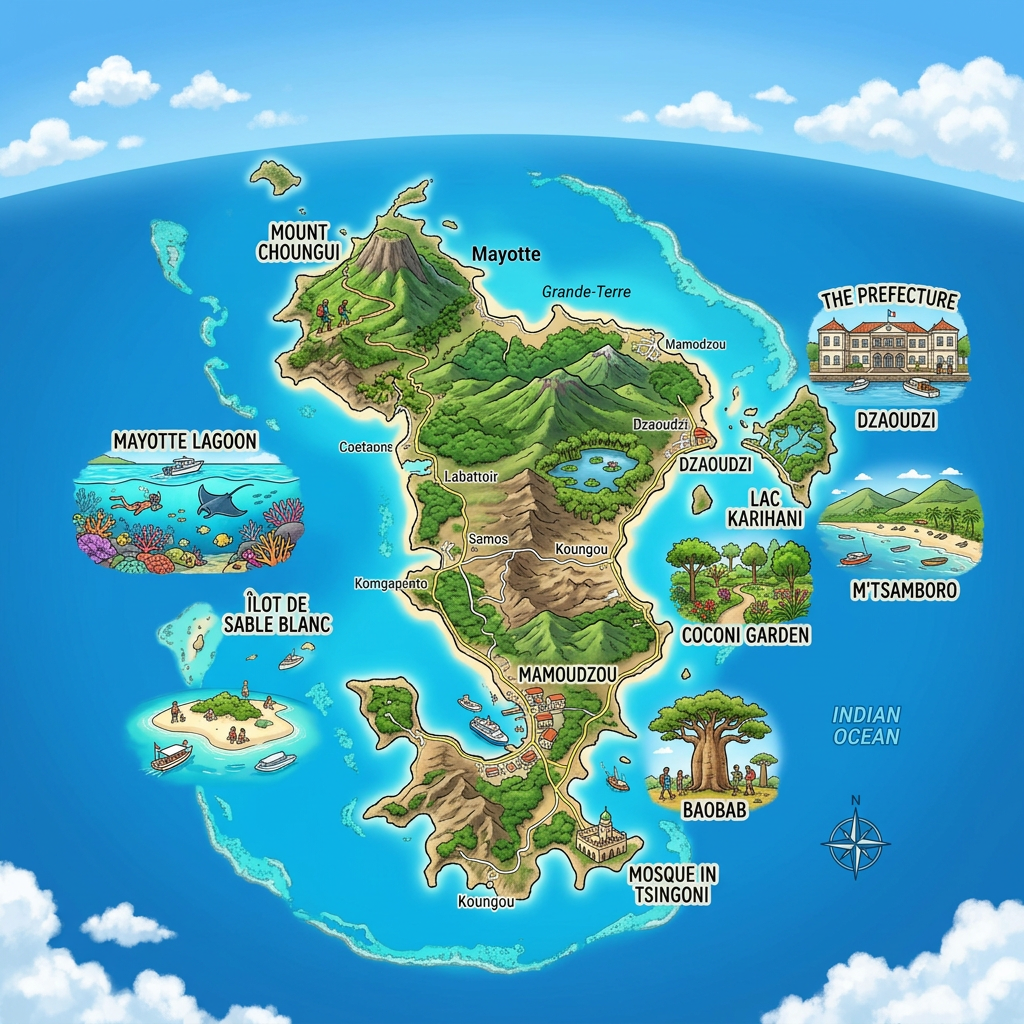
What you need to know about the department of Mayotte
We now present to you a French overseas department, also called DOM; it is actually 976, its name is Mayotte. The territory of this department consists of two islands located at the extreme southeast of the Comoros archipelago, namely Grande-Terre and Petite-Terre.
Furthermore, this French department is also located in the channel situated between Africa and Madagascar, which is obviously the Mozambique Channel. More precisely, 976 is located about 310 km from Madagascar. The prefecture of this department and at the same time its largest city is called Mamoudzou, and it is located on the eastern side of the largest island of Mayotte.
The population of Mayotte is known as the Mahorais; they currently number 321,000 inhabitants, and since the department has an area of 376 km², the population density in department 976 is approximately 854 inhabitants per km².

Who are the neighbors of the department of Mayotte?
Mayotte is less than 70 km from the island of Anjouan, one of the three different islands of the Comoros archipelago. This geological proximity makes boat cruises between the Comoros and Mayotte feasible and contributes to the increase in illegal migration flows. The various neighbors of Mayotte are Tanzania and Mozambique on the African continent, and Madagascar, whose closest shores are 350 km from the coast of Mayotte.
What is the climate of the department of Mayotte like?
First, when we talk about the climate type of the Mahoran territory, we know it is a tropical climate. The reason is because its location is in the southern hemisphere, mainly in the tropical zone. First, this tropical climate is characterized by a first hot, rainy, and windy season. This season normally runs from December to April. Then, there is the cool or cold season: it is a dry season due to the wind blowing from the southeast. Finally, there are the interseasons, which are normally the months of May and November.
Typical daily temperature ranges are about 28°C during the driest period (i.e., from January to April) and 25-26°C during the coolest period (i.e., from June to September). Temperatures never exceed 32°C in June-September and sometimes reach 34-35°C in November-March, and combined with the current proximity, the intensity is worrying.
The absolute annual rainfall is not particularly high, reaching 1,200 mm on the small island of Pamanzi, with more than 100 mm of precipitation from December to April; the wettest month is January, when there are very heavy showers.
In any case, there is a lot of daylight during the storm season, which can be surprising but fleeting because tropical rainstorms mainly appear as showers or thunderstorms.
However, the sunniest periods are dry and cool. During the dry season, there are still some possible brief thunderstorms, especially on the main island, where there are some small elevations: the highest point is Mount Benalla, up to 600 meters altitude; moreover, the archipelago is protected by Madagascar, only 300 km to the southeast. In any case, the waters of Mayotte are warm enough for swimming; indeed, the water temperature varies from 26°C between July and September to 29°C between February and April.
What are the most important cities of the department of Mayotte?
We have compiled for you a list of the 15 main cities of Réunion.
- Mamoudzou
- Bandrélé
- Bouéni
- Dzaoudzi
- Sada
- Tsingoni
- Chirongui
- Pamandzi
- Acoua
- Mtsamboro
- Kani-Kéli
- Dembéni
- Koungou
- M’Tsangamouji
- Chiconi

FAQ – Mayotte map
A Mayotte map helps locate the archipelago’s main municipalities, roads, and administrative boundaries. It also provides an overview of the islands, coastline, landscapes, and surrounding natural areas.
A map is useful for planning a trip, organizing an itinerary, or finding a specific location in the archipelago. It also helps users better understand Mayotte’s geography, the distribution of municipalities, and its natural features.
A detailed Mayotte map is available in printed form from certain organizations or in digital format on various specialized platforms. It may include municipalities, road networks, coastal areas, and the main points of interest.
