
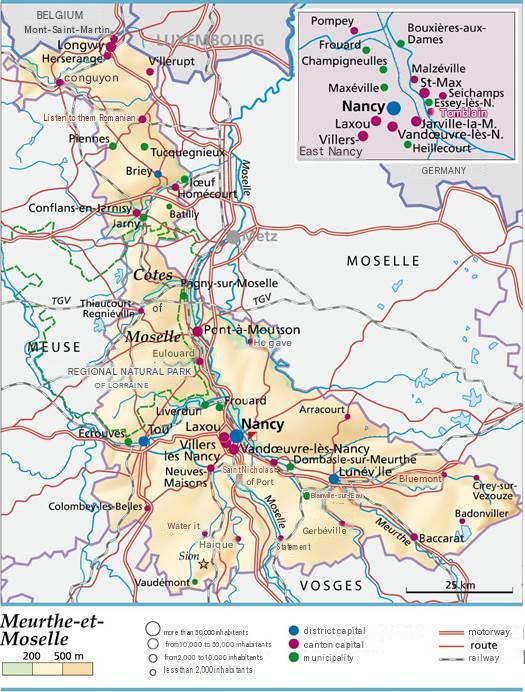
What you need to know about Meurthe-et-Moselle ?
We are here to introduce you to Meurthe-et-Moselle, more precisely the 54th department. This department is indeed part of the Lorraine region, which historically and administratively belongs to the Grand Est.
Historically, Meurthe-et-Moselle is one of the oldest departments in the country, but that was in 1871. Initially, before the establishment of the Treaty of Frankfurt, the divisions were split into Meurthe and Moselle divisions, two distinct departments. Furthermore, the provinces of Meurthe and Moselle were governed by the Provincial Council.
In addition, the departmental capital, the largest city, and at the same time the prefecture, is Nancy. Its subprefectures are actually called Lunéville, Toul, and Briey. The inhabitants of department 54, known as the Meurthe-et-Mosellans, currently number 733,822 inhabitants, and the area of the Meurthe-et-Moselle territory is 5,246 km². This means that the population density is approximately 140 inhabitants per km².

Which departments border Meurthe-et-Moselle?
The department of Meurthe-et-Moselle is located in the center of Lorraine. It is surrounded by the departments of Meuse, Vosges, Bas-Rhin, and Moselle, and its northern border adjoins Luxembourg and Belgium.
What is the climate like in the Meurthe-et-Moselle department?
Köppen classification considers the climate of department 54 to be semi-continental. This type of climate is characterized by divergent temperatures, whether during the day or in the mid-seasons.
It can also be said that this type of climate is both continental and oceanic. That means there could be frost and there could also be heatwaves. When it comes to wind, there is not much on the Meurthe-et-Moselle territory, but rain, on the other hand, is almost always present and less violent.
Winter periods are both cold and dry and sometimes characterized by frost. But on the plains and plateaus, we observe different types and amounts of snowfall. The reason is that the height of these plateaus and plains varies between 300 and 400 m.
Summer periods are not frequently sunny although they are still warm with some thunderstorms occurring about 26 days a year. There will also be fog during the autumn periods during which there are many winds that, even if less violent, are quite abundant.
So we can affirm the temperature contrast between day and night, but also according to seasons and the day. The temperature averages around 10.2°C and throughout the year, total precipitation amounts to 768.8 mm. So, if you want to visit the Meurthe-et-Moselle department, go in June, July, or August.
What are the most important cities in the Meurthe-et-Moselle department?
We have ranked these cities based on the number of tourists they receive. So, here are the top 10 cities you should visit in the Meurthe-et-Moselle department:
- Nancy
- Lunéville
- Pont-à-Mousson
- Longwy
- Maxéville
- Vandoeuvre-lès-Nancy
- Toul
- Villers-lès-Nancy
- Laxou
- Dombasle-sur-Meurthe

What are the most important communes in the Meurthe-et-Moselle department?
To make this ranking, we referred to the area of each of the municipalities in the Meurthe-et-Moselle department.
- Toul
- Favières
- Rosières-aux-Salines
- Liverdun
- Champigneulles
- Longuyon
- Val de Briey
- Foug
- Gondreville
- Gerbéviller
Regarding this second ranking of the municipalities of Meurthe-et-Moselle, we grouped them according to the density of occupants per km2.
- Nancy
- Lunéville
- Laxou
- Pont-à-Mousson
- Dombasle-sur-Meurthe
- Vandœuvre-lès-Nancy
- Toul
- Villers-lès-Nancy
- Longwy
- Saint-Max
FAQ – Meurthe-et-Moselle map
A Meurthe-et-Moselle map helps locate the department’s main cities, roads, and administrative boundaries. It also provides an overview of rivers, natural areas, and neighboring municipalities.
A map is useful for planning a trip, organizing a route, or locating a place of interest. It also helps users better understand the department’s geography and territorial organization.
A detailed Meurthe-et-Moselle map is available in printed form from certain organizations or in digital format on various specialized platforms. It may include municipalities, road networks, landforms, and the department’s main points of interest.
