
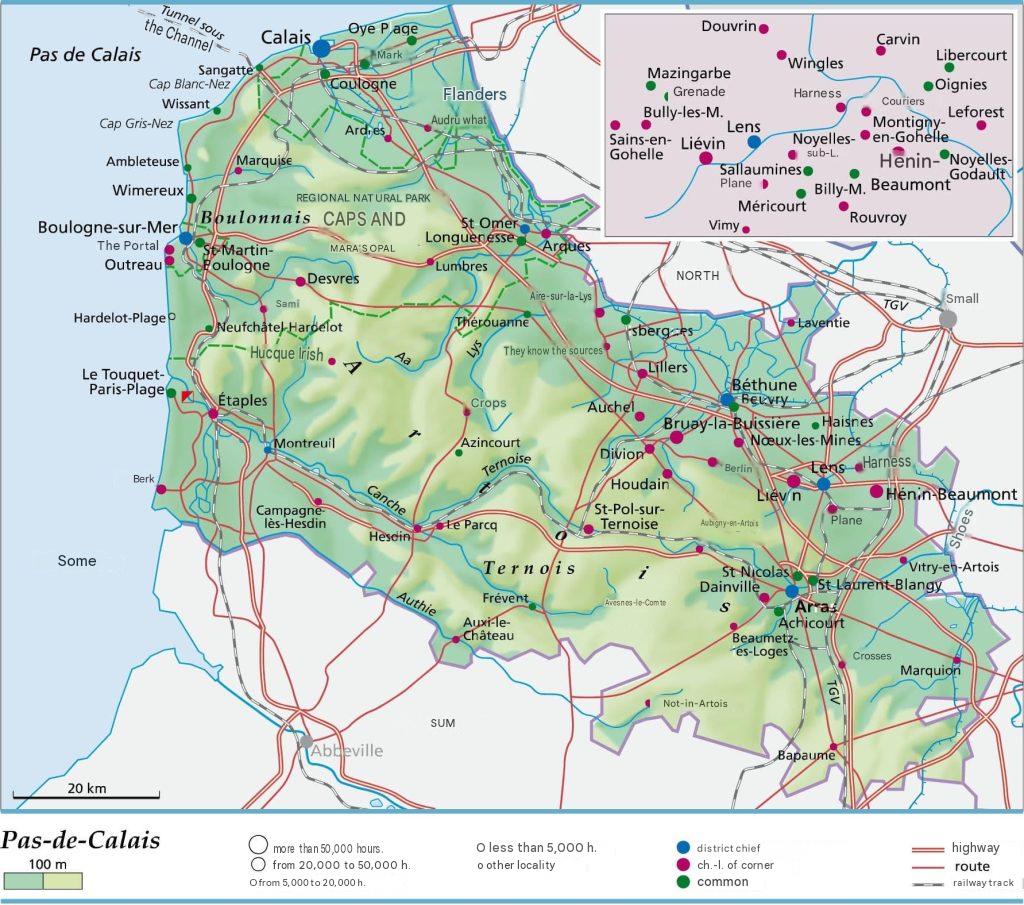
What you need to know about the Pas-de-Calais department ?
We present to you a French department numbered 62, which is currently part of the Hauts-de-France region. Its name comes from the fact that it is separated from England by a strait of the same name.
The fact is that the territory of department 62 occupies the former territory of the Artois grouping which includes Saint-Omer, Arras, Lens, and Béthune. Part of the current territory of department 62 was also formerly the coastal area of Picardy. The prefecture and capital of department 62 is called Arras, and its sub-prefectures are Béthune, Boulogne-sur-Mer, Calais, Lens, Montreuil, Saint-Omer.
Demographically, the inhabitants of Pas-de-Calais number 1,473,842 people, and the department covers an area of 6,671 km², which means that the population density is 221 inhabitants per square kilometre. In addition, administratively, the Pas-de-Calais department is divided into 7 arrondissements, 12 legislative constituencies, 39 cantons, 19 intermunicipalities, and finally 890 municipalities.

Which departments border the Pas-de-Calais department?
Since the Pas-de-Calais department is part of the Hauts-de-France region, its neighboring departments are the Nord department and the Somme department. But department 62 also has a 100 km coastline along the English Channel. Another coastline of Pas-de-Calais also faces the North Sea for 30 km.
What is the climate like in the Pas-de-Calais department?
The climate type of Pas-de-Calais is generally considered oceanic. Indeed, temperature variations are not very high, winters are milder, and summers are not very hot. So, throughout the year, the average temperature is around 11°C. Additionally, there is a climatic contrast that is somewhat more significant in the area. Moreover, the oceanic climate type of Pas-de-Calais is stronger along the coast. On the other hand, in higher altitude areas, there is much more precipitation.
Regarding climatic characteristics
- Many climatic fluctuations characterize department 62, due to its position, meaning the climate is variable, but because of the sea, there are no extreme climatic conditions.
- In the western section, the climate is influenced by the Atlantic, which causes the climate to be somewhat unsettled.
- Furthermore, in the eastern section, there are cold winter periods, even if the summer periods are much sunnier.
- Additionally, in the southern section, the climate is influenced by dry air coming from the interior of the area. This causes temperatures to exceed 35°C.
Since the climate type is oceanic, this is logically felt more near the coasts. Indeed, in this part of the department, there is a weakness in thermal amplitudes.
And even when moving further away from the coast, the climate remains similar until approaching a continental climate. Then, there is less wind in inland territories, temperatures have greater variations, and there is more frost and much more snowfall.
What are the largest cities in the Pas-de-Calais department?
Here are the most spacious cities in the Pas-de-Calais department, that is to say, these 10 cities we have selected have the largest areas in department 62:
- Calais
- Arras
- Boulogne-sur-Mer
- Lens
- Hénin-Beaumont
- Béthune
- Bruay-la-Buissière
- Bully-les-Mines
- Liévin
- Carvin

What are the largest municipalities in the Pas-de-Calais department?
To make this ranking, we referred to the area of each municipality in the Pas-de-Calais department:
- Oye-Plage
- Aire-sur-la-Lys
- Auxi-le-Château
- Baincthun
- Éperlecques
- Calais
- Marck
- Lillers
- Guînes
- Bonnières
Regarding this second ranking of municipalities in the Pas-de-Calais department, we grouped them according to the population density per km2:
- Calais
- Arras
- Liévin
- Hénin-Beaumont
- Avion
- Boulogne-sur-Mer
- Lens
- Béthune
- Bruay-la-Buissière
- Carvin
FAQ – Map of Pas-de-Calais
A map of Pas-de-Calais helps locate the main towns, natural areas, and road networks of the department. It also provides a better understanding of the geographical organization between the coastline, agricultural plains, and urban areas.
A map of Pas-de-Calais highlights important towns such as Arras, Calais, Boulogne-sur-Mer, and Lens. These cities represent major historical, economic, and tourist centers of the department.
Consulting a map of Pas-de-Calais helps plan a trip, a business journey, or a discovery of the local heritage. It makes it easier to locate tourist sites, municipalities, and the different routes across the territory.
