
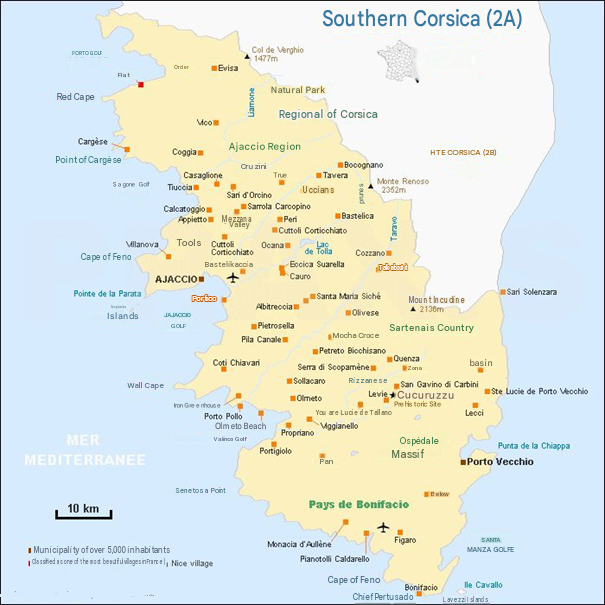
What you need to know about the Corse du Sud department ?
Unlike other French departments, the Corse du Sud department is called a departmental constituency. It is also department 2A, with Ajaccio as its prefecture and capital. In fact, in 2018, there was a merger between the north (also called Haute-Corse) and the south (also called Corse-du-Sud).
Thus, Corsica became entirely separate, a region or collectivity named Corsica with a special status. Furthermore, there is a prefect seated in Ajaccio who manages the entire administrative district of the State, which is Corse du Sud.
In fact, department 2A is a department divided into arrondissements, cantons, and communes numbering 2, 22, and 124 respectively.

Currently, the population of Southern Corsica stands at 165,892 inhabitants and the surface area of said department is 4,014.2 km2, which means the density of inhabitants per km2 is approximately 41.3.
The recorded history of Corsica begins around 560 BC, when Greeks from Phocaea, in Asia Minor, founded the city of Aralia on the east coast. Carthage ruled from the early 3rd century BC until the entire island was conquered by the Romans in a series of battles from 259 to 163 BC.
Together with Sardinia, Corsica formed a province of the Roman Empire, under which the island’s economy prospered. The Romans also implanted their language, which became the basis of the current Corsican dialect.
Between 450 and 1050 AD, the Vandals, Lombards, and Arabs led a series of invasions and partial occupations, during which the island’s towns were destroyed, its inhabitants driven inland, and the coastal farmlands deserted.
What is the climate like in the Corse-du-Sud department?
Indeed, the Corse du Sud department has a moderate Mediterranean climate. This type of climate is mainly characterized by winters with a lot of precipitation but mild temperatures, and summers that are very hot but very dry. However, on the island, there are also areas that display Alpine-type climates, especially during the winter periods. For example, the mountains are always snow-covered during the winter months, notably those before May and June.
What are the neighboring departments of the Corse du Sud department?
As you know, Corsica is an island, so the Corse du Sud department is limited to the southern part of the island. It therefore shares a common border with the Haute-Corse department to its north. On its western side, it overlooks the Mediterranean Sea, and on its east-south side, it overlooks the Tyrrhenian Sea.
What are the largest cities in the Corse du Sud department?
Based on population density per km2, here are the most important cities in the Corse du Sud department:
- Ajaccio
- Porto-Vecchio
- Propriano
- Bastelicaccia
- Sartène
- Alata
- Bonifacio
- Afa
- Grosseto-Prugna
- Zonza
- Sarrola-Carcopino
- Cuttoli-Corticchiato
- Peri
- Albitreccia
- Appietto
- Cauro
- Pietrosella
- Olmeto
What are the most important communes in the Corse du Sud department?
Referring to the area of the communes in Corse du Sud, we have listed below the most important communes:
- Ajaccio
- Bastelica
- Bonifacio
- Figari
- Levie
- Porto-Vecchio
- Quenza
- Sartène
- Zicavo
- Zonza
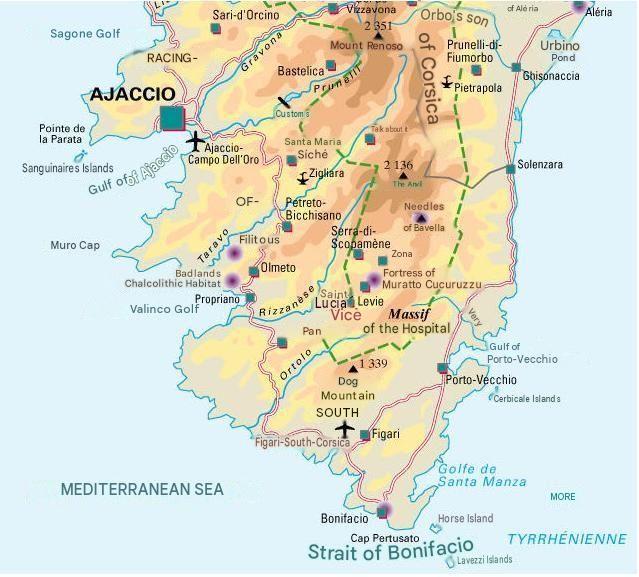
If we refer to the population density per km2, the most important municipalities in Southern Corsica are:
- Afa
- Ajaccio
- Alata
- Bastelicaccia
- Bonifacio
- Grosseto-Prugna
- Porto-Vecchio
- Propriano
- Sartène
- Zonza
FAQ: Southern Corsica
The cliffs of Bonifacio offer a spectacular view over the sea. The Bavella Needles are also perfect for mountain hiking.
Spring is ideal for enjoying the blooming landscapes without the crowds. Autumn also offers very mild and pleasant weather.
Renting a car remains the most practical way to explore the department. You can also use intercity bus lines between towns.
