
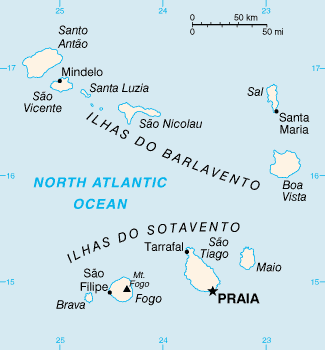
Cape Verde is a volcanic archipelago located in the Atlantic Ocean, off the coast of Senegal. This island state in West Africa, officially called the Republic of Cape Verde, is made up of 10 main islands and 5 islets. An enchanting destination, it captivates with its cultural diversity, its Afro-Portuguese blend, and its contrasting landscapes combining golden sandy beaches, arid mountains, lush valleys, and impressive volcanic reliefs, notably on the island of Fogo.
A volcanic Atlantic archipelago, Cape Verde combines windy beaches (kite/windsurf), spectacular landscapes, and Creole culture. Use a detailed map to plan your island hops (flights/ferries) and balance relaxation (Sal/Boa Vista) with hikes (Santo Antão/Fogo).
What You Need to Know About Cape Verde
| Element | Details |
|---|---|
| Official Name | Republic of Cape Verde (Cabo Verde) |
| Capital | Praia (Santiago Island) |
| Population | ~560,000 inhabitants (large diaspora) |
| Area | ~4,033 km², volcanic archipelago |
| Main Islands | Santiago, São Vicente, Santo Antão, Sal, Boa Vista, Fogo, Maio, Brava, São Nicolau |
| Languages | Portuguese (official), Cape Verdean Creole (Kriolu) |
| Currency | Cape Verdean Escudo (CVE) |
| Time Zone | CVT (UTC−1), no daylight saving time |
| Climate | Dry tropical, trade winds; short rainy season (≈ August–October) |
| Major Cities | Praia, Mindelo (São Vicente), Santa Maria (Sal) |
| Economy | Services, beach and cultural tourism, diaspora remittances |
| Points of Interest | Beaches (Sal, Boa Vista), hiking (Santo Antão), Pico do Fogo volcano, music/morna in Mindelo |
| Access | International flights (Sal, Praia, Boa Vista), inter-island connections by plane/ferry |
| Tips | Plan inter-island transfers, water/sun protection, frequent wind; book in high season |
Colors of Cape Verde
The Cape Verde flag is a blue flag with three stripes slightly offset downward, two white outer stripes and a red one in the middle. The stripes are of equal thickness. Slightly offset toward the hoist are ten yellow five-pointed stars arranged in a circle.

What to Visit in Cape Verde?
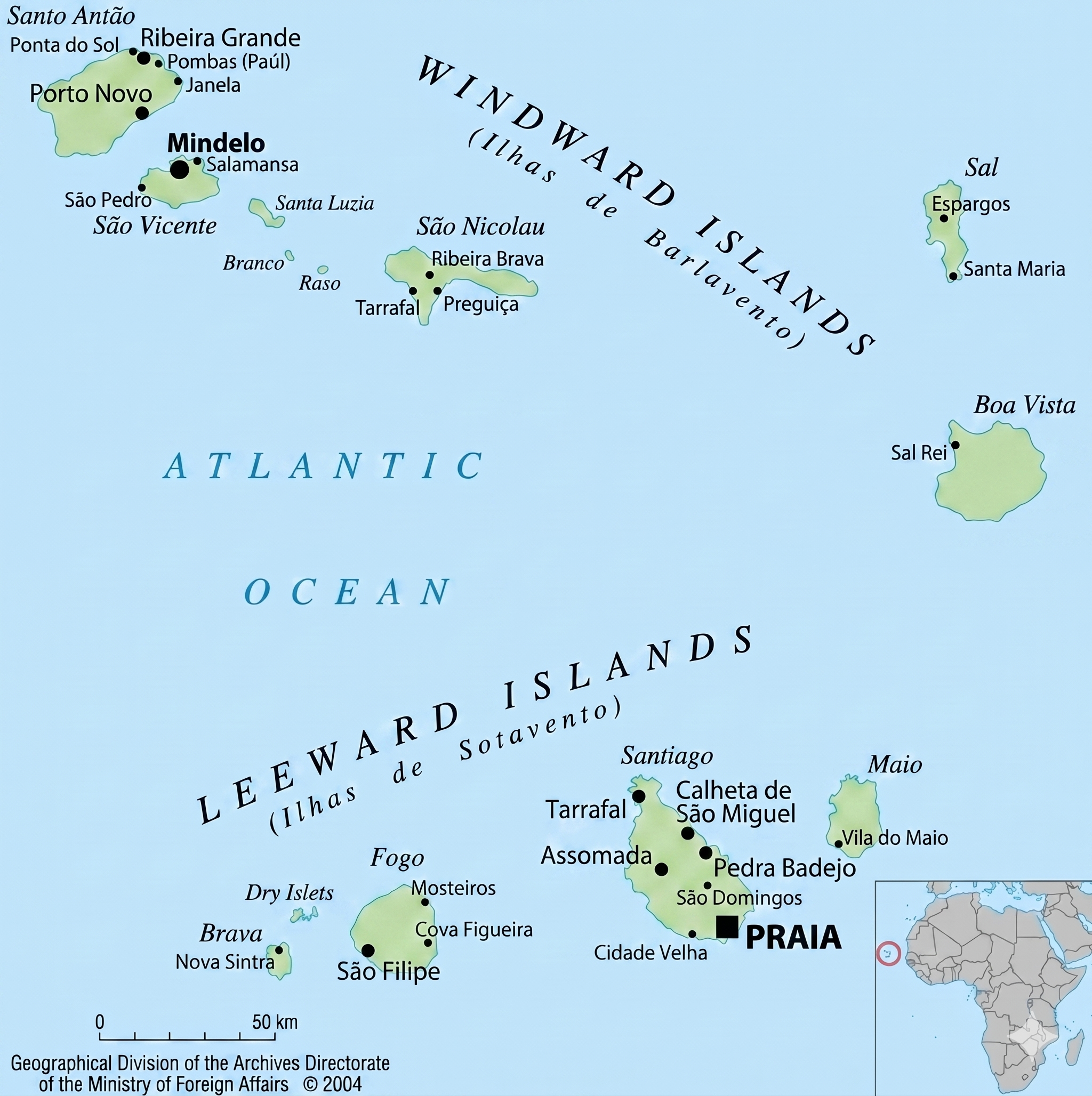
By looking at a Cape Verde map, one quickly understands that the archipelago consists of 10 volcanic islands with very different atmospheres, divided between windward and leeward islands. This geographical diversity explains the richness of possible experiences, ranging from lively cities, spectacular hikes, to wild beaches.
The main cities of Cape Verde are Praia, located on the island of Santiago, the political and administrative center of the country, and Mindelo, on the island of São Vicente, considered the cultural and musical capital of the archipelago.
The Best Tourist Destinations in Cape Verde
Santo Antão
Santo Antão is one of the most spectacular islands in the country. Highly popular with hikers, it offers lush landscapes, deep valleys, terraced farming, and some of the most beautiful trekking trails in West Africa. The island appeals both to nature lovers and those wishing to discover black sand beaches and an authentic rural life.
São Vicente
São Vicente is the cultural heart of Cape Verde. The island is lively day and night, especially in Mindelo, known for its music, festivals, and friendly atmosphere. It is also famous for its beaches such as Laginha, Baía das Gatas, and Flamingo, as well as its colonial houses and historical heritage visible on the urban map.
São Nicolau
Quieter and more preserved, São Nicolau is aimed at travelers seeking calm. The island is appreciated for its wild beaches, mountainous landscapes, and natural sites such as Monte Gordo. It is an ideal destination for swimming, gentle hiking, and discovering a more confidential Cape Verde.
Sal (addition)
The island of Sal is one of the most accessible and touristic in the archipelago. Visible on the entire Cape Verde tourist map, it is renowned for its long clear sandy beaches, turquoise waters, and ideal conditions for kitesurfing, diving, and relaxation. Sal often serves as the country’s gateway thanks to its international airport.
By consulting a Cape Verde map, it becomes clear that each island has its own identity, allowing you to tailor your itinerary according to your desires: nature, culture, beach relaxation, or adventure.
Where is Cape Verde located on the world map?
Cape Verde is an archipelago of the African continent located on the world map 620 km from Senegal, to the west of continental Africa.
Where is Cape Verde located on the world map?
Cape Verde (or Cabo Verde) is a volcanic archipelago located off the coast of West Africa, in the Atlantic Ocean. It consists of ten main islands and several uninhabited islets.
The country is situated about 620 kilometers west of Senegal, opposite the city of Dakar, and nearly 1,500 kilometers from the Canary Islands.
Thanks to its geographical position, Cape Verde occupies a strategic crossroads between Europe, Africa, and South America, which has historically favored maritime and cultural exchanges.
On a world map, it can be precisely located here:
The archipelago belongs to the African continent, but its mixed culture and Portuguese influences make it a unique territory, at the crossroads of continents and civilizations.
Transportation to get to Cape Verde and move around the islands
Travel by plane
To get to Cape Verde from abroad, the best option is undoubtedly by plane. Most international flights land at Amílcar Cabral International Airport on the island of Sal or at Praia Airport on the island of Santiago. Once there, there are also domestic flights allowing quick access to certain islands such as São Vicente, Fogo, or Boa Vista.
Boats and ferries
Another option to travel between the Cape Verde islands is to take boats and ferries that offer regular connections between the different islands of the archipelago. This can be a unique opportunity to enjoy a sea crossing with breathtaking views of Cape Verdean landscapes. However, it is important to note that these crossings can be canceled in case of bad weather or strong winds.
Land transportation
To get around within the islands, there are various means of transport such as taxis, rental cars, and public transportation. Aluguers – shared minibuses – are an economical option for traveling on the islands. However, the quality of the road network varies from one island to another and can make some roads difficult to navigate, especially during the rainy season.
Climate of Cape Verde
The climate of Cape Verde is a subtropical semi-arid climate. It is characterized by temperatures around 20 and 15°C with strong windy gusts. The climate is also Sahelian type because it is influenced by the Northwest Trade Winds which induce an average relative humidity.
However, the influence of the Harmattan coming from the east induces dryness. Between October and June, the monsoon from the Atlantic Ocean prevails and the summer period experiences significant rainfall. The annual rainfall is 230 mm with dominant droughts and rains concentrated in summer.
When to go to Cape Verde? Climate and best time to visit the archipelago
Located off the coast of West Africa, Cape Verde benefits from a dry tropical climate that is pleasant all year round. Average temperatures range between 24°C and 29°C, but may vary slightly depending on the islands. The wind, often present, softens the heat and makes the climate ideal for outdoor activities.
Here is an overview of the seasons in Cape Verde:
- December to March: the driest and most favorable period to visit the country. The days are sunny, perfect for enjoying the beaches, hiking, or water sports.
- March to June: intermediate season, generally pleasant but sometimes windy, especially on Boa Vista and Sal. Rainfall is rare, allowing comfortable travel.
- June to November: rainy season, mainly concentrated between August and October. Some roads may become impassable and some tourist sites may be temporarily closed.
Economy of Cape Verde
The Cape Verdean economy is small and remains developing, but it stands out for its stability and good governance compared to the regional average. The country mainly relies on services, trade, maritime transport, and especially tourism, a key growth sector.
The lack of natural resources and low rainfall severely limit agriculture, making Cape Verde dependent on imports and international aid.
Economic data (2024 estimates):
- Nominal GDP: approximately 2.7 billion USD
- GDP (PPP): approximately 5.6 billion USD
- GDP growth: +4.5%
- GDP per capita (nominal): around 4,800 USD
- GDP per capita (PPP): around 9,800 USD
- Inflation rate: around 2%
- Population living below the poverty line: approximately 15%
- External aid: the country remains supported by European partnerships and international organizations, especially in the fields of energy, health, and sustainable tourism.
Managing Your Budget: Money and Cost of Living in Cape Verde
The budget to plan for a stay in Cape Verde will obviously depend on the length of your stay, your desires, and the level of comfort you want. Here are some guidelines to help you better manage your expenses:

- The official currency of the country is the Cape Verdean escudo (CVE), but it is often possible to pay in euros in certain tourist areas
- The cost of living in Cape Verde is generally higher than in other West African countries, as the archipelago imports a large part of its foodstuffs and consumer goods
- Prices also vary from one island to another; for example, everyday expenses will generally be higher on the island of Sal than on Santiago. It is therefore essential to get good information before departure
- Be sure to bring enough cash, as ATMs are not everywhere and can sometimes be out of service
- Don’t forget to budget for tourist activities such as scuba diving, hiking, or guided tours.
Administrative Division of Cape Verde
The Cape Verde archipelago is divided into 22 municipalities or concelhos and 32 civil parishes or freguesias. The archipelago is geographically subdivided into two: those in the north are called the Barlavento Islands (6) and those in the south are the Sotavento Islands (4), meaning windward and leeward.

Here are the concelhos of Cape Verde:
- Boa Vista
- Brava
- Maio
- Mosteiros
- Paul
- Porto Novo
- Praia
- Ribeira Brava
- Ribeira Grande
- Ribeira Grande de Santiago
- Sal
- Santa Catarina
- Santa Catarina do Fogo
- Santa Cruz
- São Domingos
- São Filipe
- São Lourenço dos Órgãos
- São Miguel
- São Salvador do Mundo
- São Vicente
- Tarrafal
- Tarrafal de São Nicolau
Travel Formalities for Cape Verde: Visa and Other Documents
Before flying to Cape Verde, it is essential to properly prepare your trip by checking the entry formalities for the territory. Here are the main pieces of information to know:
European nationals must have a visa to stay in Cape Verde.
This visa can be obtained before departure, from the Cape Verdean consulate in your country, at a cost of around 45 euros.
It is also possible to obtain it upon arrival at the international Cape Verdean airports, for similar fees.
For a stay of less than 30 days, it is now possible to apply for an electronic travel authorization (Pre-Autorização de Viagem Eletrónica – PAVE) online, at a rate of about 35 euros. This procedure simplifies entry into the territory and replaces the traditional visa.
A valid passport is mandatory. It is recommended that it be valid for at least six months after the planned return date.
No mandatory vaccination is required, but it is advisable to check with an international vaccination center before departure and to consult the current health recommendations.
In summary, Cape Verde is an accessible and welcoming destination. By taking the time to properly prepare your stay — formalities, inter-island transport, budget, and ideal period — you will fully enjoy this charming island republic, between volcanic beaches, colorful villages, and a unique musical atmosphere.
To locate the archipelago and prepare your itinerary, start with Cape Verde (map). Refine your regional landmarks via the continent page Africa, and place the country in its Atlantic context with where Cape Verde is located.
FAQ: Cape Verde map
A complete Cape Verde map should display each island, the airports (Sal, Praia, Boa Vista, São Vicente), and the ferry routes to plan your stages.
Yes, a good Cape Verde map highlights the wind-exposed beaches on Sal and Boa Vista, useful for kitesurfing and windsurfing.
Choose a Cape Verde map at 1:25,000/1:50,000 scale with contour lines and trails, essential for Santo Antão and the slopes of Pico do Fogo.
