
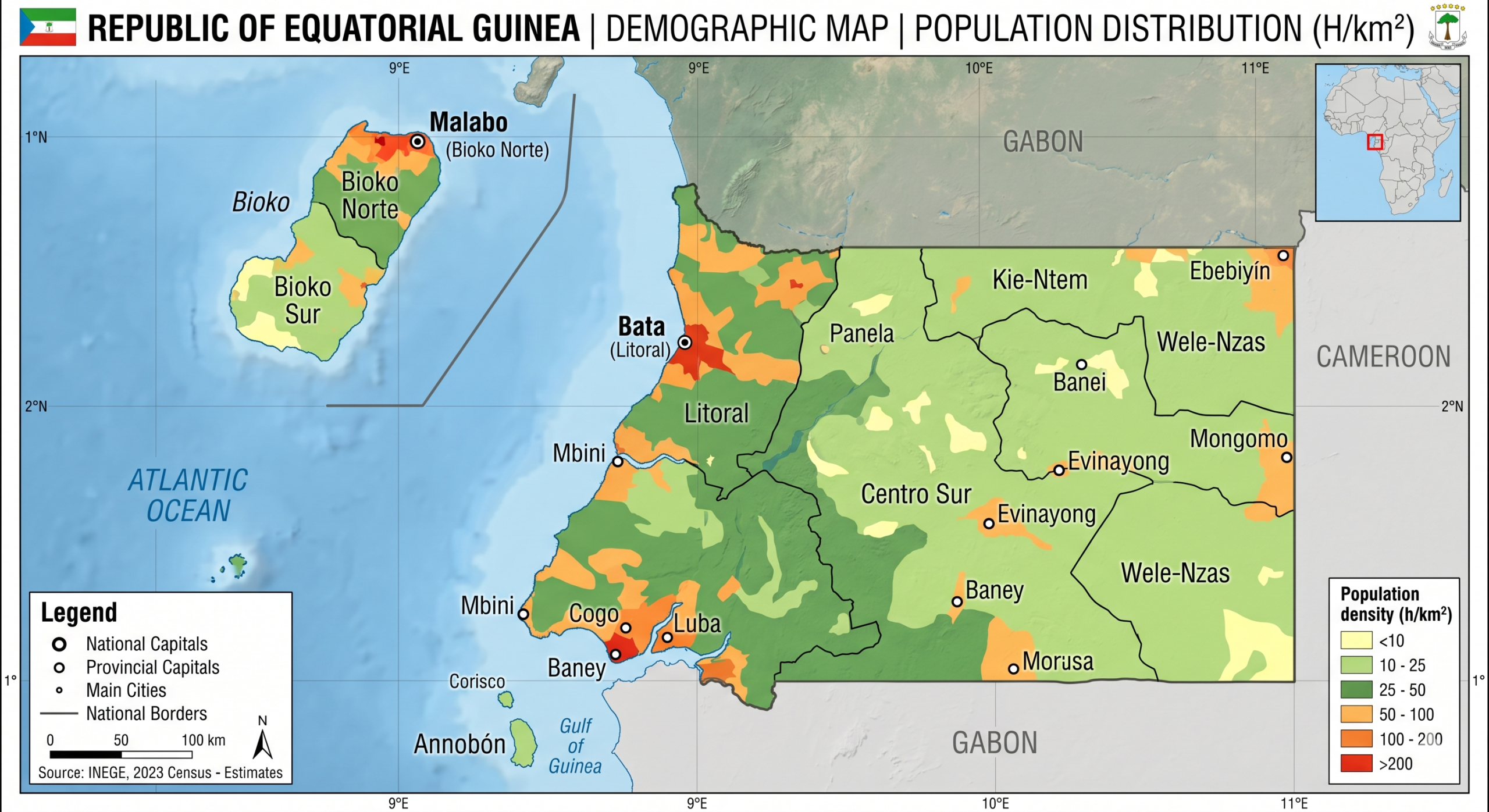
Located on the west coast of the African continent, Equatorial Guinea continues to fascinate with its cultural richness, complex history, and current realities. This small Central African state intrigues travel enthusiasts, challenges those interested in Spanish colonization, and raises many questions about its political regime, as well as its challenges in public health, economic development, and access to information.
Geography and Location of Equatorial Guinea
Equatorial Guinea benefits from a unique geographical position, consisting of two clearly distinct parts: a continental region bordered by Cameroon and Gabon, as well as several islands, including Bioko and Annobón. The island of Bioko hosts Malabo, the country’s capital, while the continental part is larger, featuring tropical forests and wild beaches that attract some enthusiasts of off-the-beaten-path tourism.

This mix of volcanic islands, savannas, and forested areas creates an astonishing variety of landscapes across a territory that remains relatively unknown. The diverse ecosystems shelter unique animal species, but the preservation of this biodiversity faces challenges linked to oil and forestry exploitation.
- Continental region: Rio Muni
- Main island: Bioko (where the capital Malabo is located)
- Small islands: Annobón, Corisco, Elobey Grande, and Elobey Chico
Table – Equatorial Guinea: Geographic and Demographic Information
| Element | Key Information |
|---|---|
| Total area | 28,051 km² |
| Capital | Malabo (official) – Oyala/Djibloho (administrative capital under development) |
| Neighboring countries | Cameroon, Gabon (and coasts on the Atlantic Ocean) |
| Particularity | Country composed of a continental part (Río Muni) and islands (Bioko, Annobón, Corisco…) |
| Estimated population | ~1.7 million inhabitants (2025) |
| Population density | ~60 inhabitants/km² |
| Relief | Equatorial forests, high plateaus, volcanic islands |
| Climate | Humid equatorial (heavy rains, constant heat) |
| Official languages | Spanish, French, Portuguese |
| Economic resources | Oil, gas, timber, agriculture |
Additional Points on the Map of Equatorial Guinea
- Equatorial Guinea is one of the smallest countries in Africa.
- Its map shows two distinct parts: Río Muni (continental) and the islands, including Bioko which hosts Malabo.
- The country is bordered by Cameroon to the north and Gabon to the south and east.
- Its strategic position on the Gulf of Guinea makes it an important geopolitical player.
- The economy depends heavily on offshore oil and gas.
The map of Equatorial Guinea highlights a small Central African country divided between a continental area, Río Muni, and several volcanic islands including Bioko, where Malabo, the capital, is located. It shows its land borders with Cameroon to the north and Gabon to the south, as well as its maritime opening onto the Gulf of Guinea. This geographical situation gives it strategic importance, notably thanks to its oil resources.
A past marked by Spanish colonization and the quest for independence
The modern history of Equatorial Guinea revolves around Spanish colonization, which began in the 18th century. At that time, European powers competed to extend their influence in Africa, and Spain occupied the territory it named “Spanish Guinea.” For decades, this colonial control shaped local society, imposed the Spanish language, and profoundly altered the social and administrative organization.

Compared to other regions of West Africa, the Spanish presence remains less marked in urban terms, but it has a lasting influence on culture, education, and even the legal system. Even today, Castilian coexists with local languages such as Fang, Bubi, or Pidgin.
After several social and political movements during the 1940s to 1960s, Equatorial Guinea finally gained its independence on October 12, 1968. This change brought hopes for a new organization, but it also opened the door to an uncertain political situation.
The post-independence period quickly experienced profound upheavals. The first governments struggled to stabilize the social and political situation, while many citizens aspired to build a strong nation on the ruins of colonialism.
An authoritarian regime shaping society
Since gaining independence, Equatorial Guinea has undergone a long period characterized by an authoritarian regime. Power remains highly centralized, with a very strong presence of authorities in all aspects of daily life, from economic decisions to the management of media and information.
Public institutions maintain a climate of strict control, often denounced by some international organizations. This limits freedom of expression and hinders the independent work of local journalists, which affects the circulation of news and information intended for the general public.
- Frequent censorship of private media
- Increased controls during election periods
- Challenges for civil society and independent NGOs
Travel and tourism: a confidential destination
Despite its discretion on the international tourist scene, Equatorial Guinea has undeniable assets. Those who venture there discover a rare authenticity and preserved nature, between virgin beaches, lush forests, and ancestral traditions. The colonial heritage, especially in Malabo, recalls the country’s Hispanic past with its colorful buildings and historic churches.

The Monte Alén National Park, renowned for its wildlife and breathtaking landscapes, is one of the must-see sites for ecotourism enthusiasts. On the island of Annobón, the island atmosphere offers a peaceful break that is uncommon in Africa.
Although the natural diversity could be a major asset, several obstacles remain to developing the travel and tourism sector. The first concerns the complex administrative procedures imposed by the authorities, notably obtaining visas or restrictions on access to certain regions.
The lack of adequate infrastructure and the perception of political instability also raise questions for investors and potential visitors. Thus, the destination mainly interests expatriates or specialists, and less often the general public.
Health situation and challenges in healthcare
In terms of health, Equatorial Guinea faces various structural problems related to the availability of care, the financing of the health system, and the persistence of infectious diseases. Some conditions such as malaria, tuberculosis, or HIV represent regular threats, especially in rural areas where medical services remain limited.
The rapid development of the oil sector has sometimes diverted resources from public services, complicating the response to essential health needs. Several NGOs and international organizations intervene to support vaccination, fight epidemics, and improve infrastructure.
- Lack of modern hospital facilities
- High prevalence of certain infectious diseases
- Occasional initiatives for awareness campaigns
Access to information and the role of media in Equatorial Guinea
The country’s media environment remains relatively closed. Most media outlets are state-owned or subject to tight control by the government. This situation creates obstacles to the free dissemination of news and information, and complicates the work of journalists wishing to provide an independent voice.
Rare private or community initiatives occasionally emerge, often on the internet or via social networks. Despite these efforts, self-censorship is widespread and public debate on sensitive topics such as democratic reform, public health, or financial transparency remains limited.
Economy and governance of the country
The discovery of offshore oil reserves in the 1990s transformed Equatorial Guinea’s economy, causing the GDP per capita to skyrocket within a few years. This oil windfall enabled significant investments in infrastructure and urban beautification, mainly in the capital and a few major cities.
However, this growth mainly benefits a minority and does not always bring the expected benefits to the entire population. Many Equatoguineans still report stark inequalities, with the majority living below the poverty line despite the apparent national wealth.
The leaders pay particular attention to political stability and internal security, to the detriment, according to some observers, of democratic openness and the normal functioning of institutions. Strategic plans aim to diversify the economy, but the administration remains focused on the oil model, which harms the creation of sustainable jobs.
In this context, the decisions of the government directly influence the social climate, wealth distribution, and Equatorial Guinea’s place on the international stage. Partnerships with various countries seek to attract foreign capital, while calls are made to strengthen transparency and regional integration.
FAQ – Equatorial Guinea map: 3 questions
Equatorial Guinea is located in Central Africa, on the edge of the Gulf of Guinea, between Cameroon and Gabon.
The country is composed of a continental part (Río Muni) and volcanic islands, including Bioko with the capital Malabo.
The country is rich in offshore oil, natural gas, timber, and equatorial forests.
