
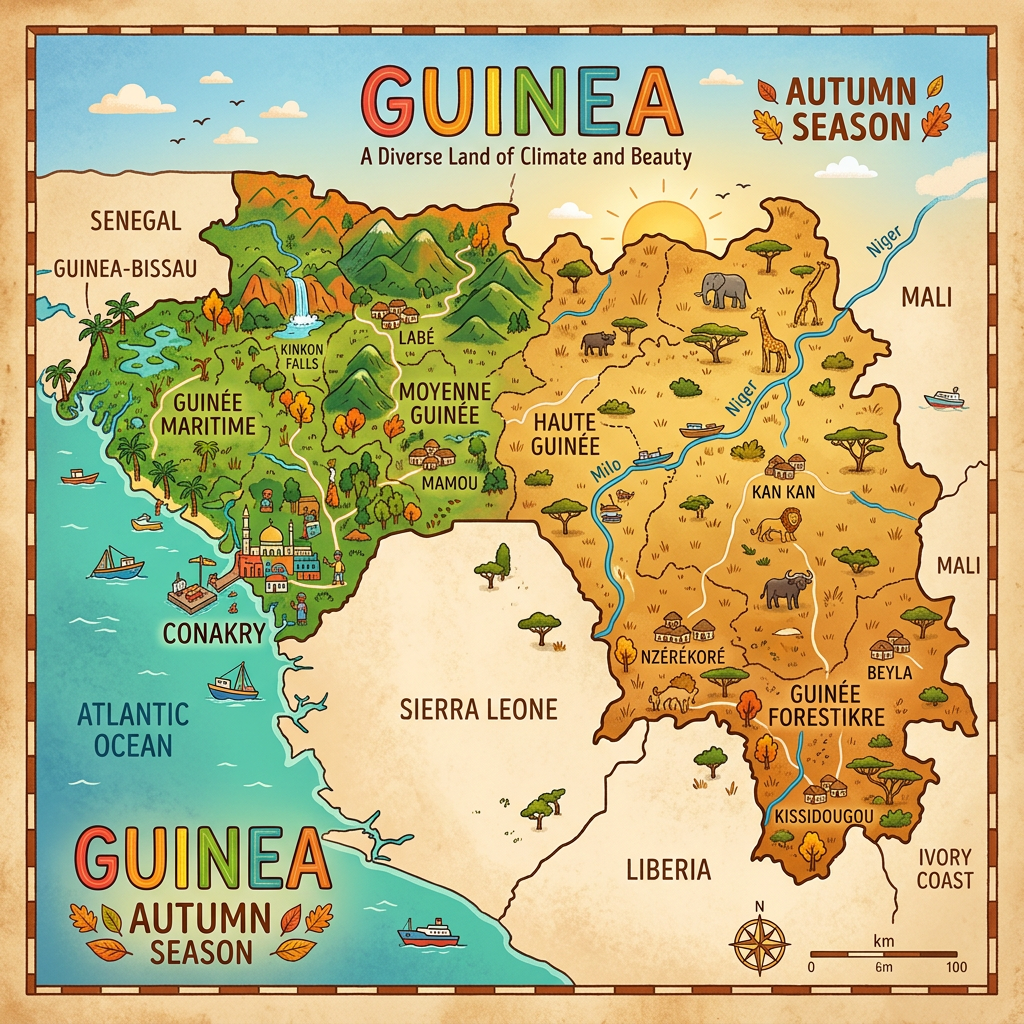
Between the Atlantic coast and the Fouta Djallon plateaus, Guinea is a major hydrological crossroads of West Africa. The map is essential for balancing terrain, seasons, and access to the regions (Lower/Upper/Forest Guinea) and for gauging journeys that are often longer than expected.
What you need to know about Guinea ?
The Republic of Guinea, often simply called Guinea, is a West African state with a presidential system within a constitutional republic.
The country covers an area of 245,857 km² and has about 14 million inhabitants (2024 estimate), with an average density of 51 inhabitants per km².
Its capital, Conakry, is also the largest city in the country, located on the Atlantic coast. It is the main economic, political, and port center of the country.
The official language is French, while several national languages such as Soussou, Malinké, and Peul are commonly spoken throughout the territory.
The international telephone code for Guinea is +224 (or 00224).
| Item | Details |
|---|---|
| Official Name | Republic of Guinea |
| Capital | Conakry |
| Population | ~13–14 million inhabitants, high coastal concentration and around Conakry |
| Area | ~245,860 km² |
| Relief & Hydrography | Fouta-Djalon (sources of Niger/Senegal/Gambia), coastal plains, savannas, forests in the southeast |
| Climate | Tropical with a marked rainy season (May–Oct.) and dry season (Nov.–Apr.) |
| Languages | French (official); national languages (Peul, Malinké, Soussou…) |
| Currency | Guinean franc (GNF) |
| Major Cities | Conakry, Kankan, Labé, Nzérékoré, Kindia |
| Economy | Mines (bauxite, gold), agriculture, fishing, services |
| Points of Interest | Fouta-Djalon (waterfalls, plateaus), Loos Islands, Haut-Niger park |
| Access | Conakry Airport (CKY), improving road network, regional road connections |
| Advice | Plan for rainy season, travel times, payment methods, and regional formalities |
Colors of Guinea

The flag of Guinea is a tricolor flag with vertical stripes: red, yellow, and green from left to right. Red symbolizes the blood shed during the struggle for independence. Yellow symbolizes the soil, fertility, and mineral wealth. Green symbolizes nature (vegetation and forest).
Best places to visit in Guinea?
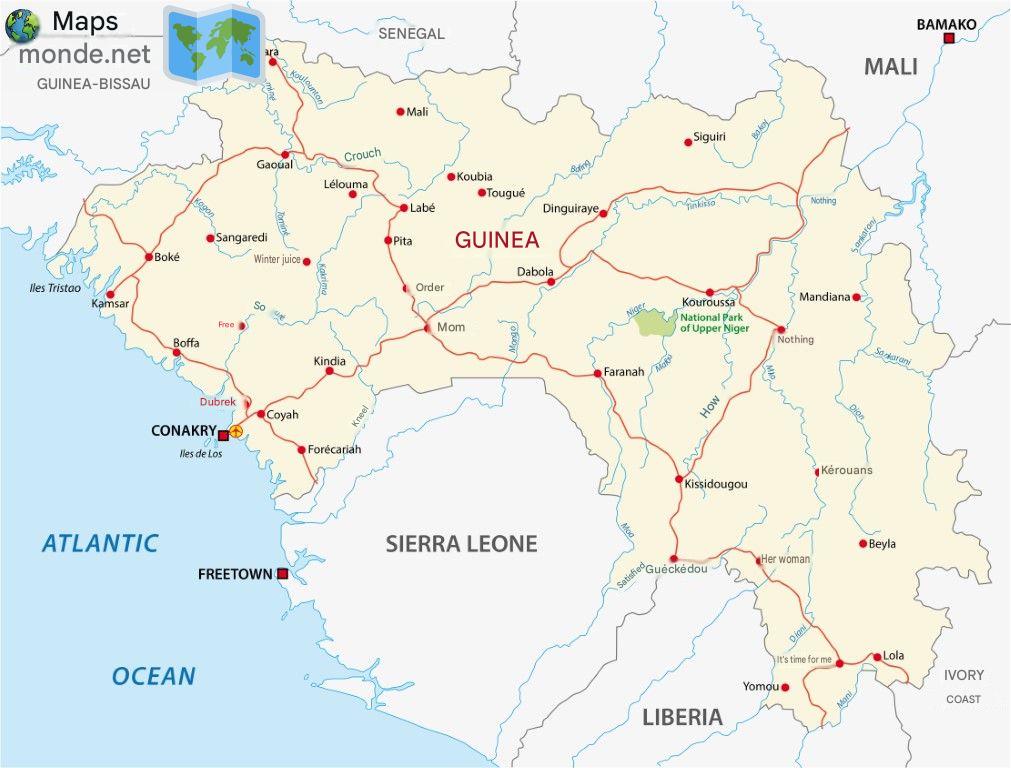
Conakry: The capital of Guinea is a large city overlooking the Atlantic Ocean and also a port city. It was also a Guinean capital during the French occupation. You will find museums, universities, natural parks, hotels, as well as covered markets and shopping centers.
Nzérékoré: This city has experienced a demographic boom in recent years. It is recognized as the economic and commercial center of the territory due to the presence of an international airport and various administrative headquarters. It is also an industrial city with several sawmills and plywood manufacturing facilities.
Guéckédou: it is a very populated city in Guinea with many immigrants coming from neighboring countries, notably Liberia, Sierra Leone, and Ivory Coast. It is a charming town where you can find lovely buildings as you walk through the streets of the city. There are also street food vendors with local specialties.
Where is Guinea located on the world map?
An African country located in West Africa, it borders Guinea-Bissau, Senegal, Mali, Ivory Coast, Liberia, and Sierra Leone. The country also has a coastline on the Atlantic Ocean along its western facade (see the overview Africa).

Climate of Guinea
Guinea has a tropical climate divided into two seasons. The first season is the rainy season occurring between May and October, and the dry season lasts the rest of the year. The annual rainfall is about 400 mm.
The territory can be divided into 4 climatic zones: Humid western section, Temperate section in the center of the country, Dry tropical section with low precipitation in the north and northeast with temperatures ranging between 20 and 40°C, Subequatorial section in the south with frequent precipitation and temperatures between 24 and 38°C.
The seasons do not coincide with changes in sunrise and sunset times. Day and night each last about 12 hours.
Administrative division of Guinea
The Guinean territory is organized into 8 administrative regions, subdivided into 33 prefectures.
The prefectures are further divided into sub-prefectures (about 303), then into communes — including 38 urban communes (of which 5 are for Conakry) and more than 330 rural communes.
These local entities are then divided into about 4,200 districts or neighborhoods and more than 15,000 sectors or villages.
The 8 administrative regions of Guinea
- Conakry Governorate
- Boké
- Kindia
- Mamou
- Faranah
- Kankan
- Labé
- Nzérékoré
Important notes:
- The Conakry Governorate has a special status (autonomous region) which includes 5 urban communes: Kaloum, Dixinn, Matam, Matoto, and Ratoma.
- The exact number of sub-prefectures and districts may vary slightly according to the latest administrative reforms (some date from 2017-2019).
Here are the 33 prefectures of Guinea :
Dalaba
Dinguiraye
Dubréka
Faranah
Forécariah
Fria
Gaoual
Guéckédou
Kankan
Kérouané
Kindia
Beyla
Boffa
Boké
Coyah
Dabola
Kissidougou
Pita
Siguiri
Télimélé
Tougué
Koubia
Koundara
Kouroussa
Labé
Lélouma
Lola
Macenta
Mali
Mamou
Mandiana
Nzérékoré
Guinea Economy
The Guinean economy remains fragile but has a strong development potential, notably thanks to its abundant mineral resources.
The country has one of the largest bauxite deposits in the world, a key resource for aluminum production. The exploitation of this ore, as well as that of gold, iron, and diamonds, represents the main source of foreign currency and public revenue.

Agriculture also remains a key sector of the economy, employing a large part of the rural population. The main crops are rice, corn, cassava, peanuts, and plantains. However, this sector remains poorly mechanized and heavily dependent on climatic conditions.
Despite sustained growth in recent years, the Guinean economy faces several challenges: limited infrastructure, regional inequalities, political instability, and high dependence on raw materials.
Key economic data (estimates 2024-2025)
- Official currency: Guinean franc (GNF)
- Nominal GDP: 10.5 billion USD
- Annual GDP growth: approximately 8%
- GDP per capita (PPP): 1,300 USD
- Inflation rate: 8.2%
- Population below poverty line: 35%
- Main industries: bauxite, gold, diamonds, iron, agro-food processing
- External debt: 1.33 billion USD
- Public revenues: 1.42 billion USD
- Public expenditures: 1.85 billion USD
Guinea is attracting increasing foreign investment, notably Chinese, in the mining and infrastructure sectors (roads, hydroelectric dams, ports).
The development of the Souapiti dam, the Simandou mining corridor, and the Boké port illustrates this desire to anchor the country on a path of sustainable and inclusive growth.
Population and linguistic data

The Guinean population is estimated at around 14 million inhabitants in 2024, with a demographic growth rate of 2.75% per year.
The fertility rate is 4.9 children per woman, while the birth rate (36.4 ‰) remains significantly higher than the mortality rate (8.9 ‰).
The life expectancy at birth is about 62 years, and the median age of the population is 19 years, illustrating a very young and rapidly expanding population.
The sex ratio is balanced, with about 100 men for every 100 women.
Languages spoken
The official language of Guinea is French, used in administration, education, and media.
However, the country has several national languages widely used in daily life:
- Peul (Pular): 32%
- Malinké (Maninka): 30%
- Soussou: 20%
These languages coexist with other regional dialects such as Kissi, Toma, or Kpelle, mainly spoken in forest areas.
Ethnic groups
Guinean society is composed of four major ethnic groups:
- Peuls and related groups: 32%
- Malinkés and related groups: 30%
- Soussous and related groups: 20%
- Forest peoples (Kissi, Kpelle, Toma, Guerzé, etc.): 10%
Religions
Guinea is predominantly Muslim, with:
- Islam: 85%
- Christianity: 8%
- African traditional beliefs: 7%
This ethnic, linguistic, and religious diversity constitutes a rich cultural mosaic at the heart of Guinean identity.
FAQ: Guinea map
A useful Guinea map highlights the Fouta-Djalon, the routes to Labé/Kankan/Nzérékoré, and access points to the coast (Conakry, Loos Islands).
The Guinea map combining relief and road network allows anticipating modest average speeds, especially in the rainy season.
Opt for a Guinea map with contour lines and protected areas (Upper Niger, Fouta massifs) to mark waterfalls and plateaus.
Yes, a structured Guinea map distinguishes Lower Guinea (coast), Middle Guinea (Fouta), Upper Guinea (savannas), and Forest Guinea (southeast).
