
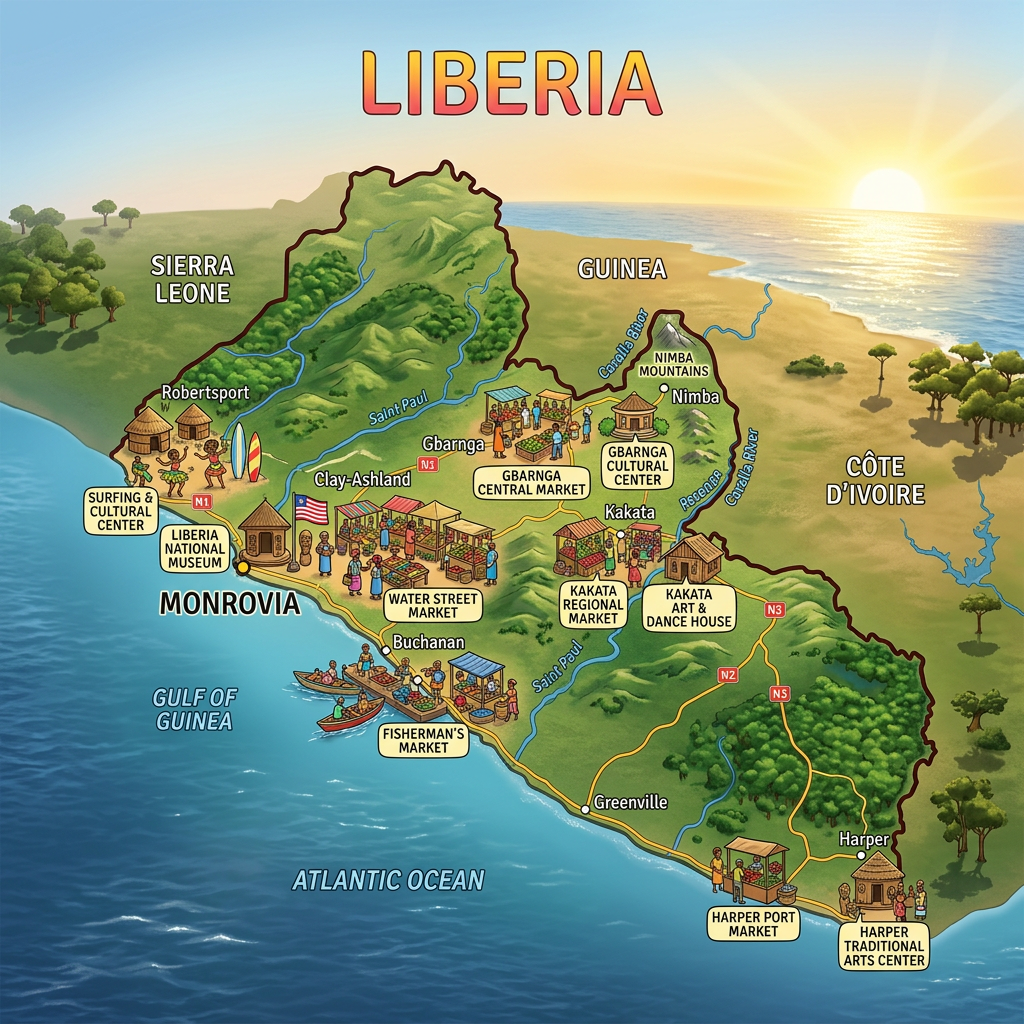
Nestled between Sierra Leone, Guinea, and Côte d’Ivoire, Liberia stands out as one of the West African countries with a unique trajectory. This territory attracts attention due to its tumultuous past, cultural diversity, and coastal landscapes marked by tropical forests stretching to the Atlantic. Imbued with a history shaped by the quest for freedom and decades of upheaval, Liberia continues today to transform through multiple social, political, and economic challenges.
Table – Liberia: geographic and demographic information
| Element | Key Information |
|---|---|
| Total area | 111,369 km² |
| Capital | Monrovia |
| Neighboring countries | Sierra Leone, Guinea, Côte d’Ivoire |
| Coastline | About 560 km on the Atlantic Ocean |
| Estimated population | ~5.4 million inhabitants (2025) |
| Population density | ~48 inhabitants/km² |
| Relief | Sandy coasts, hills, tropical forests, high plateaus inland |
| Climate | Equatorial: hot, humid, marked rainy seasons |
| Official language | English |
| Economic resources | Rubber, iron ore, gold, diamonds, agriculture |
Independence and history of Liberia
Among the nations of Africa, Liberia holds a special place for having asserted its independence early on against European colonialism. This unique status still shapes the country’s perception today and forms part of its identity. As early as 1847, this young state proclaimed its autonomy, becoming the first independent nation of the modern African continent. This particularity stems from an equally unique context: the return of former African-American slaves eager to find a free land on the West African coast.

This project of returning to the continent, initiated at the beginning of the 19th century, gave rise to a political model inspired by American institutions. The capital Monrovia is named after American President James Monroe, highlighting the influence of this transatlantic relationship. Nevertheless, this foundation sparked tensions from the outset with the indigenous populations, laying complex foundations for Liberian society.
Additional points on the map of Liberia
- The Liberian coast is renowned for its beaches and natural ports.
- The country is crossed by numerous rivers, including the Saint Paul and the Cavalla.
- The demographic map shows a population concentrated in the capital Monrovia and along the coast.
- Liberia is one of only two African countries not to have been colonized (along with Ethiopia).
- Its territory is covered by nearly 40% tropical forests.

The map of Liberia highlights its position in West Africa, bordered by the Atlantic Ocean. It shares its borders with Sierra Leone to the west, Guinea to the north, and Ivory Coast to the east. Its capital Monrovia is one of the largest natural ports in Africa, which gives the country strategic importance in the region.
From civil wars to hopes for democratic stability
The following century does not spare Liberia, engaged in a constant struggle to come to terms with its legacies. Ethnic rivalries, inequalities stemming from the initial social structure, and greed over its resources quickly become powerful drivers of internal tensions. At the end of the 20th century, these elements culminate in two long civil wars and dramatic conflicts that tear the country apart and cause significant waves of refugees to the neighboring countries.
The aftermath of these clashes is visible even in the urban architecture of the capital – Monrovia displays a mix of fragile modernity and persistent scars. While the trauma of these events remains present in the collective memory, Liberia has been trying for nearly two decades to strengthen its democratic stability, alternating relatively free elections, institutional reforms, and calls for national dialogue.
What challenges after the conflicts?
As peace takes root, Liberian society faces several challenges. It is necessary not only to heal the wounds left by the civil wars, but also to fight impunity and promote national reconciliation. Many observers closely watch every progress to measure the path traveled since the signing of the 2003 peace agreement.
The role played by the international community, notably through organizations like the UN, has also helped establish a climate conducive to reconstruction. However, this process remains fragile, depending as much on political compromises as on the concrete improvement of Liberians’ daily lives.
News and information on the current situation
In terms of news and information, major current topics often revolve around elections, management of public infrastructure, and the fight against corruption. Several organizations closely monitor the progress of human rights and regularly praise advances on the regional stage. Yet, social expectations remain high, particularly among the youth and rural populations.
Access to healthcare, education, and decent jobs are priorities. Local media also analyze the impact of common regional policies with borders and neighboring countries, a guarantee of security but also of cross-border economic dynamism.
Monrovia, the capital, a reflection of a contrasting country
On the edge of the Atlantic Ocean, Monrovia, the capital of Liberia, offers a lively panorama where Western influences, traditional markets, and exuberant popular neighborhoods mingle. A real administrative and economic heart, this city concentrates a large part of the population and houses the government headquarters as well as numerous international institutions.

Despite its vitality, Monrovia faces major challenges: uncontrolled urban development, heavy traffic, sometimes difficult waste management, and limited access to certain essential services. However, the city’s cosmopolitan identity helps attract entrepreneurs, artists, as well as NGOs involved in social support. It invites you to discover a human mosaic rich in contrasts.
Population and demographics of Liberia
The population and demographics of Liberia reveal a young and diverse society. With more than five million inhabitants recorded, the country is among those with a remarkably high proportion of young people. Nearly 60% of Liberians are under 25 years old, which generates massive needs in education, vocational training, and job creation.
More than fifteen main ethnic groups make up the national fabric, each with its own languages and traditions, bringing a lively and plural dimension to Liberian culture. The official English language coexists here with dozens of vernacular languages used in daily and intergenerational life. This linguistic abundance perfectly reflects the complexity and historical depth of the country.
Economy and economic indicators of Liberia
Liberia has historically relied on its natural resources to build its economy and improve economic indicators. Iron mines, natural rubber exploitation, subsistence agriculture, and fishing actively contribute to the gross domestic product. Despite this undeniable potential, most households live in precarious balance, exposed to fluctuations in global markets and the consequences of years of conflict.
In recent years, leaders have sought to diversify growth through sustainable agriculture, light industry, and encouragement of local small businesses. Here are some key sectors of the Liberian economy:
- Export of minerals (iron, gold, diamonds)
- Rubber and coffee cultivation
- Coastal fishing and forestry
- Community services and emerging tourism initiatives
Major public investment projects target transport infrastructure, access to energy, and digital technology. The volume of trade with borders and neighboring countries also strongly influences the dynamism of the local market.
Borders and neighboring countries: interactions and cooperation
Surrounded by three major nations, Liberia maintains strategic relations with its border partners. Population movements, regional integration, and securing road networks can significantly impact internal stability. Cooperation with Guinea, Sierra Leone, and Ivory Coast therefore plays a key role in anticipating or responding to cross-border crises.

In order to promote a peaceful and economically stimulating environment, informal trade networks thrive across official borders – sometimes creating additional challenges in customs surveillance and taxation. The sharing of natural and water resources also becomes a central issue in bilateral agreements.
What are the prospects for regional cooperation?
The Economic Community of West African States (ECOWAS) encourages ongoing dialogue regarding the coordinated management of borders and the mobility of goods and people. This dynamic multiplies opportunities, both for crisis resolution and for building a solid foundation to support human and industrial development.
Sharing best practices, pooling skills, and uniting against certain issues such as poaching or deforestation are immediate priorities. These efforts illustrate the commitment to fully integrate Liberia into a region fostering positive transformations.
FAQ – Liberia map
Liberia is located in West Africa, on the Atlantic Ocean coast, between Sierra Leone, Guinea, and Ivory Coast.
The capital is Monrovia, located on the coast, facing the Atlantic Ocean.
The country is distinguished by its sandy coastline, its dense tropical forests and its plateaus inland.
