
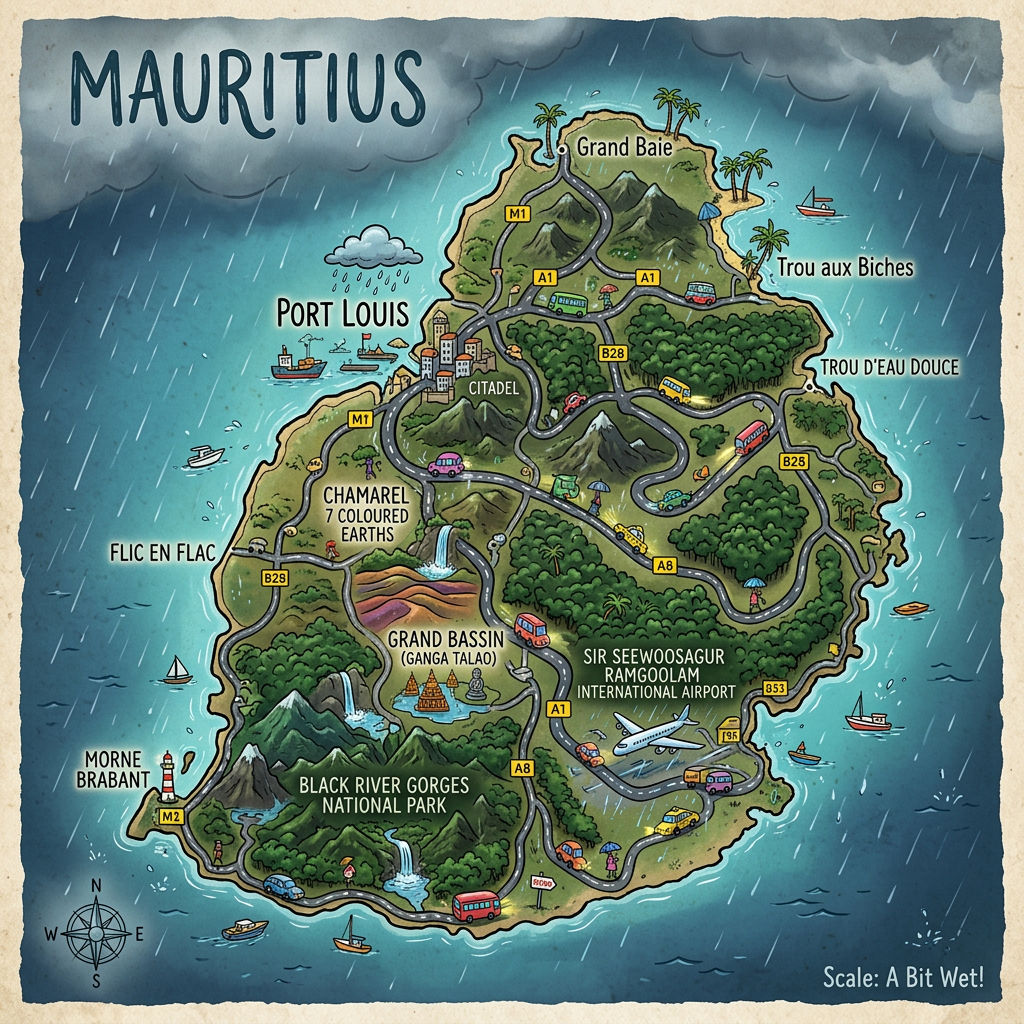
Want to discover Mauritius, its varied landscapes and its paradisiacal beaches? It’s impossible to get your bearings without taking a look at a map of Mauritius. Whether to plan routes or find the most beautiful tourist sites, understanding the local geography quickly becomes fascinating. Here’s how to use each type of map to better organize your stay or simply satisfy your curiosity.
Geography and location of Mauritius
Located in the Indian Ocean, off the coast of Madagascar, Mauritius is part of the Mascarene archipelago. Its small size does not prevent it from offering a diversity of striking landscapes. There are both lush mountains, numerous coastal villages, and turquoise blue lagoons that border almost the entire island.

Table – Mauritius: geographical and demographic information
| Element | Key Information |
|---|---|
| Total area | 2,040 km² |
| Capital | Port Louis |
| Neighboring countries | None (Island state, Indian Ocean) |
| Archipelago | Mauritius, Rodrigues, surrounding islets and reefs |
| Estimated population | ~1.3 million inhabitants (2025) |
| Population density | ~635 inhabitants/km² (high) |
| Relief | Volcanic: mountains, plateaus, and coastal plains |
| Climate | Tropical, influenced by trade winds, with rainy season (November-April) |
| Main languages | Mauritian Creole, English, French |
| Economic resources | Tourism, sugarcane, financial services, ICT |
The map of Mauritius allows easy visualization of the cardinal points and the precise location of each area of interest. The north, with Grand Baie and Pointe aux Canonniers, attracts many for its activities, while the southwest coast offers a wilder environment around Morne Brabant. Each part of the island has its particularities, making the choice of where to stay strategic to make the most of it.
The map of Mauritius illustrates a small island state in the Indian Ocean, located east of Madagascar and southwest of the Seychelles archipelago. Its volcanic reliefs, beaches bordered by lagoons, and coral reef make the island a major tourist destination. The capital Port Louis concentrates much of the country’s economic and port activities.
Additional points on the map of Mauritius

- Mauritius is located in the Indian Ocean, about 900 km east of Madagascar.
- The country is part of the Mascarene Islands, alongside Réunion and Rodrigues.
- Its physical map reveals volcanic landscapes, with the Piton de la Petite Rivière Noire (828 m) as the highest point.
- The demographic map shows a high population concentration on the northwest coast around Port Louis.
- The island is surrounded by a lagoon protected by a coral reef, visible on tourist maps.
What are the different types of maps available?
Travelers often consult several maps before departure or on site. Depending on the purpose, it is better to choose a tourist map or opt for a more detailed road map if you are going on an adventure by car or bike. Some also prefer topographic maps, which provide a more precise view of the relief and protected natural areas.
For those looking to locate hotels and accommodations or quickly spot the distances between two regions, there are also digital tools that allow multiple data to be displayed simultaneously on the same interface. Choosing the right medium greatly helps optimize the discovery of the island, especially for those who like to go off the beaten path.
Tourist map: key points to spot
It usually starts with examining a tourist map of Mauritius. This type of document indicates the most famous beaches, museums, local markets, and the location of botanical gardens such as the one in Pamplemousses. The suggested routes guide you to must-see historical monuments or iconic natural sites, such as the Black River Gorges, Chamarel, or Cap Malheureux.
Browsing a tourist map always holds some surprises, whether it’s a lively village or a hidden hike among volcanic hills. It also helps locate the main transportation as well as the roads leading to these famous Mauritian viewpoints.
Road map: driving on Mauritius
Taking the road on the island often calls for consulting a road map, ideal for anticipating trips between cities, attractions, and scattered beaches. The main roads converge around Port Louis, the capital, then radiate out to the rest of the island. The signage remains fairly clear but can seem confusing during the first few kilometers, so keeping a road map handy quickly becomes reassuring.
Thanks to these precise representations, measuring distances and estimating travel time become easy. This proves useful to avoid frequent traffic jams around the capital or to successfully complete a full tour of the island without unnecessary detours.
Topographic map: exploring Mauritian nature
To get off the classic paths, the topographic map gives another dimension to the trip. It highlights mountains, ancient craters, or forest reserves such as those in the Mare Longue estate or the Black River Gorges National Park.

With this type of map, going on a hike or climbing a volcanic peak such as Pieter Both becomes much easier. The reliefs being clear, steep paths appear clearly, thus avoiding unpleasant surprises on the ground. Many visitors appreciate these documents when they want to combine relaxation and nature immersion.
Regions and areas to explore with a map of Mauritius
The island is divided into several zones with distinct atmospheres, easily identifiable on a map. The north concentrates the major festive spots and lively beaches. To the east, the panoramas change with preserved lagoons around Trou d’Eau Douce or Belle Mare. The central lands, for their part, hold traditional villages and sugar cane fields.

Elsewhere, the west coast attracts with its spectacular sunsets behind the Morne mountains, while the south stands out for its cliffs and unique rock formations. Each of these regions deserves a closer look, as the atmosphere varies greatly from one area to another.
City maps: how to better find your way?
In the city, especially in Port-Louis or Curepipe, having a detailed map makes perfect sense. These tools make it easier to move from one neighborhood to another and to locate cafés, markets, and local shops.
In urbanized areas, maps help anticipate parking or identify administrative and cultural centers to visit. They also serve to organize a gourmet break or choose a unique place to taste typical Mauritian cuisine.
Distances and routes: preparing your trips
Planning your routes requires taking into account the distances and routes shown on the road map. Even though the island seems compact, some secondary roads wind between fields or hills, sometimes lengthening travel times. Information on the kilometers separating each village is useful for creating balanced daily circuits.
Moreover, anticipating connections between bus lines or the taxi network helps combine different means of transport without wasting time. Some mobile apps even link this cartographic data to their route suggestions.
Hotels and accommodations: where to stay according to the map?
The distribution of hotels and accommodations is clearly visible on a tourist map. Many hotel complexes line the northwest and west lagoons, while more charm emanates from certain guesthouses in the center or south. The choice often depends on the planned activities and excursions considered.
Easily finding your future address or comparing options based on distance to the beach, shops, or a natural area is among the advantages of a good map. This helps avoid long daily trips and adapt your stops to fully experience Mauritius.
- Locate transport and taxi stations
- Find popular restaurants
- Select panoramic viewpoints
- Find access to hikes or cycling routes
- Confirm the exact location of beaches or historic sites
Must-see activities and tourist sites on the map
Identifying the major activities and tourist sites remains easy with the help of a carefully annotated map. Among the key places grouped along a route, you will find islets like Île aux Cerfs, Hindu temples, or the colorful dunes of Chamarel. Some itineraries also lead to the picturesque weekly markets in Mahébourg or Flacq.
Enthusiasts of water sports benefit from locating diving schools, sailing clubs, or kitesurfing spots directly on their preferred medium. Those who prefer heritage discover, around an illustrated page, the museums and colonial buildings near historical routes.
Tips for making the most of the Mauritius island map
To make the most of each document, combining several formats is smart: an interactive map to adjust choices in real time, then a reliable paper version to prevent possible internet outages. Noting down useful numbers in advance or marking your day’s stops limits the risk of setbacks.
In the end, good guides often combine photos, descriptions, and symbols specific to each activity, making map reading even more intuitive. This is ideal for personalizing your exploration of Mauritius without missing hidden corners or modern conveniences accessible everywhere.
Customize your routes and getaways using the map
Creating your own route, according to your desires and holiday priorities, becomes more accessible when you know how to analyze a map in detail. Adjusting your days based on the weather or extending a stop after a beautiful discovery comes naturally when alternative options remain visible on a faithful representation of the territory.
Thanks to the Mauritius island map, each visitor retains complete freedom to pace their stay, try new experiences, whether along the beaches, in the mountains, or in lively small towns.
FAQ – Mauritius island map: 3 questions
Mauritius is located in the Indian Ocean, east of Madagascar and south of the Seychelles.
The capital is Port Louis, located on the northwest coast of the island.
The island is of volcanic origin, bordered by a coral reef and features varied landscapes including mountains, plateaus, and tropical beaches.
