
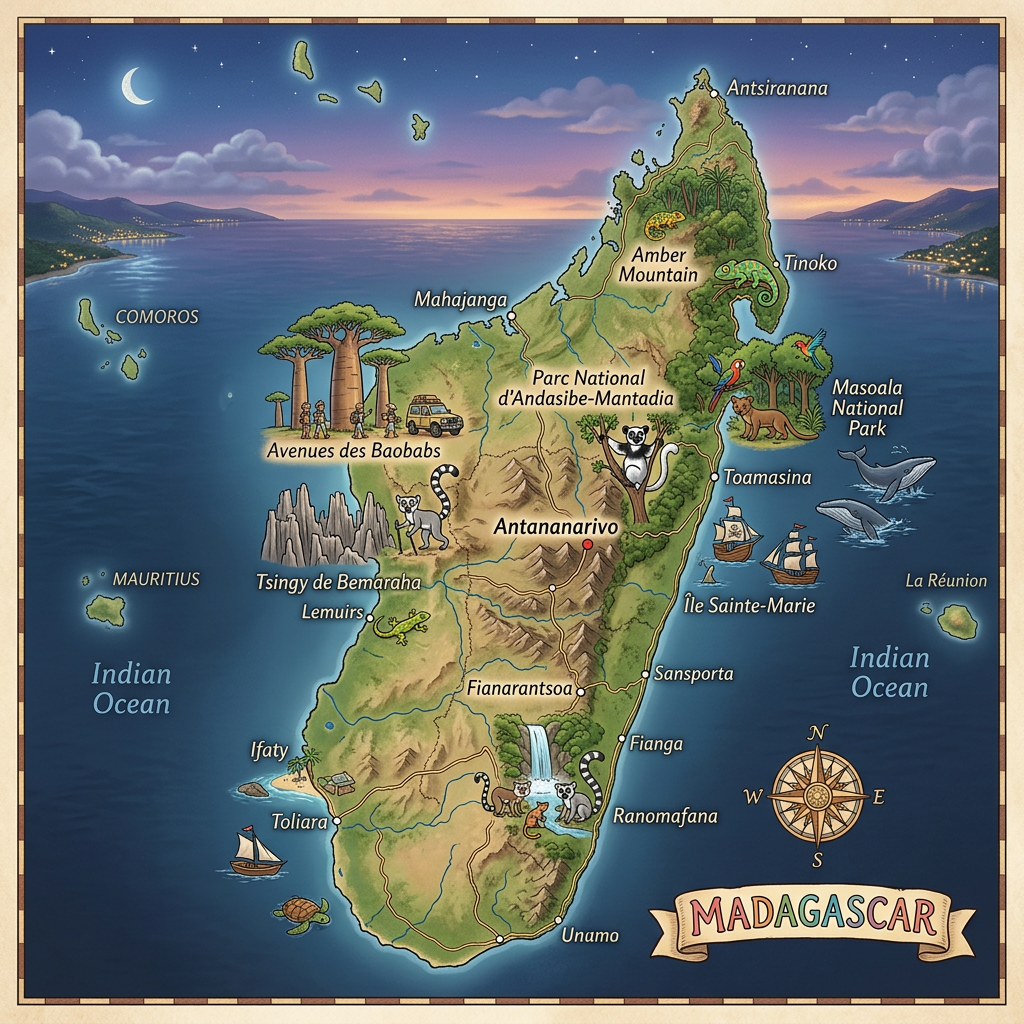
A vast island with contrasting landscapes, Madagascar is best explored slowly: use a map to connect the Highlands, the humid east coast, and the drier west. Plan around the seasons (rains and cyclones) and book the parks and flagship islands early (Nosy Be, Sainte-Marie, Isalo, Andasibe).
What you need to know about Madagascar ?
Madagascar is a vast island located in the Indian Ocean, off the southeast coast of Africa. It is separated from the African continent by the Mozambique Channel, about 400 kilometers wide.
Officially called the Republic of Madagascar, the country is a unitary state with a semi-presidential system, based on a republican constitution.
Its capital and largest city is Antananarivo (often called Tananarive).
The Malagasy territory covers 587,041 km², making it the 4th largest island in the world and the 48th largest country.
The population is estimated at about 30.3 million inhabitants in 2024, ranking Madagascar 53rd worldwide in terms of population.
The country’s international telephone code is +261 (or 00261).
| Item | Details |
|---|
| Official Name | Republic of Madagascar |
| Capital | Antananarivo |
| Population | ~29–30 million inhabitants, high concentration in the Highlands |
| Area | ~587,000 km² (4th largest island in the world) |
| Relief & Hydrography | Central Highlands, mountain ranges (Andringitra), long coasts, mangroves, east/west rivers |
| Climate | Tropical trade winds; rainy season Nov–Apr, dry season May–Oct; cyclone risks on the east coast |
| Languages | Malagasy (official), French (official), English present in tourism |
| Currency | Malagasy Ariary (MGA) |
| Major Cities | Antananarivo, Toamasina (Tamatave), Mahajanga, Toliara (Tuléar), Fianarantsoa, Antsiranana (Diego Suarez) |
| Economy | Agriculture (vanilla, clove, lychee), mining, fishing, nature tourism |
| Points of Interest | Lemurs, Tsingy, parks (Andasibe, Isalo), islands (Nosy Be, Sainte-Marie), baobabs |
| Access | Flights to Antananarivo, Nosy Be; domestic air and road connections |
| Tips | Plan for seasons/cyclones, long distances, road conditions, reservations for parks and islands |
Countries bordering Madagascar
The neighboring countries of Madagascar are the Comoros (archipelago), Réunion (France), Mauritius, Mozambique (on the African continent), and the Seychelles.
The colors of Madagascar
The flag of Madagascar is a tricolor flag with a vertical white band on the hoist side and two superimposed red and green bands. The three bands are of equal size.

The white band signifies purity, the red band represents sovereignty, while the green band represents the coastal areas and hope.
The best places to visit in Madagascar

Antananarivo (Tananarive)
Capital and largest city of the country, Antananarivo is located in the heart of the Central Highlands. Founded in the 17th century by the Merina kings, it embodies the historical and political soul of Madagascar.
Here you can discover the Queen’s Palace (Rova of Antananarivo), the Ambohimanga Palace, listed as a UNESCO World Heritage site, as well as numerous markets and government institutions.
Modern and lively, the capital also hosts the main international airport of the country.
Tamatave (Toamasina)
Located on the east coast, Tamatave is the largest port city of Madagascar and the nerve center of maritime trade.
It charms with its coconut-lined beaches, its colorful central market, and its street food influenced by Creole and Asian flavors.
However, some coastal areas are off-limits for swimming due to the presence of sharks — an essential precaution to know before any visit.
Majunga (Mahajanga)
On the northwest coast, Majunga is known for its lively waterfront, its commercial port, and its warm and sunny climate all year round.
The city offers a friendly atmosphere, between peaceful beaches, craft markets, and local grills served in seaside kiosks.
It is an ideal stop to discover the mixed culture and cuisine of northwestern Madagascar.
Nosy Be
Nicknamed the “Island of Perfumes,” Nosy Be is one of the country’s most touristy destinations. Located off the northwest coast, it attracts with its paradise beaches, its turquoise waters, and its exceptional marine life.
You can practice scuba diving, explore the Lokobe Reserve, or enjoy Mount Passot to admire a spectacular sunset over the volcanic lakes.
Antsirabe
Located 170 km south of Antananarivo, Antsirabe is a spa town known for its cool climate, its hot springs, and its craft workshops (precious stones, embroidery, miniatures).
Called the “city of pousse-pousse”, it combines colonial charm and Malagasy way of life, offering a pleasant stop on the southern route towards Fianarantsoa and Tuléar.
Financial map of Madagascar
The Malagasy economy is mainly based on agriculture, which remains the backbone of the country. Classified by the International Monetary Fund (IMF) among the low-income countries, Madagascar remains one of the most economically vulnerable nations, with more than 77% of the population living below the poverty line, according to United Nations data.

The agricultural sector contributes to more than 60% of GDP and employs the majority of the active population. Food crops dominate, notably rice (which covers nearly 50% of cultivated arable land), but also cassava, corn, sweet potato, and potato.
The island is also known for its export crops such as vanilla, coffee, cocoa, pepper, and lychee, which represent a significant share of foreign exchange earnings.
Despite its agricultural, mining, and tourism potential, Madagascar faces many challenges: limited infrastructure, recurring political instability, and climate vulnerability.
Key Economic Data (2024-2025 estimates)
- Official currency: Malagasy Ariary (MGA)
- Nominal GDP: 10.2 billion USD
- GDP at purchasing power parity (PPP): 35 billion USD
- Annual GDP growth: approximately 3.3%
- GDP per capita (PPP): 1,460 USD
- Human Development Index (HDI): 0.510
- Population below poverty line: 43%
- Inflation rate: 6.1%
- Unemployment rate: approximately 3.6%
The Malagasy economy currently ranks 155th worldwide, and the country is pursuing several structural reforms aimed at stimulating investment, developing rural infrastructure, and promoting a sustainable growth model based on agriculture and ecotourism.
Climatic map of Madagascar
The climate of Madagascar can be divided into five specific climatic zones including.
The northern and northwestern section: this is an area that experiences a long and significant rainy season strongly influenced by the monsoon. This rainy period generally occurs between December and April, and temperatures range between 15 and 37°C.
The Eastern section mainly along the North to South coastline: This area features a humid tropical climate with heavy rainfall. This part of the island is subject each year to cyclonic hazards and strong trade winds. This rainy season occurs between January and March.
The Western section of the island has a moderate tropical climate. This is characterized by low rainfall and temperatures ranging between 6 and 37°C.
The center of Madagascar (also called the Central Highlands) has a temperate subtropical climate. This is marked by a significant rainy season and a more or less constant temperature throughout the year of about 20°C.
The Southern part of the island has a semi-desert climate with very divergent temperatures ranging from -6°C to 40°C.
Demographic, demolinguistic and administrative map of Madagascar

Demography
The population of Madagascar is estimated at about 30.3 million inhabitants in 2024, with a population growth rate of 2.4% per year.
The fertility rate is 3.8 children per woman, while the birth rate (31 ‰) remains significantly higher than the death rate (6.4 ‰).
The life expectancy at birth is 66.6 years, including 65.1 years for men and 68.2 years for women.
The male/female ratio is balanced, with about 100 men for every 100 women.
This young population (median age around 19 years) is mainly concentrated in the central highlands and in the coastal areas of the east and northwest.

Administrative Divisions of Madagascar
The territory of Madagascar is organized into 6 provinces, which are themselves subdivided into 22 regions, then into communes or decentralized territorial communities.
The 6 provinces of Madagascar
- Antananarivo (Tananarive)
- Antsiranana (Diego-Suarez)
- Toamasina (Tamatave)
- Mahajanga (Majunga)
- Toliara (Tuléar)
- Fianarantsoa
The 22 regions of Madagascar
- Diana
- Sava
- Itasy
- Analamanga
- Vakinankaratra
- Bongolava
- Sofia
- Boeny
- Betsiboka
- Melaky
- Alaotra-Mangoro
- Atsinanana
- Analanjirofo
- Amoron’i Mania
- Haute Matsiatra
- Vatovavy-Fitovinany
- Atsimo-Atsinanana
- Ihorombe
- Menabe
- Atsimo-Andrefana
- Androy
- Anôsy
Demolinguistic data
The Malagasy population descends from Austronesian or Melanesian lineages. They are the ancestors of the Vazimbas and Vézos who gave rise to the current population. The Malagasy ethnic groups currently number 19, including:
- Antaifasy
- Antaimoro
- Antaisaka
- Antakarana
- Antambahoaka
- Antandroy
- Antanosy
- Bara
- Betsileos
- Betsimisarakas
- Bezanozanos
- Mahafaly
- Masikoro
- Mérinas
- Sakalaves
- Sihanaka
- Tanala
- Tsimihety
- Vézos
There are also ethnic minorities which are the Comorians, the Sinoa (Chinese), and Karana (Indo-Pakistani)
The official language in the country is French but the national language is Malagasy; however, each ethnic group has its dialectal variations. On the other hand, the Mérina dialect is recognized by the constitution as a national language.
To start, consult the dedicated page Madagascar Map. Continue with the capital and its surroundings via Antananarivo, then get inspired by an accessible and popular island with Nosy Be.
FAQ: Madagascar Map
A Madagascar Map that distinguishes altitudes and road axes helps organize an itinerary between Antananarivo, the humid east, and the dry west.
Yes, a Madagascar Map combined with the seasons shows the exposure of the east coast and helps adapt schedules and routes.
Prefer a Madagascar Map with park boundaries, road access, and estimated travel times (Andasibe, Isalo, Tsingy).
It is better to carry an offline Madagascar Map and/or GPX tracks: signage is uneven and roads are sometimes degraded.
