
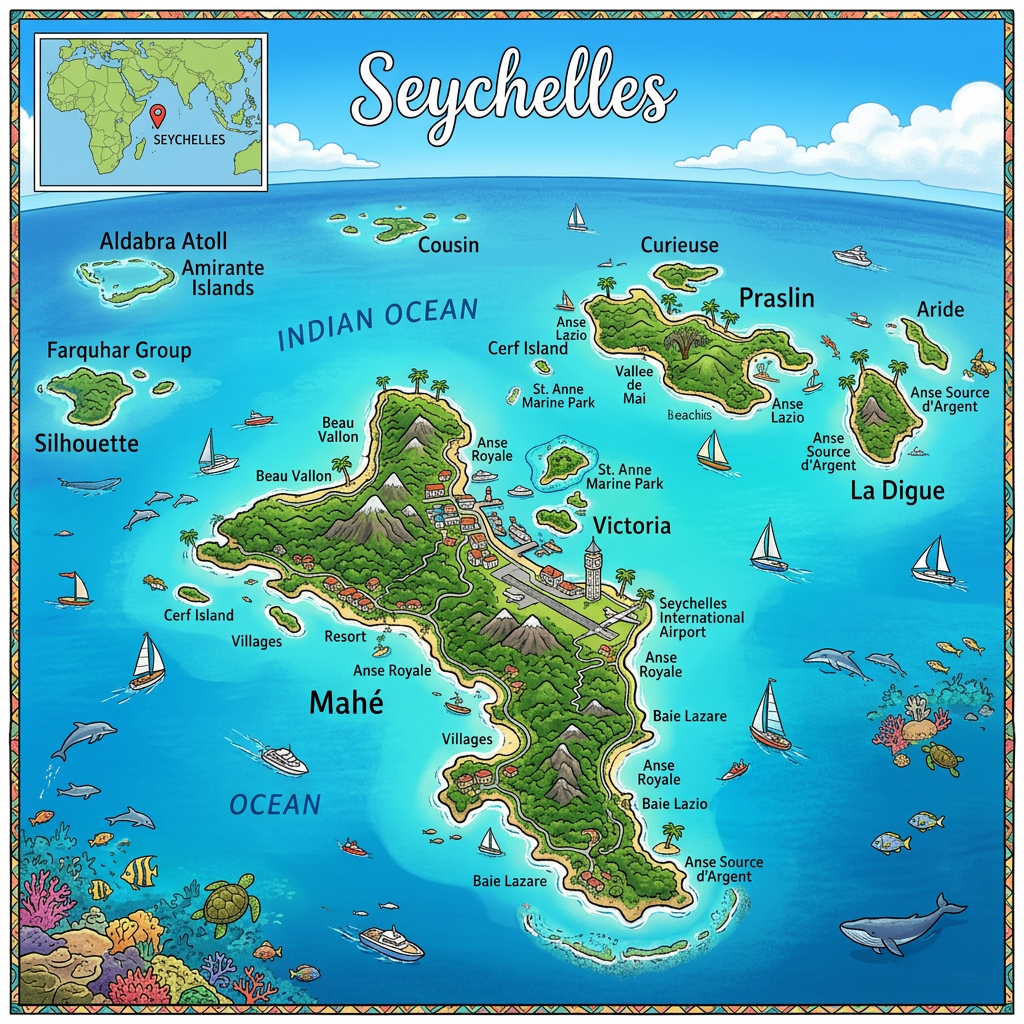
The Seychelles is an island state composed of several islands (115 in total with only 8 inhabited). Together, they form the Republic of Seychelles, which is a presidential republic. Its capital and largest city is Victoria.

The total area of the country is 455 km2, which ranks it 179th largest in the world. Its current population is 85,981 inhabitants, ranking it 198th in terms of population size. The country is part of SADC, COMESA, and the AfDB, and the telephone code is 248.
Map of Seychelles – key figures to read on the map
| Indicator | Key figure | Fun & useful reading |
|---|---|---|
| Land area | 455 km² | Smaller than Paris |
| Total number of islands | 115 | Highly scattered archipelago |
| Inhabited islands | ≈ 33 | Majority are untouched |
| Total population | ≈ 100,000 inhabitants | Low human density |
| Capital | Victoria | One of the smallest capitals in the world |
| Main island | Mahé | Political and economic center |
| Second island | Praslin | Iconic nature & beaches |
| Third island | La Digue | World postcard |
| Total coastline | ≈ 491 km | Beaches everywhere |
| Bordering ocean | Indian Ocean | Warm waters all year round |
| Highest point | Morne Seychellois – 905 m | Surprising relief |
| Time zone | UTC +4 | No seasonal time change |
| Climate | Equatorial tropical | Stable temperatures |
| Average temperature | 26–30 °C | All year round |
Colors of Seychelles
The flag of Seychelles is a rectangular flag composed of 5 colors arranged in rays. These rays start from the lower side of the hoist. From the first to the last section of the flag: blue, yellow, red, white, and green.
The blue color symbolizes the blue of the sky and the sea, and the yellow color represents the sunlight. Red and white symbolize the people and justice, and green represents nature.

Best places to visit in Seychelles?
Victoria:
It is a trading city full of various markets (crafts, food products) as well as several art galleries and many tourist sites. You will also see the clock tower and a cultural and commercial center, which are popular attractions in the city.
Beauvallon
It is a very beautiful town to visit in Seychelles, where you will see magnificent beaches, various restaurants, lively bars, and hotels for accommodation. Surely your stay in Beauvallon will be one of the most memorable in the country.

Mahé
This city is one of the most popular tourist destinations in the country. Its beach is very famous and it is full of natural attractions. It also has several mountain ranges, the highest in the Seychelles. Enjoy the sunsets on the pink sand beaches and admire the magnificent granite rocks.
To prepare a sea itinerary and compare anchorages, get inspired by a cruise in the Seychelles. If you hesitate with other nearby archipelagos, explore the map of Mauritius and the regional landmarks around Zanzibar to locate the entire Swahili basin.
Where are the Seychelles located on the world map?
On the world map, the Seychelles are located in the Indian Ocean, more precisely to the East of the African continent and to the Northwest of Madagascar. Its other neighbors are the Comoros, Mauritius, and other French overseas regions including Mayotte and Réunion.
Climate of the Seychelles
The climate of the Seychelles is tropical equatorial, characterized by a small variation in temperatures throughout the year. The seasons are therefore not distinguished by cold or heat, but mainly by humidity levels and winds. The driest and slightly cooler period generally extends from May to October, while the hotter and more humid period is between November and April.

Temperatures are generally mild and stable, mostly ranging between 25 and 30 °C. The days are sunny, with warmth present but rarely stifling, thanks to sea breezes that temper the atmosphere, especially during the dry season.
The temperature of the Indian Ocean is particularly pleasant and suitable for swimming all year round, with an average around 27 to 28 °C. During the hottest months, especially between April and May, the water temperature can occasionally reach 30 °C.
Rainfall varies greatly depending on the islands and the terrain. Annual precipitation averages between 300 and 800 mm on the driest islands, but can reach up to 2,000 mm on the island of Mahé, especially in mountainous areas exposed to humid winds. Despite these rainy episodes, showers are often short and intense, quickly giving way to sunshine.
Significant distances (scattered archipelago)
| Route | Distance | Average time |
|---|---|---|
| Mahé → Praslin | ≈ 44 km | 15 min plane / 1h ferry |
| Praslin → La Digue | ≈ 7 km | 15 min boat |
| Mahé → La Digue | ≈ 51 km | 1h30 ferry |
| Mahé → Aldabra | ≈ 1,100 km | Restricted access |
Administrative division of the Seychelles
The Seychellois territory is subdivided into 25 administrative districts which are:
- Anse aux Pins
- Anse Boileau
- Anse Étoile
- Anse Royale
- Au Cap (formerly Anse Louis)
- Baie Lazare
- Baie Sainte-Anne
- Beau Vallon
- Bel Air
- Bel Ombre
- Cascade
- Glacis
- Grand’Anse (Mahé)
- Grand’Anse (Praslin)
- La Digue and the Inner Islands
- La Rivière Anglaise
- Les Mamelles
- Mont Buxton
- Mont Fleuri
- Plaisance
- Pointe La Rue
- Port Glaud
- Roche Caïman
- Saint Louis
- Takamaka
Economy of Seychelles
The Seychelles have an economy based on tourism and agricultural and semi-industrial activities. These include fishing and the processing of coconut as well as vanilla. Other dominant activities in the country are also boat building and carpentry. Here are some economic indicators of Seychelles:
- Official currency: Seychellois Rupee
- Nominal GDP: 1.583 billion USD
- Purchasing power parity GDP: 2.901 billion USD
- Annual GDP growth rate: 4.1% nominal and 10.8% purchasing power parity
- GDP per capita nominal: 16,575 USD
- GDP per capita purchasing power parity: 30,383 USD
- Inflation rate: 3.699%
- Population below poverty line: 39.3%
Population and linguistic data of Seychelles
The Seychellois population currently numbers 95,981 inhabitants with an annual population growth rate of 0.74%. The fertility rate in the country is 1.85 children per woman. The birth rate is 13.4 ‰ and the death rate is 7 ‰.
The life expectancy of a Seychellois at birth is 75.2 years with an average age of 35.8 years. The sex ratio of the total population is 106 men to 100 women. The languages used in the country are Seychellois Creole (89%), English and French as official languages, Others (3.8%) and Unspecified (1.2%).
The ethnic groups composing the population are: French origins, Africans, Indians, Chinese, Arabs. The religions of the population are: Roman Catholic (82.3%), Anglicanism (6.4%), Adventism (1.1%), Other Christians (3.4%), Hinduism (2.1%), Islam (1.1%), Unspecified (1.5%)
FAQ: Seychelles map
Locate the Mahé : Praslin : La Digue triangle for quick connections, then add an outer island if you have more than a week.
The drier period from May to September offers less swell in the south and steady trade winds, useful for crossings between Mahé, Praslin, and La Digue.
Look for protected bays on the west side: south, marked marine parks, and reef passes easily accessible from the beaches.
