
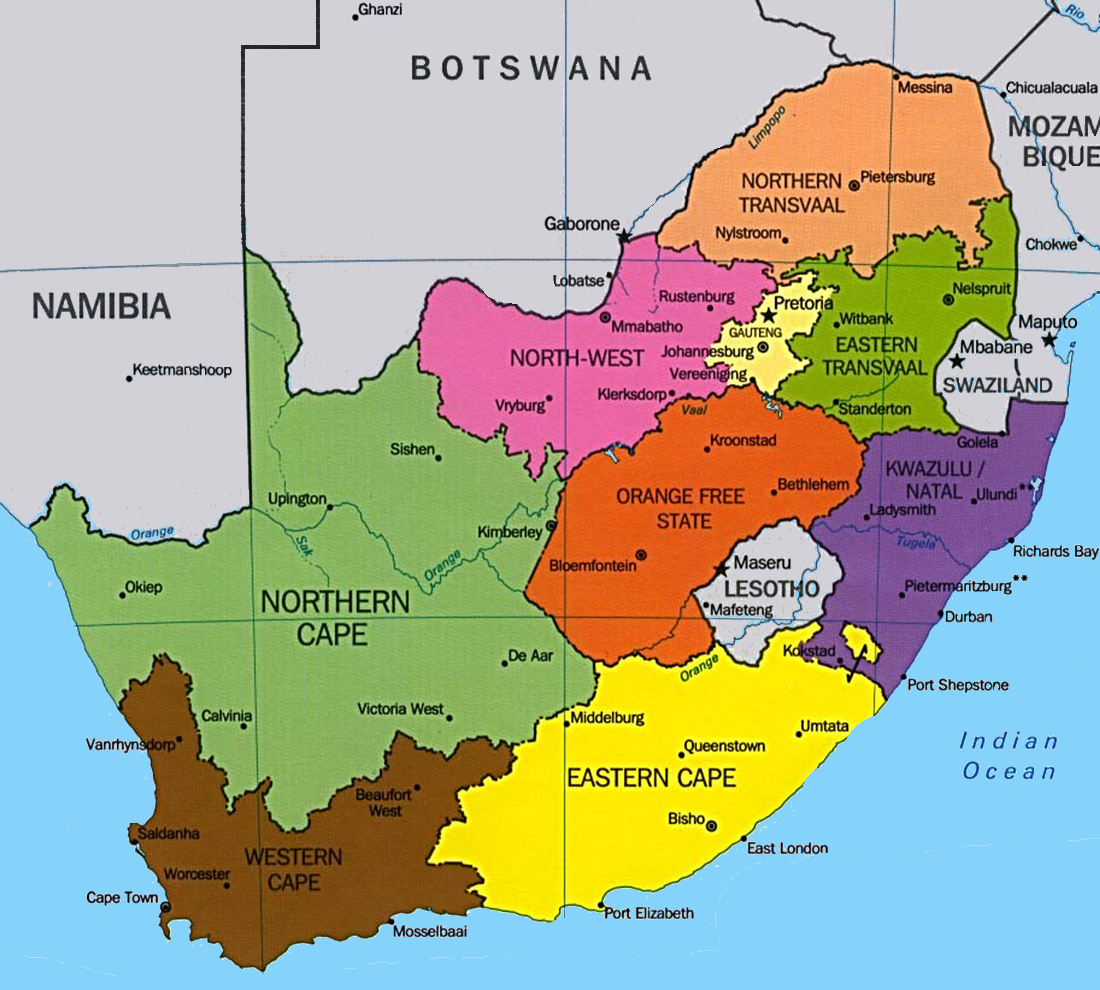
Located at the southernmost tip of the African continent, South Africa is a country with many faces. Its map reveals an impressive mosaic of landscapes, ranging from beaches bordering two oceans to the rugged mountains of the Drakensberg, as well as the vast plateaus and semi-desert areas of the Kalahari. With a population rich in cultures and languages, and a unique geopolitical organization with three capitals, South Africa stands out as much for its geographical as for its demographic diversity.
Table – South Africa map: Geographical and demographic information
| Element | Key Information |
|---|---|
| Total area | 1,221,037 km² |
| Capital(s) | Pretoria (administrative), Cape Town (legislative), Bloemfontein (judicial) |
| Bordering countries | Namibia, Botswana, Zimbabwe, Mozambique, Eswatini, Lesotho (enclave) |
| Coastline | Over 2,500 km bordering the Atlantic and Indian Oceans |
| Relief | High plateaus, mountain ranges (Drakensberg), desert areas (Kalahari) |
| Estimated population | About 62 million inhabitants (2025) |
| Linguistic groups | 11 official languages (including Zulu, Xhosa, Afrikaans, English) |
| Main cities | Johannesburg, Durban, Pretoria, Cape Town, Port Elizabeth |
| Population density | About 50 inhabitants/km² |
| Climate | Varied: Mediterranean in the southwest, subtropical in the east, semi-arid inland |
What you need to know about South Africa ?
South Africa is a country located at the extreme south of the African continent. It is also called the Republic of South Africa due to its status as a unitary parliamentary constitutional republic.

The South African population is currently 56.72 million and is composed of Blacks, Coloureds, Whites, and Asians. The South African territory covers an area of 1,219,912 km², ranking it 25th among the largest countries in the world.

The country’s administrative capital is Pretoria, its legislative capital is Cape Town, and its judicial capital is Bloemfontein. Its largest urban area is Johannesburg, and the country’s telephone code is 27 (+27 or 0027).
Countries Bordering South Africa
The neighboring countries of South Africa are Namibia, Botswana, Zimbabwe, Mozambique, and Eswatini. There is also Lesotho, which is located inside South African territory.
Additional points about the map and the country
- The provinces: South Africa has 9 provinces, including Gauteng (the most populous) and Northern Cape (the largest).
- The climatic diversity is reflected on the map with areas of savana, desert, subtropical forests, and mountains.
- The country is home to famous national parks visible on tourist maps, such as the Kruger National Park.
- South Africa has three capitals, a unique fact that often intrigues travelers and geographers.
- The demographic map reveals a population very concentrated in urban areas, especially around Johannesburg and Cape Town.
The colors of South Africa
The flag of South Africa is composed of 6 colors which are black, green, yellow, white, red, and blue. Towards the hoist side, there is a black isosceles triangle bordered by a yellow band. The whole is encompassed by an inverted green Y bordered by white bands. Below there is a red band and below that a blue band.

Blue symbolizes the sky, green the land, white represents the European natives, black: the black people, and yellow symbolizes the country’s gold. Red represents the blood of martyrs during ethnopolitical conflicts between whites and blacks. The green “Y” represents the unity of the nation and its people.
The best cities in South Africa
Johannesburg
It is the cradle of the sub-Saharan African economy and the largest urban area in the country. Among the city’s must-sees, you can visit the Apartheid Museum. Indeed, Johannesburg will allow you to see social class inequality as well as various problems. However, it is a welcoming city that will allow you to visit shops and shopping centers. There are also sporting events as well as an active urban culture.
Durban
It is the third largest urban area in the country, highly loved because of the largest port on the continent. It was in Durban that the end of Apartheid took place, which saw many refugees from the civil war arrive. It is therefore a city representative of African culture. Enjoy a magnificent seaside with public beaches and hamburger vendors. You will also see a city in full growth with modernized architecture.
Cape Town
This is the most popular city among backpackers, who come to the city to admire the sparkling waters of Table Mountain, which is naturally magnificent. You will be delighted to taste a variety of dishes and admire the diverse architectures. Bars are also numerous and active even at night. The city in its western section has vineyards as well as bustling townships off the coast. You can also go scuba diving to see sharks or whales.
Financial map of South Africa
The South African economy is the second most performing in Africa. It is an industrialized country with several manufacturing centers. The country’s technology is the most advanced on the continent. Indeed, South Africa owes its success to the nationalization of its industries.
There are about 700 of these across the territory. The state has also implemented labor-related legislation as well as easy access to bank loans for entrepreneurs. Thus, it is part of the G20, of which it is the only African country.
- Here are some economic data of the country:
- Currency: South African Rand
- GDP at nominal parity: 283 billion USD
- GDP at purchasing power parity: 711 billion USD
- GDP growth rate: Nominal: 0.2%, PPP: 3.5%
- GDP per capita at nominal parity: 4,736 USD
- GDP per capita at purchasing power parity: 11,911 USD
- Inflation rate 3.3%
- Population below the poverty line: 16.6%
- Human Development Index: 0.468
- Unemployment rate as % of active population: 29.8%
Climate map of South Africa
The climate of South Africa is strongly influenced by its geographical position, that is, in the southern part of the hemisphere and between two oceans: Atlantic and Indian.
A tiny part located in the Northwest section has a desert climate, while inland, especially on the plateaus, the climate is Mediterranean. The climate in the northeast, however, is subtropical.
Temperatures as well as rainfall vary constantly throughout the South African territory. This ranges between 25 and 30°C on average throughout the year. However, temperatures are slightly different between the north and the south. For example, Pretoria and Cape Town show annual averages of 17.5°C and 17°C respectively.
During summer, almost the entire South African territory shows very hot temperatures that can even reach 38°C during heatwaves. In cold periods, some snowfall is observed in areas located at high altitude. In this case, temperatures hover around -6.1°C.
Demographic and administrative map of South Africa
Demographics
The population of South Africa currently stands at 58,558,000 inhabitants according to the latest United Nations data. The fertility rate of this population is 2.35 children per woman and the life expectancy at birth of a South African is 63.7 years.
However, the natural growth rate of the South African population is 0.97% and the male/female ratio of the total population is 101.6%. Finally, the average age in the country is 27.6 years, indicating a very young population.
Administrative map

South Africa is made up of 9 provinces which are then subdivided into metropolitan municipalities and/or districts. These are then further subdivided into local municipalities. Finally, the municipalities are subdivided into neighborhoods.
Here are the 9 provinces:
- Eastern Cape
- Free State
- Gauteng
- KwaZulu-Natal
- Limpopo
- Mpumalanga
- North West
- Northern Cape
- Western Cape
Here are the metropolitan municipalities (totaling 8)
- Buffalo City
- Cape Town
- Ekurhuleni
- eThekwini
- Johannesburg
- Mangaung (Bloemfontein)
- Port Elizabeth
- Pretoria
South Africa map
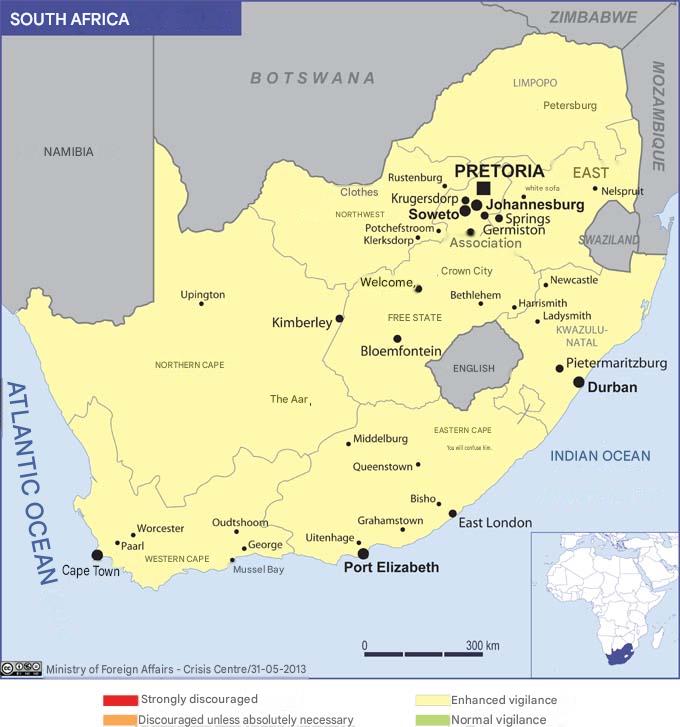
South Africa map

Credit to the author Jacques
Demolinguistic data of South Africa
The South African population consists of 5 racial divisions composed of Black Africans, Whites, Coloureds, and Asians. The respective percentages are 80.2%, 8.4%, 8.8%, and 2.5%.
This subdivision is directly related to the languages of the country. Indeed, South Africa has 11 official languages which are:
- IsiZulu
- IsiXhosa
- Afrikaans
- English
- Sepedi
- Setswana
- Sesotho
- Xitsonga
- siSwati
- Tshivenda
- isiNdebele
IsiZulu, IsiXhosa, Afrikaans, and English have the most speakers with 22.7%, 16%, 13.5%, and 9.6% respectively.
Map of South Africa

Political map of South Africa

Relief political map of South Africa
Read our article on the Correct the map campaign:
FAQ – South Africa map: geographic and demographic information
South Africa is located at the southern tip of the African continent. It is bordered by the Atlantic and Indian Oceans and shares borders with Namibia, Botswana, Zimbabwe, Mozambique, and Eswatini.
South Africa has a population of approximately 64 million people in 2025. Its population is distributed across major metropolitan areas, rural regions, and several diverse provinces.
South Africa covers an area of approximately 1,221,037 km². Its territory includes plateaus, mountains, plains, and a long coastline bordered by two oceans.
