
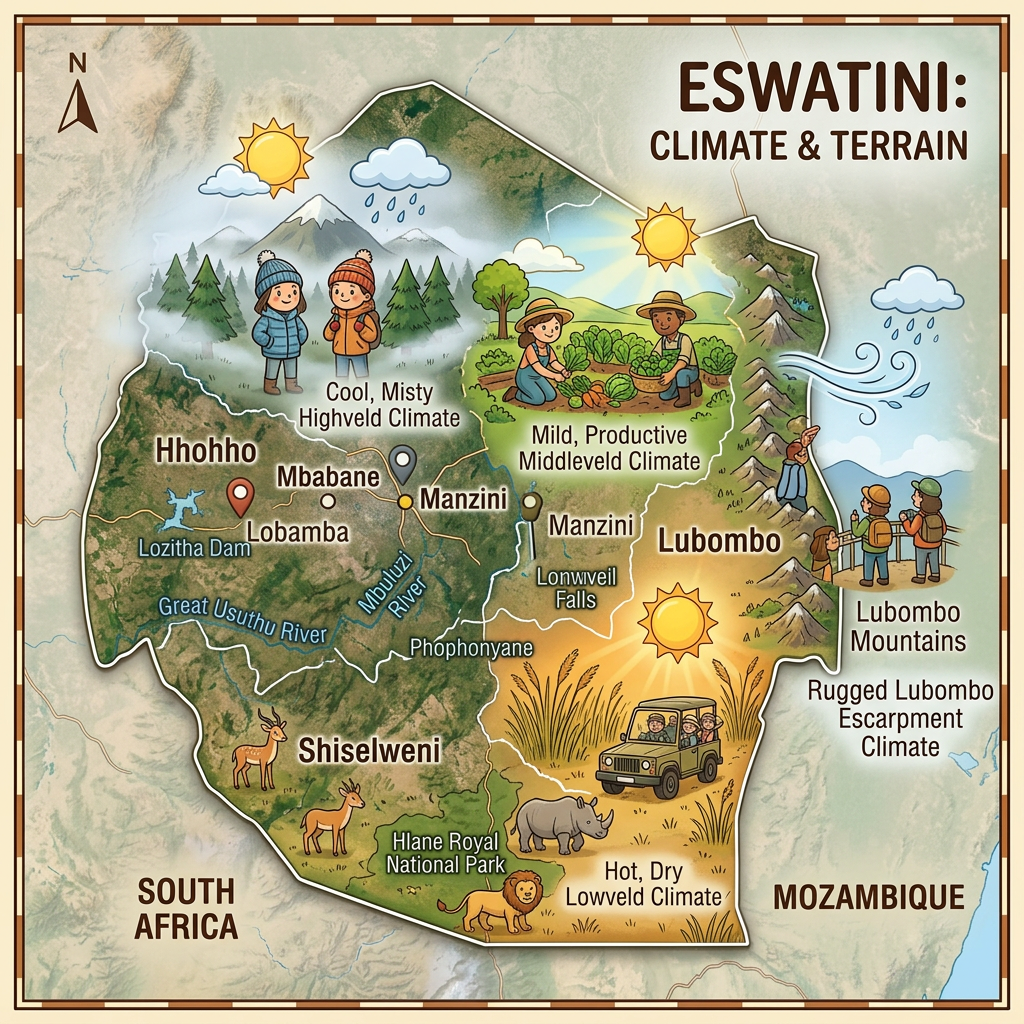
Located between South Africa and Mozambique, Eswatini, formerly known as Swaziland, intrigues with its uniqueness. This little-known country draws attention thanks to its fascinating history, rich culture, and the personality of its monarch, King Mswati III. Let’s discover together the main characteristics of this kingdom, which stands out as an exception on the African continent.
The geographical and political basics of Eswatini
With its small area, Eswatini ranks among the smallest states in Africa. It shares borders with two regional heavyweights: South Africa and Mozambique. This landlocked territory strongly influences its political and economic relations, making regional cooperation a daily necessity for its inhabitants.

Eswatini’s political life is distinguished by a monarchical regime rare in southern Africa. The head of state, King Mswati III, plays a central role in leading the country. This monarchy remains a deep heritage, rooted both in tradition and in current political modernity.
Table – Eswatini: Geographical and demographic information
| Element | Key Information |
|---|---|
| Total area | 17,364 km² |
| Capital(s) | Mbabane (administrative), Lobamba (legislative and royal) |
| Neighboring countries | South Africa, Mozambique |
| Estimated population | ~1.2 million inhabitants (2025) |
| Population density | About 69 inhabitants/km² |
| Relief | High plateaus in the west, plains in the east |
| Climate | Subtropical: hot and rainy summers, dry winters |
| Official languages | Swati (Siswati), English |
| Economic resources | Sugar, wood, coal, agriculture, and textiles |
| Particularity | Absolute monarchy (King Mswati III has been in power since 1986) |
History and evolution of the kingdom
The history of Eswatini remains marked by the colonial period and the process leading to independence from the United Kingdom. After having long been under British tutelage, the country gained national sovereignty in the early 1970s, thus crossing a key milestone to assert its own identity and institutions.
Choosing the name Eswatini also reflects a desire to reconnect with cultural roots while affirming the kingdom’s uniqueness compared to its neighbors. This official change, which occurred in 2018, marks a clear will to distinguish itself under the aegis of King Mswati III.
Additional points on the map of Eswatini
- Eswatini is one of the smallest countries in Africa, landlocked between South Africa and Mozambique.
- The physical map shows great diversity: mountains, savannas, and fertile valleys.
- The economy is highly dependent on South Africa, its main trading partner.
- The country has two capitals: Mbabane and Lobamba, a rare fact on the African continent.
- The demographic map reveals a population mainly concentrated in the western region.
The map of Eswatini illustrates a small country landlocked between South Africa and Mozambique. Despite its small size, Eswatini features a great variety of landscapes, from the mountains in the west to the plains in the east. Its two capitals, Mbabane and Lobamba, reflect both its modern administration and its royal traditions.
Landlocked status and regional interactions
Being landlocked between South Africa and Mozambique is not without challenges for Eswatini’s economy. This relative isolation forces the country to forge strong commercial ties with its powerful neighbors, a sine qua non condition for its supply and economic development.
On a daily basis, this geographical proximity influences the movement of goods, people, and ideas. Many Eswatini citizens traditionally work across the border, especially in South Africa, which shapes the social and demographic dynamics of the kingdom.
What are the main economic exchanges?

The main industries rely on sugarcane, textiles, and some mining resources. Manufactured products are transported daily to South Africa, the indispensable regional engine. Income from cross-border workers also supports families who remain in the country.
Moreover, the energy dependence on its neighbors pushes Eswatini to invest in joint infrastructure projects, thus strengthening the interdependence characteristic of Southern Africa.
What are the consequences for transport and tourism?
Travel is mainly organized via roads connecting Mbabane, the capital, to major South African and Mozambican routes. This strategic positioning indirectly stimulates tourism activity focused on the ease of passage between different African destinations.
This transit tourism opens the door to discovering Swazi traditions, while raising specific logistical questions related to border management and local cultural preservation.
Population, demography, and linguistic plurality
With fewer than one million three hundred thousand inhabitants, the population of Eswatini remains relatively small compared to neighboring countries. Its demography reflects the vitality of a people deeply rooted in their lands and customs.

Mostly from the Swati ethnic group, society draws on its traditions to maintain a strong social fabric. Cultural celebrations, family structure, and community organization give each village a particular atmosphere.
What is the role of the official languages?
In daily life, the official languages remain English and Swati. Education, administration, and the business world frequently use these two languages depending on the context. Schools incorporate their learning from the earliest years, serving both as a national bond and a gateway to the outside world.
Such a linguistic situation facilitates regional and international contacts, while strengthening the sense of belonging to a national entity specific to Eswatini.
How is demographic cohesion expressed?
The modest size of the territory promotes privileged bonds within the population. Extended families, collective celebrations, and local commitments animate daily life. These dynamics contribute to internal cohesion and protect the Swazi cultural heritage.
This framework helps preserve a significant part of ancestral practices and beliefs, including during the major royal ceremonies in which King Mswati III actively participates.
- Modest area, favoring dense and close social networks
- Predominant role of the Swazi ethnic group in all social strata
- Balanced presence of English and Swati in the public sphere
- Annual celebration of rituals such as Umhlanga (the reed dance)
Culture, monarchy, and national identity
Over the years, the monarchy embodies the country’s historical continuity. King Mswati III enjoys a special status, blending spiritual authority and institutional power. Royal decisions shape social life, while the people express their attachment to traditional figures.
Behind the respect for the king, the cultural richness shines especially during national and family festivities. Numerous events linked to the royal calendar combine music, dance, and the wearing of traditional costumes.
How does the monarchy shape local identity?
Through speeches, educational programs, or public campaigns, the monarchy regularly promotes respect for Swazi customs and traditions. This emphasis on common identity helps to overcome certain contemporary difficulties, whether economic or societal.
The sacred nature of certain traditions strengthens the legitimacy of royal power, thus perpetuating cohesion around distinctive local values. Eswatini benefits from its uniqueness to build a strong image in the African community.
What roles do Mbabane and urban life play?

Mbabane, the capital of Eswatini, combines modernity and ancient customs. Central administrations share space with popular markets, where official languages and various foreign influences coexist daily.
Its streets reflect constant contact with the outside world, reminding us how the country’s landlocked status has not diminished its capacity to shine regionally. The city appears as a living laboratory for recent social transformations.
The future of Eswatini and its challenges
The upcoming challenges for this small kingdom concern both its openness to the outside world and the preservation of its own identity. Demographic changes, managing a small area, and dependence on its neighbors will inevitably raise questions about the future choices of the monarchy.
Faced with the globalized world, Eswatini will have to juggle between adapting to international changes and protecting a centuries-old internal balance. Its inhabitants will certainly be able to benefit from a rich historical experience, nurtured by strong cultural cohesion and the solidarity that characterizes the Swati population.
FAQ – Eswatini map: 3 questions
Eswatini is a small landlocked country, located between South Africa and Mozambique.
Mbabane is the administrative capital, while Lobamba is the seat of Parliament and the monarchy.
The country benefits from a subtropical climate, with hot and rainy summers and dry winters.
